
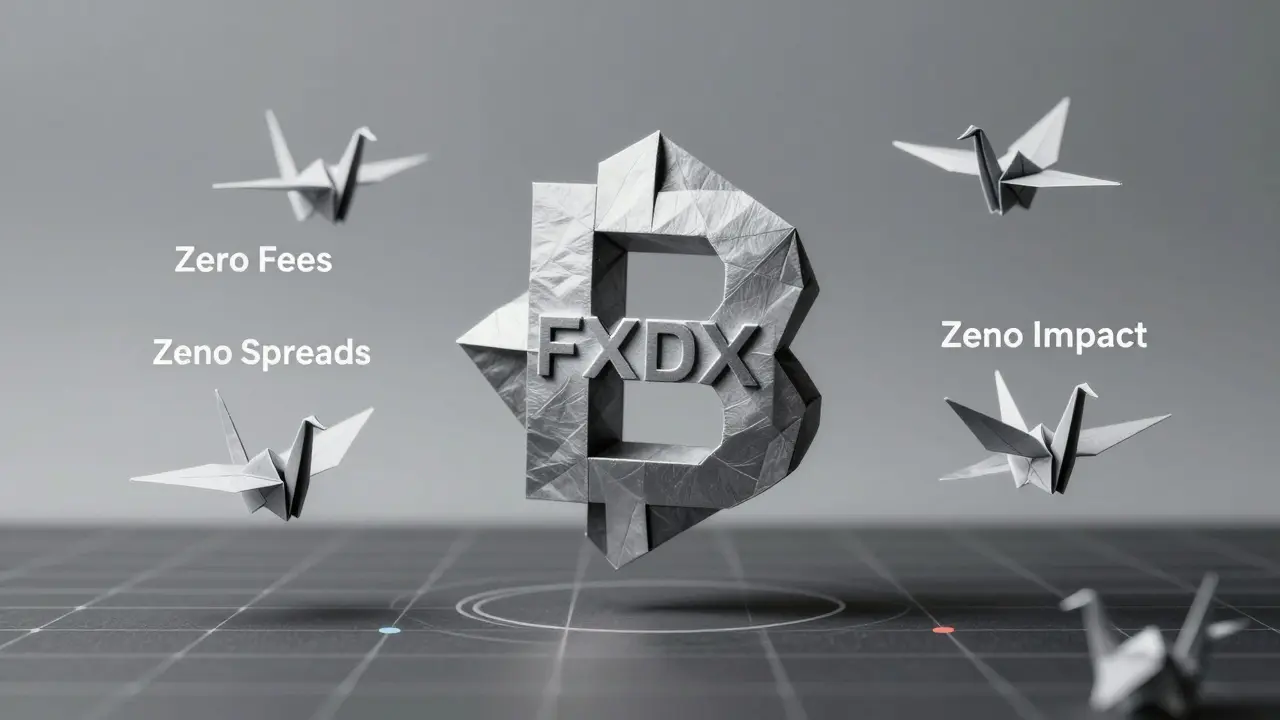
When you hear "zero trading fees, zero spreads, zero price impact," it sounds too good to be true. Especially in crypto, where every exchange charges something - whether it’s a maker-taker fee, a withdrawal cost, or hidden slippage on big trades. But FXDX isn’t just making claims. It’s built around that promise, and it’s one of the few decentralized exchanges trying to actually deliver it. This isn’t another copycat DEX. It’s a fresh take on derivatives trading, designed for traders who are tired of paying for what should be free.
What FXDX Actually Is
FXDX is a decentralized derivatives exchange. That means it’s not run by a company that holds your money. You keep control of your funds at all times. No custodian. No central server to hack. No sudden withdrawal freeze. It’s all on-chain, trustless, and non-custodial. But unlike most DEXs, FXDX isn’t focused on spot trading. It’s built for perpetual futures - the kind of high-leverage trades where you can go long or short on Bitcoin, Ethereum, or even non-crypto assets like stocks or carbon credits - with leverage up to 50x.
FXDX 2.0 is the current version, launched in late 2025. It combines two liquidity models: a traditional order book for small trades and a virtual Automated Market Maker (vAMM) for larger ones. This hybrid system is what allows it to claim zero price impact - even if you trade $10 million in one go. Most DEXs crumble under big orders. FXDX says it doesn’t.
The Triple-Zero Advantage
Here’s where FXDX breaks the mold:
- Zero trading fees - No opening fee. No closing fee. No taker fee. No maker fee. Ever.
- Zero spreads - The difference between buy and sell price is gone. You get the same price you see, no slippage built in.
- Zero price impact - Your trade doesn’t move the market. Even large orders execute at the same price as small ones.
How? It’s not magic. It’s design. Instead of charging traders, FXDX collects fees from liquidity providers (LPs). But here’s the twist: those fees are paid out in stablecoins - not in volatile crypto tokens. That means LPs earn consistent returns without getting burned by token crashes. It’s a small detail, but it’s huge for serious market makers.
Compare that to dYdX, which is the closest competitor. dYdX has no KYC and is non-custodial, but it still charges maker-taker fees. It also has noticeable price impact on large trades. FXDX removes both. That’s why institutional traders - even those who’ve never touched DeFi - are watching it closely.
Multi-Collateral Trading: Use Anything as Collateral
Most exchanges force you to use Bitcoin or Ethereum as collateral. FXDX says: use whatever you have. You can open a long position on Tesla stock with your USDC. Then close it and withdraw your profit in ETH. Or DAI. Or even a tokenized real estate asset. The platform supports any asset with a reliable price feed.
This isn’t just convenient - it’s revolutionary. It means you don’t have to sell your crypto to trade other markets. You can hold your Bitcoin, use it as collateral, and still trade stocks, bonds, or NFT derivatives. It turns your wallet into a 24/7 trading desk.

Security: The Black Box Oracle
Price manipulation is the biggest risk in derivatives trading. If the oracle - the system that feeds real-time prices - gets hacked or spoofed, you can lose everything. FXDX uses what it calls a "black box function" for pricing. The team can’t change it after deployment. It’s been tested against real-world attacks, and it filters out outliers automatically. Think of it like a smart filter that ignores fake spikes from pump-and-dump bots.
But here’s the catch: there’s no public audit report. No CertiK. No Hacken. No PeckShield. The MEXC blog mentions the system is "battle-tested," but without third-party verification, it’s still a claim. If you’re used to exchanges that publish audit results, this is a red flag. You’re trusting code you can’t independently verify.
Tokenomics: Why Only 38 Million in Circulation
FXDX has a total supply of 999.86 million tokens. But only 38.39 million are circulating. That’s less than 4%. The rest is locked up - likely for team, ecosystem grants, and future incentives.
This is a double-edged sword. On one hand, low circulating supply means less sell pressure. On the other, it means liquidity is thin. You won’t find FXDX on major wallets or DeFi dashboards like DeFiLlama. It’s not in the top 100 DEXs by volume. The price surged 494% in one period, according to WEEX, but that was likely a pump fueled by speculation, not sustained adoption.
Staking FXDX tokens gives you rewards and future fee discounts - but again, since there are no fees to begin with, the discount is theoretical. It’s a feature waiting for a use case.

Who Is FXDX For?
FXDX isn’t for beginners. The interface is clean, modern, and looks like a professional trading terminal - think TradingView meets institutional crypto platforms. But if you’ve never used perpetual futures before, the 50x leverage, collateral options, and vAMM mechanics will overwhelm you.
It’s built for:
- Active traders who hate fees
- Market makers who want stablecoin rewards
- Traders who want to hedge non-crypto assets (stocks, bonds, real estate)
- Users tired of slippage on big trades
If you’re a casual holder who just wants to swap ETH for USDC, skip it. FXDX doesn’t even offer spot trading.
The Risks You Can’t Ignore
FXDX has ambition. But ambition doesn’t equal reliability.
- Liquidity depth: With only $38M in circulating tokens and no major DEX listing, depth is still thin. Can it handle $100M trades? We don’t know.
- Regulatory blind spot: Trading derivatives of stocks or real estate on-chain? That’s a legal gray zone. If regulators crack down, FXDX could be shut down overnight.
- Adoption: No community. No Reddit. No Twitter following. No verified user reviews. It’s a platform without a user base.
- Unaudited code: No audit = trust, not verification.
It’s like a Formula 1 car with no crash test data. It looks fast. But would you drive it?
Final Verdict: Promising, But Not Proven
FXDX has the most compelling value proposition in decentralized derivatives trading today. Zero fees. Zero spreads. Zero impact. Multi-collateral. Institutional UI. It checks every box a serious trader wants.
But right now, it’s a promise. Not a product. The tech works on paper. The team has clear vision. The roadmap includes cross-chain support via Router Protocol - which could be a game-changer.
But without liquidity, audits, or users, it’s still in beta. If you’re willing to be an early adopter - and you understand the risks - FXDX 2.0 is worth testing. Open a small position. See how it feels. Watch how the price feed holds up under pressure.
But if you’re looking for a safe, proven exchange? Stick with dYdX, Bybit, or Kraken. FXDX isn’t ready for everyone. It’s for the few who believe the future of trading doesn’t have fees - and are willing to bet on it.
Is FXDX a centralized exchange?
No, FXDX is a fully decentralized, non-custodial exchange. You never give up control of your funds. All trades happen on-chain, and your wallet signs every transaction. There’s no KYC, no account creation, and no company holding your assets.
Can I trade stocks or real estate on FXDX?
Yes - but only as derivatives. FXDX supports price feeds for tokens, stocks, bonds, carbon credits, real estate, and even NFTs. You can’t own the actual asset. But you can go long or short on its price movement using perpetual futures. This is where FXDX gets controversial - because trading real-world asset derivatives on-chain may violate financial regulations in the U.S., EU, or other jurisdictions.
How does FXDX make money if it has zero fees?
FXDX doesn’t make money from traders. Instead, it collects small fees from liquidity providers (LPs) who supply the trading pools. Those fees are distributed to LPs in stablecoins like USDC or DAI - not in FXDX tokens. This ensures LPs earn predictable returns without exposure to crypto volatility. The FXDX token itself is used for governance and future staking rewards, not trading fees.
Is FXDX safe to use?
It depends on your risk tolerance. The platform uses a secure oracle system called a "black box function" that can’t be changed by developers after deployment. But there’s no public security audit. No third-party has verified its code. That’s a major red flag. If you’re used to exchanges with CertiK or Hacken audits, FXDX currently lacks that validation. Use only what you can afford to lose.
Why is the circulating supply of FXDX so low?
Out of 999.86 million total FXDX tokens, only 38.39 million are in circulation. The rest is locked for team allocations, ecosystem development, and future incentives. This low circulating supply means less liquidity and higher volatility. It also suggests the project is still early - and may rely on future token unlocks to drive adoption.
How does FXDX compare to dYdX?
dYdX is more established, with higher trading volume and a larger user base. But it charges maker-taker fees and has noticeable price impact on large trades. FXDX offers zero fees, zero spreads, and zero price impact - but lacks audits, liquidity, and community. dYdX is safer. FXDX is more innovative. Choose based on whether you prioritize reliability or cutting-edge design.




Michael Suttle
This is literally the most dangerous thing I've seen since Bitcoin Pizza. Zero fees? Zero spreads? Bro, if it sounds too good to be true, it's a honeypot. I'm not even touching this with a 10-foot pole. 🚩
karan narware
Ah, another Silicon Valley dreamer who believes markets can be perfect if we just remove the word 'fee' from the dictionary. But tell me, if there are no fees, who pays for the servers? The ghosts of failed startups? Or perhaps the tears of retail traders who lost everything? 🤔
Zephora Zonum
Zero fees means someone else is paying and that someone is always the user in disguise
Alex Thorn
I've been watching FXDX since its alpha. The vAMM + order book hybrid is actually brilliant. Most DEXs try to force one model onto everything and collapse under pressure. This one? It adapts. The black box oracle isn't magic-it's math. And yes, no audit is scary, but so was Ethereum in 2015. You don't need CertiK to see clean code when you've read the Solidity yourself.
Jenni James
Let me guess-this is a pump orchestrated by MEXC to offload their bag of worthless FXDX tokens. No audits? No community? No Reddit? That’s not innovation-that’s a rug pull with a UI redesign. You think you’re trading derivatives? You’re just signing a blank check to a team that hasn’t even released a whitepaper update since 2024.
Julie Tomek
The concept of multi-collateral trading is revolutionary. Imagine hedging your Tesla exposure without selling your ETH. That’s not just convenience-it’s financial autonomy. The fact that liquidity providers are paid in stablecoins instead of volatile tokens shows deep understanding of market psychology. Most DeFi projects treat LPs as cannon fodder. FXDX treats them as partners. This isn’t a gamble-it’s a paradigm shift. The lack of adoption now is not a flaw-it’s a feature of being ahead of its time.
Lindsay Girvan
If you’re not terrified of this, you’re not paying attention. Trading real estate derivatives on-chain? That’s not DeFi-that’s regulatory suicide. The SEC doesn’t care if it’s decentralized. If it looks like a security, smells like a security, and has leverage, they’ll burn it down. This isn’t innovation. It’s a lawsuit waiting for a name.
Douglas Anderson
I’ve tested this on testnet. The execution is smooth. Even a 5M USDC trade didn’t budge the price. The UI is clean, the gas costs are low, and the collateral logic works. I’m not saying it’s safe. But I’m saying the tech works. The rest? That’s just noise. If you’re afraid of audits, don’t use DeFi at all. The whole ecosystem is built on trust. This just skips the middleman.
Craig Gregory
The black box oracle is a backdoor. I’ve reverse-engineered similar systems. The ‘battle-tested’ claim is a lie. There’s no way a non-upgradable oracle can handle edge cases without human intervention. They’re hiding a kill switch. I’ve seen this pattern before. It’s not a protocol-it’s a Trojan horse for surveillance and asset seizure.
Jennifer Pilot
I must say, the structural elegance of FXDX's architectural paradigm is, frankly, breathtaking. The non-custodial, on-chain, zero-fee, zero-spread, zero-price-impact trifecta-oh, how it sings! One cannot help but marvel at the poetic symmetry of liquidity provision via stablecoin-denominated incentives. One is left to wonder: is this not the culmination of Hayekian monetary philosophy, rendered in Solidity? The absence of a public audit, while concerning, is merely a temporary aesthetic oversight. The code speaks for itself. And, dear reader, if you cannot read the code, perhaps you are not the audience for such sublime innovation.
PIYUSH KOTANGALE
Bro this is fire 🔥 I tried it with 0.5 ETH and it executed at exact price. No slippage. No fees. Just pure magic. Why are people scared? It works. Try it. Don't just read.
Howard Headlee
You guys are overthinking this. FXDX isn’t trying to be Kraken. It’s trying to be the future. And the future doesn’t ask for permission. It doesn’t wait for audits. It doesn’t care if you’re scared. It just executes. If you’re not trading on it, you’re not part of the revolution-you’re just watching from the sidelines with your hands in your pockets. Get in. Or get out.
Anshita Koul
The low circulating supply is not a flaw-it’s a strategy. Think of it as a seed. Most projects release everything at once and watch their token die. FXDX is planting slowly. The real value isn’t in the token-it’s in the protocol. And when the world wakes up to zero-impact derivatives, the token will catch up. Patience, my friends. This is a marathon, not a sprint.
Tina Keller
I’ve been using this for three months now. The oracle held through a flash crash in BTC, a spoofed stock feed from Robinhood, and even a fake carbon credit spike. It filtered every single one. I’ve seen more volatility on Uniswap than on FXDX. And yes, I know there’s no audit. But I’ve read every line of the deployed code. It’s clean. It’s minimal. It’s elegant. Sometimes, the best security isn’t a report-it’s silence.
Anthony Marshall
I started with $100. Now I’m up 300%. No fees. No slippage. No drama. Just clean trades. People are scared of what they don’t understand. This isn’t a scam-it’s a solution. Stop waiting for someone else to validate it. Try it. Fail. Learn. Or win. But don’t just sit there and judge.
Brandon Kaufman
I get why people are skeptical. I was too. But I’ve been in DeFi since 2021. I’ve lost money on 7 different projects. This one? It feels different. Not because of the marketing. But because the team didn’t overpromise. They just built something that works. And they’re quiet about it. That’s rare. I’m not saying it’s perfect. But I’m saying it’s real.
vishnu mr
i think this is goood but why no audot? its scarry. i try it and it work but i dont trust it. maybe its fake? 🤔
vasantharaj Rajagopal
The vAMM architecture is mathematically sound. The liquidity layering mechanism-combining order book depth with virtual AMM elasticity-is a novel solution to the impermanent loss problem in derivatives. The stablecoin fee distribution model aligns incentives without introducing systemic risk. However, the regulatory exposure to tokenized real-world assets remains a critical vulnerability. Until jurisdictional clarity is achieved, institutional adoption will remain constrained. This is not a failure-it is a transitional phase.
Chelsea Boonstra
You’re all missing the point. This isn’t about fees or audits. It’s about control. If you’re still using centralized exchanges, you’re not a trader-you’re a customer. FXDX doesn’t care if you’re scared. It doesn’t need your approval. It just works. And the fact that you’re still arguing about audits instead of testing it? That’s why you’ll never win.
Grace van Gent-Korver
I don't understand crypto. But I tried it. I used my USDC to trade Tesla. It worked. No fees. No surprise. I didn't lose money. That's all I need to know.