

Imagine selling Bitcoin for a profit of ₹1,00,000. In most parts of the world, you might pay between 10% and 20% in capital gains tax, depending on how long you held it. But if you are trading from India, the government takes a flat 30%. And that is just the start. You also face a 1% deduction at source and an 18% GST on exchange fees. This aggressive taxation framework has made India one of the toughest jurisdictions for digital asset investors globally.
If you are a Bitcoin trader or hold other cryptocurrencies in India, understanding these rules is no longer optional-it is essential to avoid heavy penalties and unexpected cash flow issues. The laws changed drastically starting April 1, 2022, with further tightening in July 2025. Here is exactly how the system works, what you owe, and where the traps lie.
The Core Framework: Section 115BBH
The backbone of this regime is Section 115BBH, which was introduced under the Income Tax Act by Finance Minister Nirmala Sitharaman during the 2022 Union Budget. This section imposes a flat tax rate of 30% on all income arising from the transfer of Virtual Digital Assets (VDAs).
What counts as a VDA? The definition is broad. It includes Bitcoin, Ethereum, NFTs, stablecoins, and any other token not issued by the government or RBI. Crucially, gift cards and vouchers are excluded, but almost everything else in the crypto space falls under this net.
The most striking feature of this law is its lack of nuance. Unlike traditional stocks or mutual funds, there is no distinction between short-term and long-term capital gains. Whether you held your Bitcoin for one day or ten years, the tax rate remains fixed at 30%. Furthermore, this amount is subject to applicable surcharge and a 4% health and education cess. For most individual investors, this pushes the effective tax rate to approximately 31.2%.
The No-Loss-Offsetting Rule: A Major Trap
If there is one rule that frustrates Indian traders more than any other, it is the prohibition on loss offsetting. In standard equity markets, if you lose money on one stock, you can use that loss to reduce the taxable gain from another profitable stock. In the world of VDAs, this privilege does not exist.
Here is how it works in practice:
- You buy Bitcoin and sell it at a loss of ₹30,000.
- You buy Ethereum and sell it at a profit of ₹30,000.
- Your net economic position is zero. However, for tax purposes, the losses and gains are treated separately.
- You must pay 30% tax on the ₹30,000 Ethereum profit, which equals ₹9,000.
- The ₹30,000 loss on Bitcoin cannot be used to reduce this liability. Nor can it be carried forward to future financial years.
This means active traders who experience volatility across their portfolio often end up paying taxes even when their overall wallet balance hasn't grown. Experts describe this as creating "artificial tax liabilities" that do not reflect actual economic reality.
Tax Deducted at Source (TDS): Section 194S
In addition to the final tax bill, you deal with immediate deductions through Section 194S. Effective July 1, 2022, this rule mandates a 1% Tax Deducted at Source (TDS) on crypto transfers.
The threshold for this deduction is ₹50,000 per year. If your total crypto transactions exceed this limit within a financial year, exchanges and platforms deduct 1% before crediting your fiat proceeds. In certain cases involving non-PAN holders or specific transaction types, this threshold drops to ₹10,000.
While TDS is not a tax itself-it is merely an advance payment toward your final liability-it creates significant liquidity challenges. For high-volume traders, having 1% locked away on every withdrawal can strain cash flow. Moreover, compliance varies between platforms. Some Indian exchanges automatically deduct this amount, while others require manual reporting, leading to confusion and potential mismatches in your Form 26AS (tax credit statement).

The New Layer: 18% GST on Services
July 2025 brought another change to the landscape. The government clarified that services provided by crypto platforms are subject to the standard 18% Goods and Services Tax (GST). This applies to exchange fees, wallet storage charges, and other service-based costs incurred during trading.
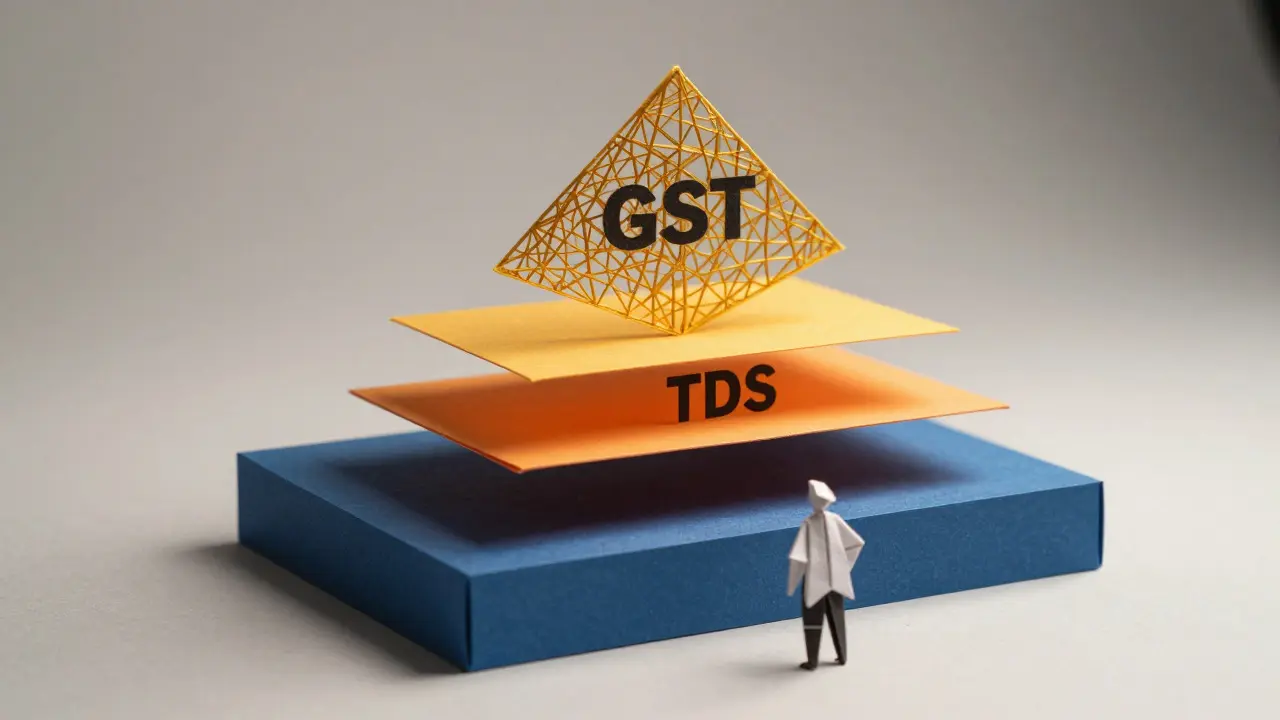
This creates a three-tier taxation structure for Indian crypto users:
- Income Tax: 30% + cess on profits.
- TDS: 1% deducted at source on large transfers.
- GST: 18% added to platform service fees.
For retail investors, this increases the cost of entry and exit. When calculating your break-even point, you must now factor in not just the price movement of the asset, but also the cumulative impact of these fees and taxes.
| Country | Tax Rate on Gains | Long-Term Benefit? | Loss Offsetting Allowed? |
|---|---|---|---|
| India | 30% + Cess | No | No |
| United States | 0%, 15%, or 20% | Yes (Lower rates after 1 year) | Yes |
| Germany | 0% (after 1 year holding) | Yes (Tax-free after 1 year) | Yes |
| Singapore | 0% | N/A | N/A |
| United Kingdom | 10% or 20% | Yes (Allowances apply) | Yes |
How to Calculate Your Liability
The calculation method prescribed by the Income Tax Department is rigid. You are allowed to deduct only the cost of acquisition. This means the original purchase price of the cryptocurrency. You cannot deduct transaction fees, gas fees, storage costs, or administrative expenses. This restriction significantly inflates your taxable base compared to jurisdictions that allow full expense deductions.
The formula is straightforward:
(Selling Price - Purchase Price) × 30% = Tax Liability
Let’s look at a concrete example. Suppose you bought 0.1 BTC for ₹2,00,000. You later sold it for ₹3,00,000. Your profit is ₹1,00,000. Even if you paid ₹5,000 in exchange fees and network gas fees, those are ignored. Your tax liability is calculated on the full ₹1,00,000 gain.
Tax Payable = ₹1,00,000 × 30% = ₹30,000. Plus 4% cess, bringing the total closer to ₹31,200.
Compliance and Record Keeping
To file your returns correctly, you must maintain meticulous records. The Income Tax Department introduced Schedule VDA in the income tax return format for FY 2022-23, which continues into FY 2024-25. This schedule requires you to report every single transaction involving virtual digital assets.
What you need to track:
- Purchase date and sale date for each asset.
- Quantity of crypto bought and sold.
- Value in INR at the time of both acquisition and disposal.
- Details of the exchange or platform used.
For casual investors who buy and hold, this might take 10-15 hours a year. For active traders managing multiple wallets and exchanges, it can consume 40-50 hours annually. Many users rely on specialized tax software like ClearTax or Koinly, which have updated their modules to handle India’s specific requirements as of late 2025. These tools help aggregate data from various APIs to generate the necessary reports for Schedule VDA.
Market Impact and Future Outlook
The introduction of these strict rules has had a tangible effect on the Indian crypto market. Industry reports indicate a 40-60% decline in trading volumes on domestic exchanges following the April 2022 implementation. Retail participation has contracted, with many users migrating to international platforms or peer-to-peer (P2P) networks to manage their exposure, though this introduces new compliance risks regarding TDS.
Institutional adoption remains minimal due to the unfavorable tax treatment compared to traditional investment vehicles like gold or equities. However, the regulatory vacuum has been replaced by clarity, albeit harsh clarity. Legal experts suggest that while the current framework is punitive, potential revisions to loss-offsetting rules or TDS thresholds could emerge as the government evaluates the balance between revenue generation and fostering digital innovation. Until then, traders must operate within these constraints, prioritizing accurate record-keeping and strategic holding periods to mitigate the impact of the flat tax rate.
Does India tax crypto holdings if I don't sell?
No. India taxes the "transfer" of Virtual Digital Assets. This means you only owe tax when you sell, swap, or spend your crypto. Simply holding Bitcoin or Ethereum in a wallet does not trigger a tax event, regardless of how much the value increases.
Can I deduct gas fees and exchange commissions from my tax?
Currently, no. Under Section 115BBH, the only allowable deduction is the cost of acquisition (the purchase price). Transaction fees, gas fees, and storage costs are not deductible, which increases your effective tax burden compared to other asset classes.
Is the 1% TDS refundable?
Yes. The 1% TDS deducted under Section 194S is an advance payment toward your final tax liability. When you file your annual income tax return, this amount is credited against your total tax owed. If the TDS exceeds your final tax liability, you can claim a refund from the Income Tax Department.
Do I pay different tax rates for short-term vs long-term crypto gains?
No. One of the most distinct features of India's crypto tax regime is that it applies a flat 30% rate to all gains, irrespective of the holding period. Whether you hold Bitcoin for one month or five years, the tax rate remains the same.
How does the 18% GST affect my trading costs?
The 18% GST applies to the services provided by crypto exchanges, such as trading fees and withdrawal charges. While this is not a tax on your profits, it increases your operational costs. You should factor this additional percentage into your break-even calculations when entering trades.