

Running a cryptocurrency exchange in Japan isn't just about building a good app. It is one of the toughest regulatory hurdles in the world. If you are looking to serve Japanese customers, you need to navigate a system that demands deep pockets, ironclad security, and patience measured in years, not months.
As of August 2026, the landscape has shifted dramatically. The Financial Services Agency (FSA) moved oversight from the Payment Services Act to the Financial Instruments and Exchange Act (FIEA). This means crypto is no longer treated just as a payment method; it is increasingly viewed through the lens of securities law. For exchanges, this brings stricter rules but also clearer legal ground compared to the confusion seen in other major markets.
The Core Requirement: FSA Registration
You cannot operate without permission. Every platform serving Japanese residents must be registered with the FSA. As of mid-2025, only 21 platforms held active licenses. Since the framework began in 2017, 17 exchanges have been canceled for non-compliance. That is a nearly 45% failure rate among those who tried.
The process starts with your corporate structure. You must form a kabushiki-kaisha (joint-stock company) under Japanese law. A remote entity won't cut it. You need a physical branch office in Japan and a resident manager. This manager bears personal responsibility for regulatory compliance, meaning their reputation and career are on the line if things go wrong.
Capital is another major filter. The minimum requirement is 10 million yen (approximately USD 68,000) plus positive net assets. While this number might sound low to some, when combined with operational costs, it filters out fly-by-night operators. The real cost comes later in compliance infrastructure.
Security Standards: The 95% Cold Storage Rule
Japan’s security rules were born from tragedy. After the 2018 Coincheck hack, where $534 million worth of NEM tokens were stolen, the FSA tightened its grip. Now, exchanges must keep at least 95% of user assets in offline cold wallets.
This isn't a suggestion. It is a mandate verified by audits from the Japan Virtual Currency Exchange Association (JVCEA). Your technical infrastructure must include:
- DDoS protection capable of withstanding attacks exceeding 1 Tbps.
- Multi-signature wallet systems.
- 24/7 monitoring with response teams available within 15 minutes of any incident.
Critics argue this creates single points of failure. Blockchain attorney Masako Tanaka noted that exchanges should be allowed to use institutional custody solutions like Coinbase Custody for better capital efficiency. However, the FSA remains strict. For users, though, it works. In March 2025, when a security incident hit several global platforms, Bitbank users reported their Bitcoin remained safe because of these cold storage protocols.
The Hidden Hurdle: JVCEA Token Listings
Getting licensed is only half the battle. To list new tokens, you typically need approval from the JVCEA. Most of the 21 licensed exchanges are members. The JVCEA enforces standards stricter than the FSA itself.
In Q2 2025, the JVCEA’s 17-member Token Listing Committee rejected 72% of applications. They require comprehensive whitepaper reviews, smart contract audits from Japanese-certified firms like NCC Group, and detailed market manipulation prevention plans. This contrasts sharply with Singapore, where exchanges can self-certify listings.
This creates a bottleneck. Retail investors often complain they cannot access trending meme coins or new altcoins until months after global launch. One Trustpilot review for GMO Coin highlighted this frustration, noting the delay in accessing popular tokens. For traders used to instant access, this feels restrictive. For regulators, it’s a necessary filter against scams.
Costs and Timeline: What to Expect
If you are planning to enter the market, budget accordingly. According to data from YB Case, achieving full compliance takes an average of 18 to 24 months. The financial cost ranges between USD 500,000 and USD 1 million.
Where does this money go?
- Compliance Staff: Hiring officers with Japanese regulatory experience costs around ¥12 million per year (USD 78,000).
- AML Systems: You need Anti-Money Laundering software capable of processing 10,000+ transactions per second while meeting FATF standards.
- Banking Relationships: This is the hardest part. Only 8% of Japanese banks currently service crypto exchanges due to conservative guidelines. Securing fiat on-ramps requires significant negotiation and trust-building.
The FSA requires a 6-month "shadow operation" period before full licensing. During this time, your systems must process simulated transactions without errors. It is a stress test designed to prove you can handle live traffic securely.
The 2025-2026 Shift: FIEA Integration
The biggest change in recent years is the move to the FIEA. Announced in September 2025, this transition treats crypto assets more like securities. By Q2 2026, the system will be fully integrated.
This creates a tiered approach. Payment tokens follow modified rules, while investment-oriented tokens face full securities regulation. Hans Lombardo, Deputy Director of Financial Instruments at the FSA, stated this acknowledges crypto's evolution into a multi-functional asset class.
For exchanges, this means higher compliance costs but greater legitimacy. Japan now ranks third globally for regulatory clarity, behind only Switzerland and Singapore. Unlike the U.S., where the SEC and CFTC fight over jurisdiction, Japan offers a unified path. However, the Bank of Japan warned in June 2025 that the transition period could create temporary arbitrage opportunities that fragment the market.
Trading Restrictions: No High Leverage
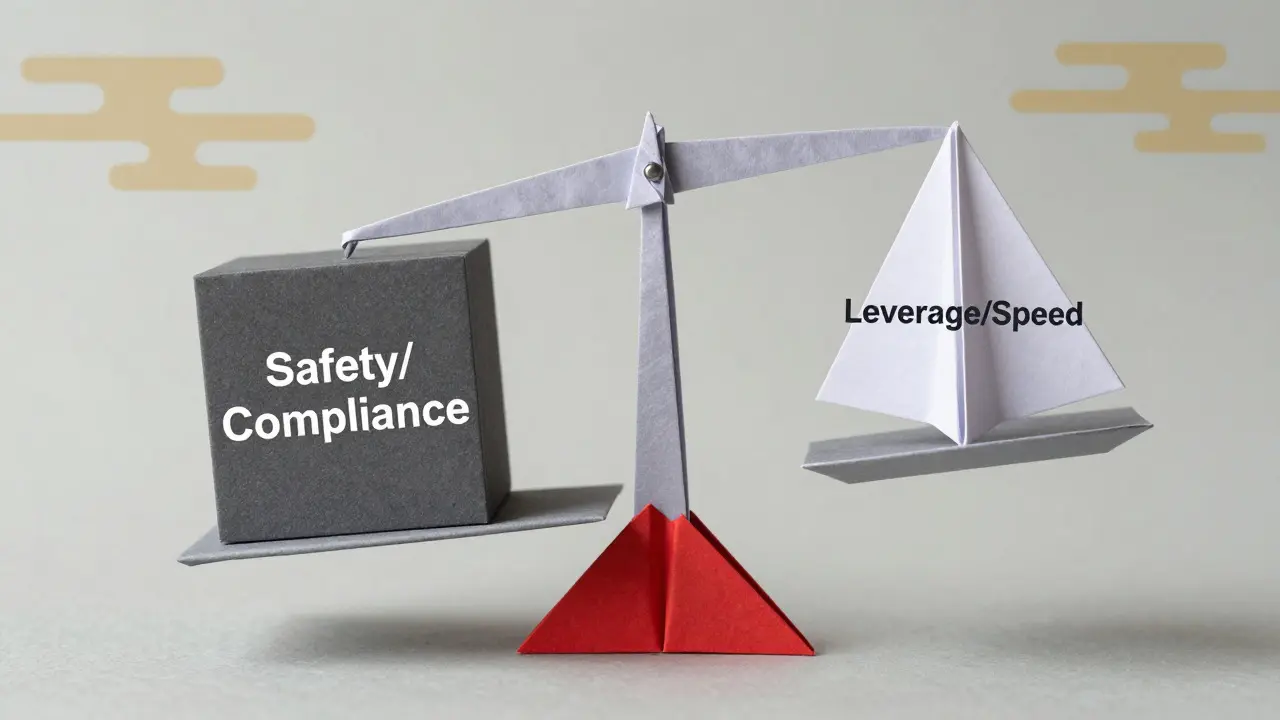
If you are a professional trader, Japan might feel limiting. The FSA prohibits margin trading above 2x leverage. This was reduced from 4x in 2023 to protect retail investors. Compare this to Dubai’s VARA, which allows up to 100x leverage.
This restriction caused an estimated 15% decline in active day traders on Japanese platforms according to CryptoCompare. Professional traders often leave for offshore platforms, while retail investors stay for safety. The trade-off is clear: safety versus flexibility.
| Feature | Japan (FSA/JVCEA) | Singapore (MAS) | United States (SEC/CFTC) |
|---|---|---|---|
| Licensing Cost | $500k - $1M | $200k - $500k | $1M+ (Legal complexity) |
| Time to License | 18-24 Months | 12-18 Months | 24-36 Months (Uncertain) |
| Token Listing | JVCEA Pre-approval Required | Self-Certification Allowed | Case-by-Case Security Analysis |
| Cold Storage | Mandatory 95% | Recommended Best Practice | No Federal Mandate |
| Max Leverage | 2x | Varies by Platform | Up to 100x (Derivatives) |
Future Outlook: Banks and ECISB
Looking ahead, the barriers may lower slightly for traditional finance players. The FSA is consulting on allowing bank groups to register as "cryptocurrency exchange operators." This could see giants like Mitsubishi UFJ Financial Group enter the market directly.
The proposed Amendment Act 2025 introduces the Electronic Payment Instrument and Crypto-asset Intermediary Service Business (ECISB) framework. If passed, it would require providers to file notifications before adding new services. While this adds paperwork, it signals a maturing market where banks feel comfortable participating.
For now, the message is clear: Japan prioritizes investor protection over speed. If you value certainty and security, Japan is a top-tier destination. If you want rapid innovation and high-leverage trading, you might look elsewhere. But for sustainable, long-term growth in Asia, there is no safer harbor.
How much does it cost to get a crypto license in Japan?
The total cost ranges from USD 500,000 to USD 1 million. This includes legal fees, compliance officer salaries, AML system implementation, and the 18-24 month preparation period. The minimum capital requirement is 10 million yen, but operational costs far exceed this.
What is the difference between PSA and FIEA for crypto?
The Payment Services Act (PSA) treated crypto primarily as a payment tool. The Financial Instruments and Exchange Act (FIEA), implemented in late 2025, treats crypto more like securities. This shift imposes stricter disclosure and reporting requirements, especially for investment-oriented tokens.
Can foreign companies operate crypto exchanges in Japan?
Yes, but they must establish a local subsidiary. You need a kabushiki-kaisha (joint-stock company) with a physical office in Japan and a resident manager who takes personal responsibility for compliance. Remote management is not permitted.
Why do Japanese exchanges have fewer altcoins?
Most licensed exchanges belong to the JVCEA, which requires pre-approval for all new token listings. The committee rejects many applications due to lack of transparency or security concerns. This results in a curated list of tokens, delaying access to new launches compared to unregulated markets.
Is leverage trading banned in Japan?
Leverage trading is restricted, not banned. The maximum leverage allowed is 2x. This rule was tightened in 2023 to protect retail investors from excessive losses. Professional traders often find this limit restrictive compared to global standards.