
Imagine losing your phone. In the old world of crypto, that meant losing your life savings because you forgot to write down a 12-word seed phrase on a piece of paper. Now imagine logging into your bank app on a new device with just your fingerprint, no password required. That is the promise of Account Abstraction, and it is finally happening.
We are past the theoretical stage. With the launch of ERC-4337 on Ethereum mainnet in March 2023, the infrastructure for smarter, safer, and easier wallets is live. But what does this actually mean for you as a user? It means the days of managing complex private keys and paying gas fees in ETH might be coming to an end. This technology separates the control of your funds from the execution of transactions, allowing smart contracts to act as your wallet. Let’s break down how this changes everything.
The Problem with Traditional Wallets (EOAs)
To understand why account abstraction matters, we have to look at how current wallets work. Most people use Externally Owned Accounts (EOAs). Think of MetaMask or Trust Wallet. These are controlled by a single private key. If you lose that key, your money is gone forever. There is no "forgot password" button. There is no customer support.
This creates two massive problems:
- High Barrier to Entry: Non-crypto users find seed phrases terrifying. Who writes down 12 random words? What if they get wet? What if a thief sees them?
- Security Vulnerabilities: When you interact with a decentralized application (dApp) using an EOA, you often have to sign blind transactions. Malicious actors exploit this by tricking users into signing approvals that drain their wallets.
Traditional EOAs are rigid. They can only send value. They cannot enforce rules like "only allow spending up to $50 per day" or "require two signatures for large transfers." Account abstraction fixes this by replacing EOAs with Smart Contract Accounts.
How ERC-4337 Works Without Changing the Blockchain
You might wonder, "Why didn’t this happen earlier?" Ethereum’s core developers debated changing the protocol itself to support smart contract wallets natively. However, changing the base layer of Ethereum is risky and slow. Instead, the community chose a clever workaround: ERC-4337.
This standard operates as a layer *on top* of the existing blockchain. It doesn’t require a hard fork. Here is the simplified workflow:
- UserOperation: Instead of sending a traditional transaction, your wallet creates a UserOperation. This contains data about what you want to do, who you are, and your signature.
- Alt Mempool: These operations go into a waiting area called the alt mempool. They don’t hit the blockchain directly yet.
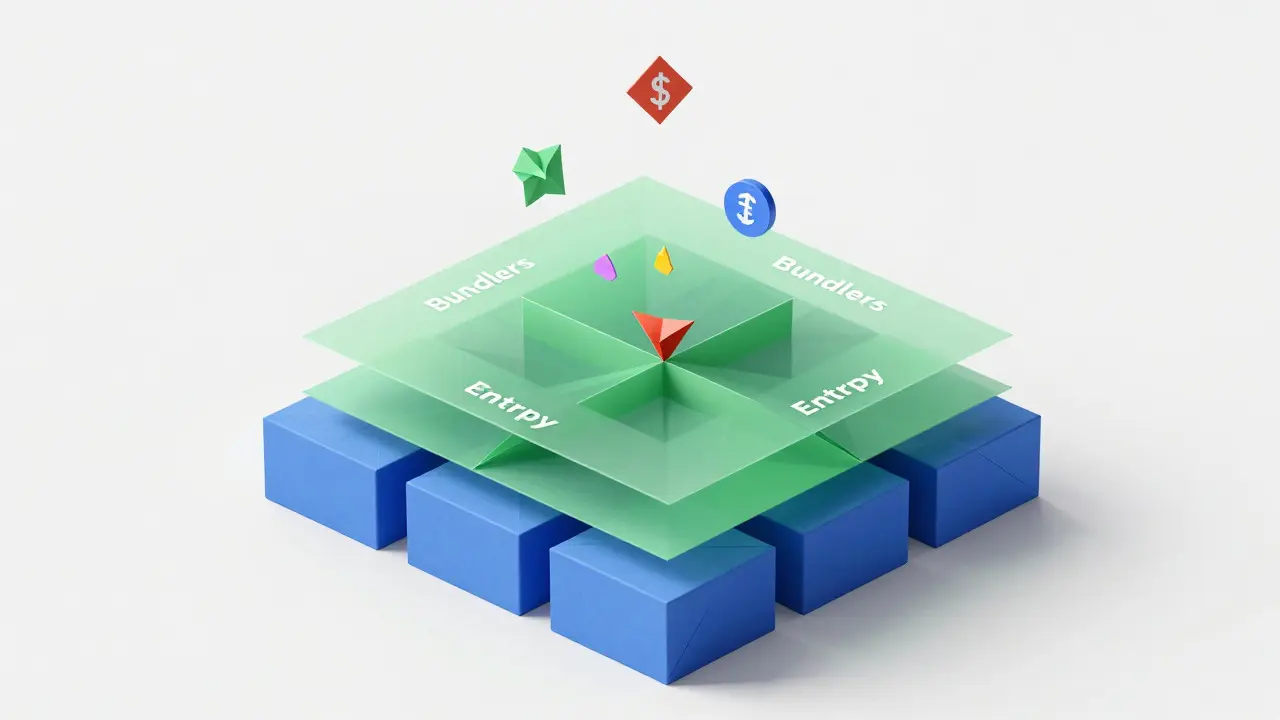
- Bundlers: Special nodes called bundlers pick up these operations, bundle them together, and submit them to the blockchain efficiently.
- EntryPoint: A single, whitelisted smart contract called the EntryPoint verifies and executes all bundled operations.
This architecture allows for features that were previously impossible without complex workarounds. For example, Paymasters can pay your gas fees. You can buy NFTs using USDC instead of needing ETH for gas. The Paymaster reimburses the network, creating a seamless experience similar to buying coffee with a credit card rather than carrying exact change.
Key Features That Change Your Daily Experience
The real power of account abstraction lies in its programmability. Because your wallet is now a smart contract, you can code logic into it. Here are the most impactful features for everyday users:
Social Recovery
No more lost keys. With social recovery, you designate trusted guardians-friends, family, or even institutional services. If you lose access to your primary device, these guardians can vote to restore your wallet. For instance, a setup might require 3 out of 5 guardians to approve a recovery request. This eliminates the permanent loss risk associated with forgotten passwords.
Multisig and Spending Limits
You can create custom security rules. Want to ensure no one can steal more than $1,000 from your wallet even if they hack your phone? Set a daily spending limit. Want to protect joint accounts? Require multiple signatures for any transaction over $500. This level of granularity was previously reserved for corporate treasuries, not individual users.
Session Keys
Gaming and frequent micro-transactions are painful with current wallets because you have to sign every single action. Session keys allow you to grant temporary permissions to an app. You sign once, and the app can execute actions within defined limits (e.g., "allow this game to spend 10 tokens for the next hour"). After the session expires, the permission vanishes. This makes Web3 gaming feel like Web2 gaming.
Security: Better Protection Through Code
Critics argue that smart contracts introduce new risks. While true, account abstraction actually enhances security when implemented correctly. Here is why:
- Blind Signing Prevention: Smart contract wallets can simulate transactions before execution. They can warn you if a transaction looks suspicious or drains your balance unexpectedly.
- Biometric Integration: Since the wallet is a contract, the signature can come from anywhere. You can use FaceID, TouchID, or hardware keys. The contract validates the biometric proof via a secure enclave, keeping your private key hidden.
- Time-Locks: Large transfers can be automatically delayed. If someone hacks your account, the time-lock gives you a window to freeze assets or alert guardians before the funds leave.
Unlike EOAs where the private key is the single point of failure, smart contract wallets distribute trust and add layers of verification. The code enforces the rules, not human memory.
| Feature | Traditional EOA (e.g., MetaMask Legacy) | Smart Contract Wallet (AA) |
|---|---|---|
| Access Method | Private Key / Seed Phrase | Biometrics, Social Recovery, Multi-sig |
| Gas Payment | Must hold native token (ETH/SOL) | Can pay with any token via Paymasters |
| Recovery | None (Lost key = Lost funds) | Social Recovery / Guardians |
| Transaction Batching | One action per signature | Multiple actions in one signature |
| Custom Security Rules | None | Spending limits, Time-locks, Session keys |

Industry Adoption and Infrastructure
The ecosystem is moving fast. Major players are building infrastructure to make AA invisible to the user. Alchemy, Safe, and Argent are leading the charge with embedded accounts. These solutions allow dApps to offer "Login with Email" experiences while maintaining self-custody under the hood.
Ethereum remains the standard-bearer due to ERC-4337, but other chains are adapting. Solana, Polygon, and Arbitrum are integrating compatible modules. The goal is interoperability: you should be able to use your abstracted wallet across different blockchains without friction. As Layer 2 networks mature, the cost of executing these smart contract validations drops significantly, making AA economically viable for small transactions.
Challenges and Future Outlook
It’s not all smooth sailing. Complexity is the enemy of adoption. Developers need to build robust UIs that explain what session keys and guardians do. If a user misunderstands a permission, they can still lose funds. Education is critical.
Additionally, centralization risks exist. Bundlers and Paymasters are currently operated by a few entities. If a major bundler goes offline or acts maliciously, it could disrupt service. Decentralizing these roles is a priority for future upgrades.
Looking ahead, account abstraction will likely become the default. As Web3 aims for billions of users, the EOA model is simply too fragile. We are moving toward a future where your wallet is as easy to use as your email account, but with the security and ownership benefits of blockchain. The technology is here. The question is no longer "if" but "when" you will switch.
What is Account Abstraction in simple terms?
Account Abstraction allows users to replace traditional private-key wallets with smart contract wallets. This enables features like password-less login, social recovery, and paying gas fees with tokens other than the native currency, making crypto easier and safer to use.
Is ERC-4337 safe to use?
Yes, ERC-4337 is considered safe as it is an official Ethereum Improvement Proposal. However, safety also depends on the specific wallet implementation you choose. Always use reputable providers like Safe or Argent that have undergone rigorous audits.
Do I need to migrate my current wallet?
Not immediately. You can continue using your EOA wallet. However, to benefit from features like social recovery and gasless transactions, you may want to try a new smart contract wallet provider. Many allow you to fund the new wallet directly from your old one.
What are Paymasters?
Paymasters are smart contracts that pay gas fees on behalf of users. This enables "gasless" transactions where you can pay fees in stablecoins like USDC or have the fee sponsored by the dApp you are using.
How does Social Recovery work?
Social recovery lets you appoint trusted contacts (guardians). If you lose access to your wallet, these guardians can vote to restore your access. For example, a 3-of-5 setup requires three guardians to approve the recovery, preventing single points of failure.