
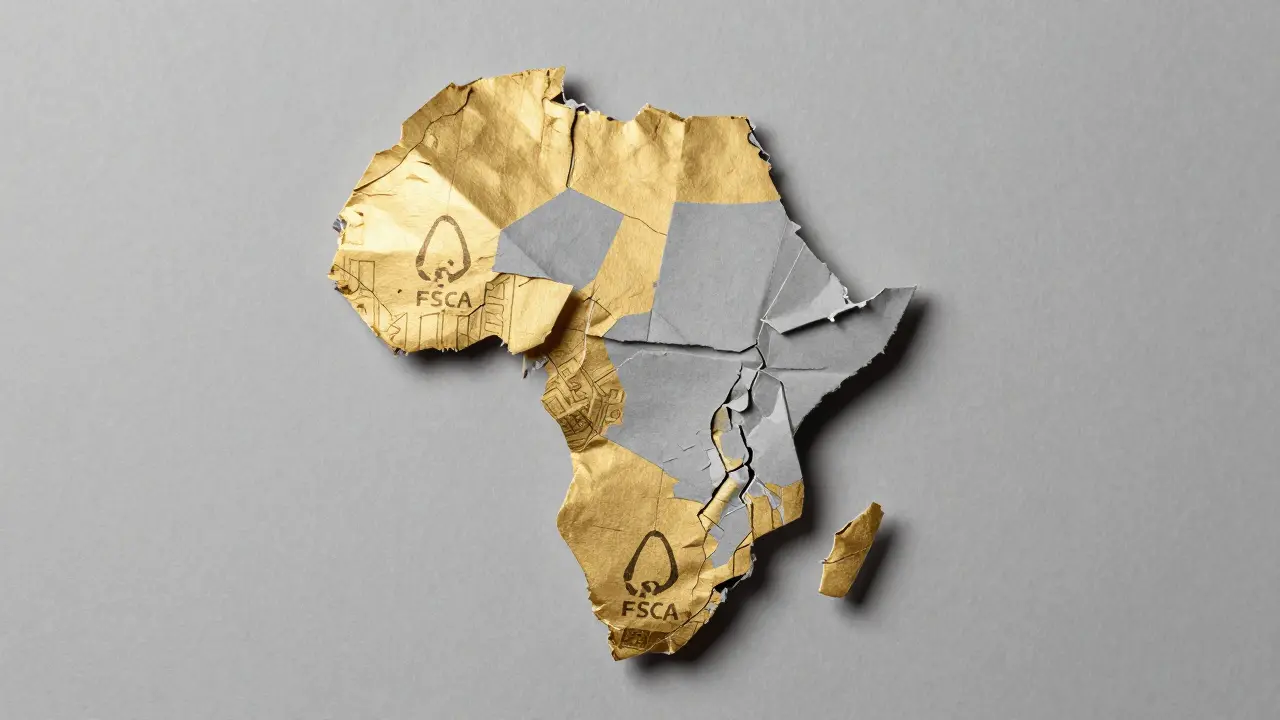
When you can't use your bank to buy Bitcoin, but you still want to send money to your family across the border, what do you do? In many parts of Africa, this isn't a hypothetical question-it's daily reality. While digital currencies promise financial freedom, banking restrictions have turned crypto into a high-stakes game of hide-and-seek. Some countries ban it outright. Others pretend it doesn't exist. And just a few have built real rules around it. The result? Millions are left navigating a patchwork of gray zones, where access to crypto depends less on technology and more on which side of the border you're on.
South Africa: The Regulatory Blueprint
South Africa stands out as the only African country that has built a clear, enforceable system for crypto. Since 2023, the Financial Sector Conduct Authority (FSCA) has treated crypto assets as financial products. That means every exchange, wallet provider, or trading platform operating in the country must register, follow strict anti-money laundering rules, and report transactions over ZAR 25,000 (about $1,500). This is called the Travel Rule, and it forces companies to collect names, ID numbers, and bank details for every large transaction. It’s not perfect, but it works. Unlike other African nations, South Africa didn’t try to shut crypto down. Instead, it brought it inside the system. VASPs (Virtual Asset Service Providers) now have legal pathways to operate. Companies like Luno and Yellow Card have offices in Johannesburg because they know exactly what’s allowed. This isn’t just about control-it’s about inclusion. By creating rules, South Africa gave ordinary people a way to use crypto without breaking the law.
Nigeria: The Ban That Didn’t Stick
Nigeria has the largest crypto market in Africa. Over 30 million Nigerians own digital assets. Yet, the Central Bank of Nigeria (CBN) banned banks from handling crypto transactions in 2021. The reason? Fear. The CBN claims crypto is "vulnerable to illicit usage," citing money laundering and terrorism risks. But here’s the contradiction: you can still buy Bitcoin. You can still sell Ethereum. You just can’t do it through your bank. That means Nigerians rely on peer-to-peer (P2P) trades, cash deposits, or foreign exchanges. If you want to pay for crypto with your salary, you have to find someone willing to meet you in a mall parking lot. Or use a third-party payment app that doesn’t ask questions. The ban didn’t stop crypto. It just made it slower, riskier, and more expensive. A 2025 report by Chainalysis showed Nigeria ranked #1 in P2P crypto volume globally-not because people love speculation, but because they have no other choice. The banking system is broken for them. Crypto isn’t a luxury. It’s a lifeline.
Cameroon: The Regional Gray Zone
In Cameroon, crypto ownership isn’t illegal. But your bank won’t touch it. That’s because of COBAC, the Central African Banking Commission, which oversees six countries including Cameroon, Chad, and Gabon. COBAC’s 2020 directive bans banks from any crypto-related activity. No deposits. No withdrawals. No transfers. No exchanges. This creates a chilling effect. Businesses that want to accept crypto payments can’t. Freelancers can’t get paid in Bitcoin without risking their bank accounts. Even importing goods becomes harder when suppliers won’t accept digital payments. People still trade crypto, but they’re forced into informal networks. Cash handoffs. Mobile money intermediaries. Third-party agents in neighboring countries. It’s messy. It’s unsafe. And it’s exactly what regulators feared-but for the wrong reasons. Instead of protecting people, the ban pushed them into riskier corners of the economy.

Tanzania: The "Don’t Do It" Approach
Tanzania doesn’t ban crypto. It just tells you not to use it. The Bank of Tanzania says the Tanzanian shilling is the only legal tender. That’s it. No fines. No arrests. No bank closures. Just a warning. But in practice, this ambiguity does more harm than help. Banks won’t process crypto-related transactions because they’re scared of future penalties. Payment apps won’t integrate crypto because they don’t know if they’ll get shut down next week. This creates a climate of fear. People who want to use crypto hesitate. Businesses that could benefit from digital payments avoid it. The government’s stance isn’t about security-it’s about control. By refusing to clarify, they keep crypto in the shadows. And in the shadows, scams thrive. Without clear rules, there’s no way to tell a legitimate platform from a fraud.
The Bigger Picture: Why This Matters
These restrictions aren’t just about crypto. They’re about financial exclusion. In Africa, over 30% of adults don’t have a bank account. Crypto was supposed to change that. But when banks refuse to play, crypto becomes a tool for the tech-savvy few, not the unbanked many. Countries that ban crypto don’t stop its use-they just make it harder for average people to access it safely. Meanwhile, places like South Africa show that regulation doesn’t mean suppression. It means protection. When rules exist, people can report scams. They can file complaints. They can recover lost funds. Without them, crypto becomes a wild west. And in a region where fraud is already rampant, that’s dangerous.
What’s Changing in 2025?
Things are shifting. Kenya, Zambia, and Rwanda are drafting crypto laws. Morocco, which banned crypto since 2017, is now working on a regulatory framework. Even the Central African Republic, which briefly made Bitcoin legal tender in 2022, reversed course in 2023-not because crypto failed, but because they didn’t have the systems to support it. The lesson? Blanket bans don’t work. Silence doesn’t protect. The future belongs to countries that build frameworks, not firewalls. Companies like Yellow Card are now being invited into parliamentary meetings in Kenya to help write the rules. That’s a sign of maturity. Governments are realizing: if people are going to use crypto anyway, it’s better to regulate it than ignore it.
What Can Users Do?
If you’re in Nigeria, Cameroon, or Tanzania, here’s what actually works:
- Use P2P platforms like Paxful or Binance P2P to trade directly with sellers. Avoid intermediaries.
- Keep your crypto in a non-custodial wallet (like Trust Wallet or Exodus). Never leave it on an exchange.
- Use mobile money services (like M-Pesa or MTN Mobile Money) as a bridge. Some P2P traders accept these.
- Never share your private keys. No one legitimate will ever ask for them.
- Document every transaction. Screenshots, chat logs, receipts-they’re your only protection.
And if you’re in South Africa? Use regulated platforms. Check the FSCA’s official list of registered VASPs. If it’s not on there, walk away.
What’s Next?
By 2026, we’ll likely see at least five African nations with full crypto laws. The question isn’t whether regulation will come-it’s whether it will come too late for those who need it most. The real battle isn’t between crypto and banks. It’s between control and inclusion. And right now, too many African governments are choosing control.
Can I get arrested for owning crypto in Nigeria?
No, owning or trading cryptocurrency is not illegal for individuals in Nigeria. The Central Bank of Nigeria (CBN) only bans banks and financial institutions from facilitating crypto transactions. You can still buy, sell, or hold Bitcoin or Ethereum using peer-to-peer platforms. However, if you operate a crypto exchange or process payments for others through a bank, you risk penalties. The ban targets institutions, not users.
Why does South Africa allow crypto but Nigeria bans it?
South Africa sees crypto as part of its financial future. Its regulators focus on managing risk through transparency-requiring exchanges to identify users and report large transactions. Nigeria, on the other hand, has chosen to block access entirely, fearing loss of control over its monetary system. The difference isn’t about technology-it’s about governance. South Africa built a system to work with innovation. Nigeria built a wall to block it.
Can I use crypto to send money to family in Cameroon?
Yes, but it’s complicated. Since Cameroonian banks are banned from handling crypto, you can’t send funds directly from your bank account. Instead, you’d need to buy crypto on a P2P platform, send it to a wallet your family controls, and then have them cash it out through a trusted local agent. This often means paying higher fees and trusting strangers. It’s possible, but it’s risky and slow compared to a simple bank transfer.
Is crypto legal in Tanzania?
Crypto isn’t illegal in Tanzania, but it’s not recognized either. The Bank of Tanzania says the shilling is the only legal tender and advises against using crypto. This creates a gray area where banks won’t process crypto transactions, and businesses avoid accepting it. While you won’t be arrested for owning Bitcoin, you won’t find any official support for it either.
How do I know if a crypto platform is legal in South Africa?
Check the Financial Sector Conduct Authority (FSCA) website for the official list of registered Virtual Asset Service Providers (VASPs). Only platforms on this list are legally allowed to operate. If a platform isn’t listed, it’s not regulated-and that means no protection if things go wrong. Always verify before depositing money.



precious Ncube
This is why I can't take African crypto narratives seriously. You're glorifying chaos as 'financial freedom.' If your system is so broken, why not fix the banks instead of running to Bitcoin like it's some magical fix? It's not empowerment-it's desperation dressed up as innovation.
Jan Czuchaj
There's a deeper philosophical layer here that most people miss. The real question isn't whether crypto can bypass banking restrictions-it's whether the very concept of centralized financial control is sustainable in a world where human mobility and digital connectivity are accelerating faster than any regulatory framework can keep up. We're not just talking about money here. We're talking about sovereignty. The fact that people in Nigeria, Cameroon, and Tanzania are building decentralized networks out of necessity suggests that the future of finance isn't being designed in boardrooms-it's being forged in parking lots and WhatsApp groups. That's not a bug. That's evolution.
Tracy Whetsel
I just want to say how much I appreciate this breakdown. 🙏 Honestly, it's easy to sit in a comfy US apartment and judge, but when you see how people are literally using crypto to feed their families across borders-no bank, no bureaucracy, just trust and tech-it changes everything. I’ve been following P2P traders in Lagos for months now. The ingenuity? Unreal. And the humanity? Even more so. We need more stories like this, not more bans.
Alyssa Herndon
I think what’s happening in Africa with crypto is actually really beautiful in a quiet way. People aren’t doing it because they want to get rich. They’re doing it because they have to. And they’re doing it carefully. They’re learning. They’re adapting. They’re protecting each other. It’s not flashy. It doesn’t make headlines. But it’s real. And it matters. We should be listening more and judging less.
Ifeanyi Uche
Naija people don't need your rules bro. CBN banned banks from crypto? Big deal. We still buy and sell every day. My cousin just sent 500k naira to his sister in Ghana using Binance P2P. No bank. No paperwork. Just WhatsApp and trust. You think regulation helps? Nah. Regulation just means more fees and more delays. We already got the system. You just don't like that we didn't ask you for permission.
Jeff French
The regulatory arbitrage here is fascinating. South Africa's FSCA framework creates compliance overhead that actually serves as a barrier to entry for bad actors, while Nigeria’s ban creates a black market with higher transaction costs and zero consumer protections. It’s not that one is better-it’s that the absence of structure amplifies risk. The data shows P2P volume correlates inversely with formal financial access. That’s not crypto being used for speculation. That’s crypto being used as infrastructure.
Elana Vorspan
I just cried reading this. 💔 Not because I’m sad, but because I’m proud. People are building financial lifelines with nothing but their phones and grit. And yet, we still act like this is some kind of fringe experiment. It’s not. It’s the future. And it’s already here. Let’s stop pretending regulation is about safety and admit it’s often about control. We need to support these communities-not police them.
Kenneth Genodiala
It's ironic how the same people who scream about financial inclusion are the first to dismiss the very institutions that built the modern economy. Crypto isn't liberation-it's a workaround for systems that failed. And if you're proud of that? You're not advocating for justice. You're celebrating dysfunction.
Shannon Black
The regulatory divergence across African nations reflects deeper institutional capacities. South Africa’s legal infrastructure allows for nuanced policy implementation. Nigeria’s central bank, constrained by political pressures and legacy systems, defaults to prohibition. This is not a technological issue. It is a governance one. The global community must engage not with crypto, but with the institutional development that enables responsible innovation.
Richard Cooper
Bro. People are using crypto to send money to their moms. That’s it. No need to overthink it. Just let them be.
Dee Resin
Oh wow. So the solution to broken banking systems is… more anonymous peer-to-peer cash handoffs? That’s not innovation. That’s just the 19th century with a blockchain sticker on it. I’m shocked anyone thinks this is progress.
Tanvi Atal
Everyone’s acting like crypto is some miracle cure. Meanwhile, 90% of these P2P traders get scammed. The fees are insane. The volatility? Deadly. And the ‘lifeline’? More like a trap. This whole thing is a hustle for tech bros and scammers. Stop romanticizing poverty.
Sony Sebastian
You're all missing the point. Crypto adoption in Africa isn't about financial inclusion-it's about circumventing monetary sovereignty. The CBN's ban was a strategic move to prevent capital flight. And let's be honest: most African crypto users aren't sending remittances-they're gambling on memecoins. The data doesn't lie. Over 70% of Nigerian crypto trades are speculative. This isn't empowerment. It's a Ponzi economy masquerading as progress.
Brian Lemke
This is one of the most hopeful things I’ve seen in years. People in Lagos, Douala, Dar es Salaam-they’re not waiting for permission. They’re building. They’re teaching each other. They’re creating systems where none existed. And guess what? It’s working. South Africa’s model proves regulation doesn’t kill innovation-it channels it. The real tragedy isn’t the bans. It’s that the world still treats African ingenuity as a problem to be fixed instead of a solution to be learned from.
Megan Lavery
I just sent crypto to my cousin in Kenya last week. She turned it into mobile money in 10 minutes. No bank. No fees. No waiting. I used to send money through Western Union. Took 3 days. $30 fee. Now? 10 mins. $2. That’s not chaos. That’s progress. And yeah, I’m glad Nigeria didn’t ‘fix’ it. They just let people figure it out.
Mae Young
Oh, so now we’re calling financial exclusion a 'beautiful struggle'? Let me guess-you also think the lack of running water in rural villages is ‘authentic’? This isn’t empowerment. It’s desperation. And when you romanticize it, you’re not helping. You’re enabling. Regulation isn’t control-it’s safety. If you want crypto to be real, stop cheering for the underground. Demand the rules. Otherwise, you’re just another crypto bro with a savior complex.