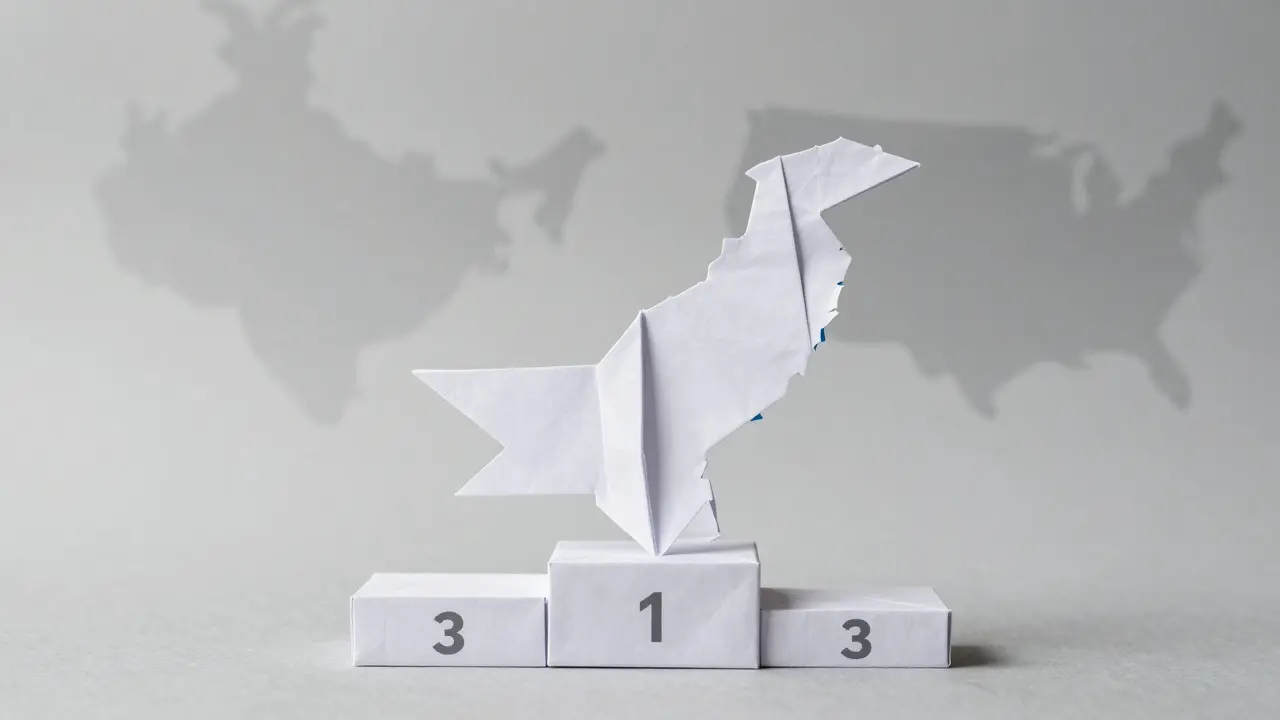
It feels like just yesterday that the State Bank of Pakistan was issuing strict warnings about digital currencies. In 2018, banks were told to block transactions, and holding crypto felt like a legal gray area for most citizens. Fast forward to October 2025, and Pakistan has climbed to the 3rd position globally in cryptocurrency adoption, trailing only India and the United States according to the Chainalysis Global Crypto Adoption Index.
This isn't just a statistical blip. It represents a massive cultural and economic shift in a country with over 230 million people. You might wonder how a nation that once restricted these assets became a global leader so quickly. The answer lies in a mix of economic necessity, regulatory pivots, and the practical utility of stablecoins for everyday survival.
The Numbers Behind the Ranking
To understand why Pakistan ranks 3rd-4th globally, we need to look at what "adoption" actually means in this context. It’s not just about how many people own a Bitcoin wallet. The Chainalysis methodology, which placed Pakistan third in its October 2025 report, looks at four specific sub-indexes:
- Retail transactions via centralized services (like exchanges)
- Retail transactions via decentralized services (like peer-to-peer networks)
- Institutional transactions via centralized services
- Institutional transactions via decentralized services
Pakistan performed exceptionally well across all these metrics. The data suggests that roughly 20 million Pakistanis hold digital currencies valued between $20 billion and $25 billion. When you compare this to the global average ownership rate of 6.9% in 2024, Pakistan is punching well above its weight class. While other rankings from May 2025 placed Pakistan as low as 9th due to different weighting methods, the trend line is undeniable: the Asia Pacific region, driven largely by Pakistan, India, and Vietnam, saw the fastest growth in crypto usage between July 2024 and June 2025.
| Ranking Source | 1st Place | 2nd Place | Pakistan's Rank | Key Metric Focus |
|---|---|---|---|---|
| Chainalysis (Oct 2025) | India | United States | 3rd | Transaction volume & PPP adjusted value |
| Alternative Analysis (May 2025) | India | Nigeria | 9th | Ownership rates & demographic spread |
The discrepancy between these rankings highlights an important nuance. If you measure by pure transaction volume relative to purchasing power parity (PPP), Pakistan shines. If you measure by raw population percentage ownership, the numbers look slightly different. However, both datasets agree on one thing: Pakistan is a top-tier player in the global crypto ecosystem.
From Ban to Boardroom: The Regulatory Flip
The most striking aspect of Pakistan's rise is the speed of its regulatory reversal. For years, the narrative was simple: crypto was banned. The State Bank of Pakistan declared it not legal tender and instructed commercial banks to cut off ties with crypto exchanges. This forced users into the shadows, relying on risky peer-to-peer trades or offshore platforms.
Then came 2024 and 2025. The government realized that banning the technology wasn't stopping the demand; it was just driving it underground and losing out on potential tax revenue and financial innovation. The turning point arrived in July 2025 with the establishment of the Pakistan Virtual Assets Regulatory Authority (PVARA). This body provides the legal clarity that institutional investors have been waiting for.
Alongside PVARA, the creation of the Pakistan Crypto Council signaled high-level political commitment. Led by CEO Bin Saqib, this council acts as a bridge between the government, private sector players, and international partners. It’s no longer a fringe topic discussed in tech hubs; it’s now part of the national economic strategy.

Why Pakistanis Are Adopting Crypto
You might ask, "Why are millions of people switching to crypto?" Is it speculation? To some extent, yes. But Kim Grauer, Chief Economist at Chainalysis, points out that the real driver in emerging markets is utility. Specifically, she notes that "crypto adoption is mostly accelerating... in emerging markets where stablecoins are transforming how people manage money."
In Pakistan, the primary use case isn't buying meme coins. It’s using stablecoins for remittances and savings protection. Here is why this matters:
- Remittances: Pakistan receives billions in remittances annually from workers abroad. Traditional banking fees are high, and transfers can take days. Stablecoins allow near-instant, low-cost transfers directly to family members’ wallets.
- Inflation Hedge: With local currency volatility, holding savings in USD-pegged stablecoins offers a way to preserve value without needing a US bank account.
- Financial Access: Decentralized applications meet local financial needs for those who may be underbanked but have smartphone access.
This utility-driven approach creates sustainable growth. Unlike speculative bubbles that pop when prices drop, utility-based adoption sticks because it solves real problems. People don't stop sending money home or protecting their savings just because the market sentiment shifts.
Geopolitics and Strategic Partnerships
Pakistan’s crypto journey isn't happening in a vacuum. High-level diplomatic engagement has played a crucial role. In June 2025, Finance Minister Muhammad Aurangzeb and Crypto Council CEO Bin Saqib held significant discussions with Michael Saylor, the CEO of MicroStrategy. Saylor’s firm holds over $62 billion in Bitcoin reserves, making him one of the most influential voices in corporate crypto adoption.
These talks focused on financial resilience. They weren't just about trading; they were about integrating blockchain infrastructure into the national economy to reduce dependency on traditional fiat systems.
There is also a geopolitical angle involving the United States. In August 2025, the Pakistan Crypto Council signed an agreement with World Liberty Financial, a venture linked to the Trump family. This partnership aims to accelerate blockchain adoption in Pakistan. Critics raise questions about conflicts of interest, especially given the connections to Steve Witkoff, a special envoy to the Middle East. However, proponents argue that this alignment helps Pakistan curry favor with anticipated US leadership, potentially securing better trade terms or investment flows.

Challenges and Risks Ahead
Despite the impressive ranking, Pakistan faces hurdles. The transition from a restrictive environment to a regulated one is complex. Here are the key risks to watch:
- Regulatory Enforcement: Having laws on paper is one thing; enforcing them fairly is another. Ensuring consumer protection against scams remains a priority for PVARA.
- External Dependencies: Reliance on foreign partnerships, like those with US-based entities, introduces volatility. If political winds shift in Washington, Pakistan’s crypto strategy could face headwinds.
- Infrastructure Gaps: Not every citizen has reliable internet or smartphone access. Bridging the digital divide is essential for true mass adoption beyond the urban centers.
Furthermore, the global regulatory landscape is still evolving. As the US and EU tighten their own rules, Pakistan must ensure its framework remains competitive without compromising security. The goal is to become a hub for legitimate business, not a haven for illicit activities.
What This Means for the Future
If current trends continue, Pakistan is likely to maintain its top-10 position through 2026 and beyond. The combination of a young, tech-savvy population, improving regulatory clarity, and institutional support creates a strong foundation. Projections suggest Bitcoin users alone will reach 1.1 billion by 2030, and Pakistan is well-positioned to capture a significant share of this growth.
For businesses and investors, this signals opportunity. For everyday citizens, it means greater financial flexibility. The story of Pakistan’s crypto adoption is no longer about defiance against restrictions; it’s about embracing a new financial reality that works for its people.
Is cryptocurrency legal in Pakistan in 2025?
Yes, as of mid-2025, cryptocurrency operates within a regulated framework. The State Bank of Pakistan previously restricted it, but the establishment of the Pakistan Virtual Assets Regulatory Authority (PVARA) in July 2025 provided legal clarity. It is no longer considered illegal tender, and licensed entities can facilitate transactions.
Why did Pakistan rank 3rd in the Chainalysis index?
Pakistan ranked 3rd due to high volumes of retail and institutional transactions, particularly when adjusted for purchasing power parity (PPP). The ranking reflects broad-based adoption driven by remittances, inflation hedging, and utility-focused use cases rather than just speculative trading.
How many people in Pakistan use crypto?
Approximately 20 million citizens in Pakistan hold digital currencies. This represents a significant portion of the population, with total holdings estimated between $20 billion and $25 billion as of 2025.
What is the role of the Pakistan Crypto Council?
The Pakistan Crypto Council serves as an industry coordination body. Led by CEO Bin Saqib, it facilitates dialogue between the government, private sector participants, and international partners to promote blockchain integration and ensure regulatory compliance.
Are stablecoins popular in Pakistan?
Yes, stablecoins are a primary driver of adoption. They are widely used for receiving remittances from abroad and for protecting savings against local currency inflation, offering a stable store of value pegged to the US dollar.
Who are the top countries in crypto adoption after Pakistan?
According to the Chainalysis 2025 index, India ranks 1st and the United States ranks 2nd. Other top performers include Vietnam, Nigeria, Indonesia, and Ukraine, depending on the specific methodology used.