

For years, the cryptocurrency world operated under a shadow of opacity. You could move billions in digital assets across borders with minimal friction, leaving traditional tax authorities scrambling to keep up. That era is effectively over. As of 2026, the global financial system has tightened its grip on digital wealth through a coordinated effort known as the Crypto-Asset Reporting Framework (CARF), which mandates the automatic exchange of crypto tax information between countries. If you hold crypto in multiple jurisdictions or use offshore exchanges, your financial footprint is no longer hidden by geography.
This isn't just bureaucratic noise; it represents a fundamental shift in how governments track wealth. The Organisation for Economic Co-operation and Development (OECD) led this charge, creating a standardized way for nations to share data about your crypto holdings, transactions, and income. The goal is simple: stop tax evasion and ensure that the decentralized nature of blockchain doesn't mean "de-taxable." For individuals and businesses alike, understanding this framework is now a matter of legal survival, not just good housekeeping.
The Engine Behind the Transparency: What is CARF?
At the heart of this new transparency regime is CARF. Think of it as the Common Reporting Standard (CRS) for banks, but built specifically for the complexities of digital assets. The CRS, launched in 2014, successfully forced banks to report foreign account holders to their home tax authorities. CARF applies that same logic to crypto.
Under CARF, countries must obtain information from what are called Reporting Crypto-Asset Service Providers (RCASPs). These are the platforms, exchanges, and custodians where you buy, sell, or store your tokens. Every year, these providers collect detailed data on their users-your identity, your account numbers, your transaction volumes, and the value of your holdings. They then send this data to their local tax authority, which automatically shares it with the tax authority of the country where you actually live.
The technical backbone of this system relies heavily on XML standards published by the OECD in late 2024. This guide ensures that whether you trade Bitcoin in Tokyo or Ethereum in Toronto, the data format sent to the IRS or HMRC is identical. It includes fields for self-certification forms and covers indirect investments, meaning even if you hold crypto through a derivative or an investment fund, those layers of complexity don't save you from disclosure.
EU Leadership and the DAC8 Directive
While the OECD sets the global standard, the European Union often moves faster on implementation. In October 2023, EU member states adopted DAC8, the eighth amendment to the Directive on Administrative Cooperation. This directive transposes the OECD’s CARF rules into binding EU law.
The timeline here is critical. EU countries were required to transpose DAC8 into national law by December 31, 2025. Starting January 1, 2026, the provisions are fully active. This means that if you are using a crypto service provider within the EU, they began collecting the necessary enhanced due diligence data immediately. The first full year of reporting under these strict new rules covers the calendar year 2026, with data likely being exchanged in early 2027.
DAC8 expands the scope significantly. It brings electronic money products and central bank digital currencies (CBDCs) into the fold. More importantly, it closes loopholes regarding indirect ownership. Previously, holding crypto via a complex corporate structure might have obscured the beneficial owner. DAC8 requires service providers to look deeper, ensuring that genuine non-profits get carve-outs, but individual investors do not hide behind shell companies.
The United States and Reciprocal Reporting
The United States has historically taken a different path, relying on FATCA (Foreign Account Tax Compliance Act) rather than fully embracing the multilateral CRS model. However, the rise of CARF has forced a convergence. The Internal Revenue Service (IRS) is aligning its requirements with the OECD framework to create a reciprocal system.
Here is how it works for American taxpayers: Non-U.S. brokers who serve U.S. customers will be required to report information following CARF guidelines. Simultaneously, U.S. brokers will report on foreign persons trading digital assets on American platforms. This creates a two-way street. The IRS sends data about foreign investors using U.S. exchanges to other participating countries, while receiving data about Americans using exchanges in Paris, London, or Singapore.
This reciprocity eliminates the old strategy of using a foreign exchange to avoid U.S. reporting. If you are a U.S. person holding assets on a non-U.S. platform that participates in CARF, your activity is visible to the IRS. The net result is a global web of visibility that makes hiding offshore crypto gains increasingly difficult.
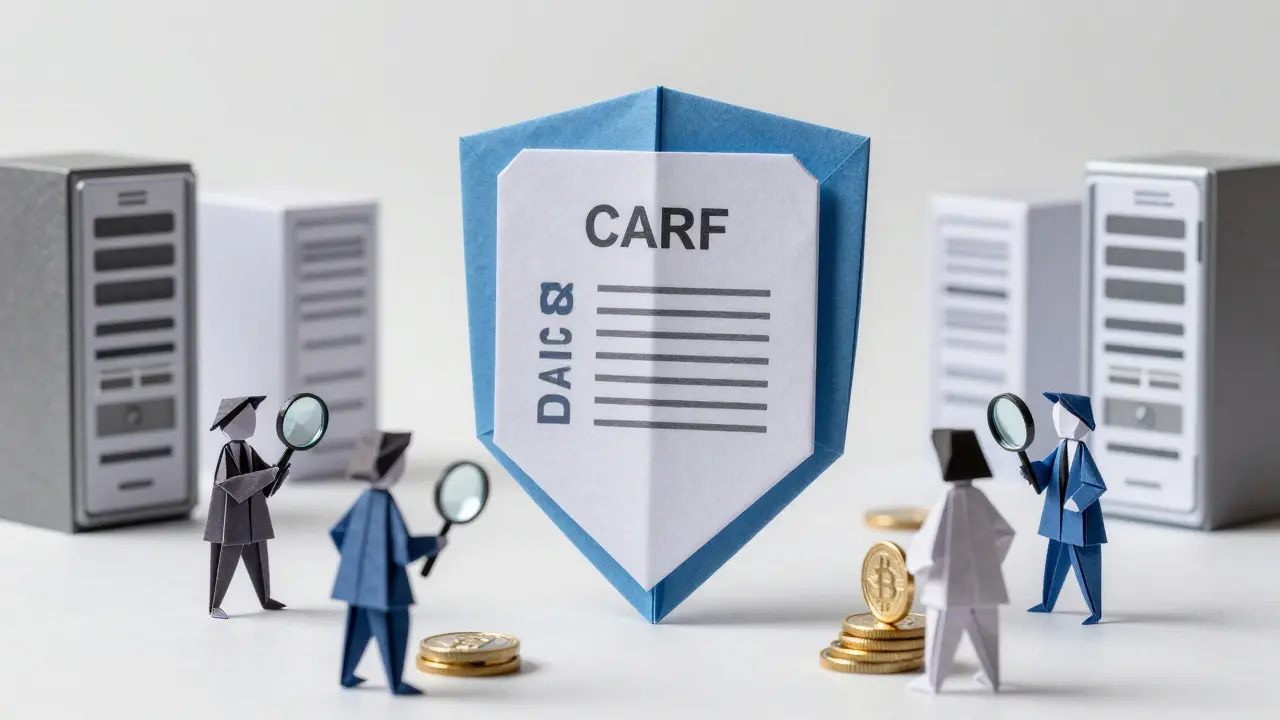
Who Has Committed? The Global Landscape
The momentum behind CARF is substantial. Following a joint statement in November 2023, 67 jurisdictions committed to implementing the framework by 2028. This number grew from an initial pledge by 54 countries targeting 2027. This list includes most major financial centers, covering a vast majority of the global GDP and crypto market volume.
| Jurisdiction / Region | Framework / Directive | Key Deadline | Status as of 2026 |
|---|---|---|---|
| European Union | DAC8 | Jan 1, 2026 (Application) | Active; Data collection underway |
| United States | IRS CARF Alignment | Ongoing | Reciprocal reporting established |
| OECD Members (General) | CARF | 2027-2028 | Legislation drafting phase |
| G20 Nations | International Standards | Varies | Committed to adoption |
Notably, some traditional "crypto-friendly" jurisdictions are joining the bandwagon. While they may maintain favorable tax rates or regulatory environments for innovation, they are largely abandoning secrecy as a selling point. The competitive advantage is shifting from "we won't tell anyone" to "we offer clear rules and low taxes." This distinction matters because it means you can still invest in friendly jurisdictions, but you must expect full transparency with your home country.
Challenges in Implementation: Technology and Compliance
Despite the political will, the practical execution of CARF faces significant hurdles. The primary challenge lies in the technological infrastructure required to capture and validate this data. Financial institutions and crypto-asset service providers (CASPs) are not used to the level of granular tracking demanded by the OECD.
Unlike traditional bank accounts, crypto wallets can be self-custodied. CARF primarily targets *service providers*-exchanges, custodians, and wallet providers that act as intermediaries. If you hold your Bitcoin in a hardware wallet with no connection to a centralized exchange, CARF does not directly see those assets. However, the moment you interact with a regulated entity-to sell, swap, or borrow against those assets-you trigger reporting obligations.
Service providers face immense pressure to build systems that can:
- Identify users accurately across decentralized identities.
- Track transactions in real-time across multiple blockchains.
- Calculate cost basis and capital gains in accordance with varying local tax laws.
- Format and transmit data via the specific XML schemas mandated by the OECD.
Tax administrations also need upgrades. Receiving massive streams of structured data from dozens of countries requires robust processing capabilities. Many smaller jurisdictions lack the IT resources to handle this influx efficiently, potentially leading to delays or errors in data matching.

What This Means for You: Practical Steps
If you are an investor, trader, or business owner in the crypto space, the days of casual compliance are gone. Here is what you need to do right now.
- Audit Your Service Providers: Check which exchanges and custodians you use. Are they located in CARF-participating jurisdictions? If so, assume they are already collecting enhanced due diligence data. Ensure your personal details (address, tax ID) are up to date.
- Reconcile Cross-Border Holdings: If you live in Country A but hold assets on an exchange in Country B, prepare for Country A to receive that data. Do not assume silence means safety. Start reconciling your records now to match what will be reported.
- Understand Indirect Exposure: Review any investments in funds, trusts, or derivatives that hold crypto. Under the amended CRS and CARF, these structures are increasingly transparent. Ensure your tax filings reflect these indirect holdings.
- Plan for Increased Scrutiny: Tax authorities will have more data, which means better algorithms for flagging discrepancies. If your declared income doesn't match the crypto sales reported by your exchange, expect an inquiry. Keep meticulous records of every transaction, including small trades and airdrops.
The narrative that crypto is inherently private is fading. The industry is maturing, and with maturity comes regulation. CARF and DAC8 are not going away; they are the new baseline. Adapting to them isn't just about avoiding penalties; it's about operating legitimately in a global economy that values transparency.
The Future of Crypto Tax Transparency
As we move through 2026 and toward the 2027-2028 implementation window, expect further refinements. The OECD will likely update the XML guides based on feedback from the initial rollout. We may see expanded coverage for newer asset classes, such as NFTs and decentralized finance (DeFi) protocols, as regulators figure out how to assign responsibility in truly decentralized environments.
Some experts argue that this level of surveillance could drive some activity back to less regulated corners of the internet. However, the convenience and liquidity of major regulated exchanges make it hard for the average user to justify moving to obscure platforms. The trend is clear: integration, not isolation. The crypto market is becoming part of the mainstream financial plumbing, and with that integration comes the expectation of full tax compliance.
For now, the best strategy is proactive transparency. Work with tax professionals who understand both traditional finance and blockchain technology. Stay informed about legislative changes in your jurisdiction and those where you hold assets. The automatic exchange of information is here, and it is only getting smarter.
What is CARF and why was it created?
CARF stands for the Crypto-Asset Reporting Framework. It was created by the OECD to address tax evasion in the cryptocurrency sector by establishing a global standard for the automatic exchange of tax-relevant information between countries. It aims to bring crypto-assets under the same transparency rules as traditional financial assets.
How does DAC8 differ from CARF?
DAC8 is the European Union's directive that implements the OECD's CARF standards into EU law. While CARF is the international framework, DAC8 is the specific legal instrument binding EU member states. DAC8 requires EU countries to transpose the rules by the end of 2025 and apply them starting January 1, 2026.
Does CARF cover self-custodied wallets?
Directly, no. CARF targets Reporting Crypto-Asset Service Providers (RCASPs) like exchanges and custodial wallets. Self-custodied wallets without a service provider intermediary are not automatically reported. However, if you ever deposit funds from a self-custodied wallet into a regulated exchange, that transaction becomes visible and reportable.
When will the US start exchanging crypto tax data?
The US IRS is aligning with CARF to create a reciprocal reporting system. Non-US brokers serving US customers will report data to the IRS, and US brokers will report on foreign clients. This system is being rolled out in phases, with significant operational requirements expected to be in place by 2027, mirroring the broader OECD timeline.
What information is shared under CARF?
CARF requires the sharing of account holder identification (name, address, tax ID), account numbers, account balances or values at the end of the reporting period, and gross amounts of payments attributable to the account (such as proceeds from sales or exchanges). It also covers indirect investments through derivatives and investment vehicles.
Which countries have committed to CARF?
As of late 2023, 67 jurisdictions committed to implementing CARF by 2028. This includes all EU member states (via DAC8), the United States, and most major G20 economies. This broad coalition covers the vast majority of global financial activity and crypto markets.
How does CARF affect DeFi users?
Currently, pure DeFi protocols without centralized operators are harder to regulate under CARF. However, the framework is evolving. If a DeFi protocol appoints a representative or if users access DeFi through a centralized gateway (like a hybrid exchange), reporting obligations may apply. Regulators are actively working on ways to extend transparency to decentralized environments.




Alexander Scheel
It is truly amusing to watch the masses panic over a system that simply demands they pay their fair share, as if honesty were some radical new concept invented by the OECD. One might think that for decades, people operated under the delusion that digital assets existed in a moral vacuum where laws of physics and finance did not apply. The irony is palpable when one considers how many self-proclaimed libertarians are now screaming about tyranny while clutching their unreported gains like misers in a Dickens novel. It seems the only freedom they cherished was the freedom to cheat.
Perhaps we should all take a moment to reflect on the societal decay that allowed such opacity to flourish in the first place. Was it really so difficult to imagine that governments would eventually catch up? Or did the sheer greed of the crypto-bros blind them to the inevitable march of bureaucratic efficiency? I suppose we shall never know, but one can certainly enjoy the spectacle of their collective indigestion.
Evelyn Kula
They want your data because they want to control everything you do, every penny you earn, and every thought you have about money. This is not about taxes, it is about total surveillance state implementation disguised as 'compliance'. The EU is just the testing ground for the globalist agenda to strip Americans of their last shred of financial privacy. Wake up sheeple! They are building the cage with golden bars called 'transparency'.
manish jha
The karma of hiding wealth is finally catching up to those who sought to evade their duties to society. It is not merely a legal issue but a spiritual failing to believe one is above the communal obligation of taxation. True enlightenment comes from accepting one's role in the larger economic ecosystem without trying to hide in the shadows of blockchain obfuscation. Those who suffered through honest labor will now see justice served as the cheaters are exposed.
Ashley Snyder
I guess this means we all need to be more careful with our records, which isn't necessarily a bad thing for peace of mind. It’s kind of nice to know there’s a standard now instead of everyone guessing what rules apply where. Let’s just try to adapt calmly and help each other understand the new forms rather than fighting the inevitable.
Sarah Hafner
Don't worry too much if you've been honest, you're probably fine! :) Just make sure your exchange info is updated. If you use a hardware wallet, remember that moving funds to an exchange triggers the reporting, so keep good notes of those transfers. It’s actually quite manageable once you get the hang of the XML requirements for providers. We can all learn together! :)
Susan Kiley
Oh, darling, do try to keep up with the rest of us who actually read the fine print. This is hardly surprising to anyone with even a modicum of financial literacy or interest in geopolitical trends. The pretension of thinking your little offshore stash was safe forever is almost cute, in a tragic sort of way. Prepare yourself for the harsh reality of adulthood, where transparency is mandatory and secrecy is a crime against the state. 😒
Gary Straiton
This is an absolute disaster for American sovereignty and individual liberty! Why are we letting foreign entities dictate how we handle our own financial data? The IRS is already incompetent enough without importing these European bureaucratic nightmares into our system. It’s time to stand up and demand that our government rejects this international shakedown before it’s too late!
alex fordy
One must consider the philosophical implications of privacy in a digital age. Is true anonymity possible, or is it merely an illusion we clung to for comfort? 🤔 The shift towards transparency forces us to redefine what we value: security through obscurity or clarity through compliance. It is a fascinating evolution of human trust systems, albeit a painful one for many. 😊
Nia Franklin
Its like a big global puzzle being solved!! And we are all pieces... kinda scary but also exciting?? I think its important to stay connected with others who are figuring this out too.. maybe we can form study groups or something?? The world is getting smaller and more interconnected every day!!! 🌍✨
Mohamed Shoaeb
it is what it is no point crying over spilt milk just update your records and move forward life goes on and technology always catches up with regulation sooner or later so just accept it and keep trading wisely
Sonia Gomez Gomez
So let me get this straight, you guys think you can hide behind complex corporate structures and shell companies while the rest of us pay our taxes honestly? How dare you insult our intelligence and our patience. It is time for accountability and moral rectitude to prevail over your greedy schemes. Face the music and pay up! ;)
Zothana Pachuau
Look, if you’re going to play in the big leagues, you have to follow the rules, simple as that. It’s not personal, it’s just business. Maybe this will teach some people to diversify properly instead of relying on loopholes that clearly aren’t working anymore. Stay sharp and don’t let the drama distract you from the actual mechanics of the market.
Linda Leeuwesteijn
Hey everyone, let’s support each other through this transition! 💪 It’s a lot to process, but we’ve got this. Sharing resources and tips can make a huge difference. Remember, we’re all learning together, so be kind and patient with yourselves and others. You’re doing great! 🌟
Shawn Schaerer
THE SYSTEM IS BROKEN AND THEY KNOW IT! WHY ARE WE STILL USING CENTRALIZED EXCHANGES THAT REPORT TO THE GOVERNMENT? THIS IS A MASSIVE INFRINGEMENT ON OUR RIGHTS! WE MUST DECENTRALIZE OR DIE TRYING! WAKE UP PEOPLE! THE REVOLUTION IS NOW! 🔥🔥🔥
Hicham Mounir
I hear you, it feels overwhelming right now. But look at it this way, it’s just another layer of bureaucracy we have to navigate. Take a deep breath and break it down step by step. You’re not alone in this, and it’s okay to feel frustrated. Let’s just focus on what we can control.
Sarah Campbell
America first!! Why are we listening to the EU on this?? Our constitution guarantees privacy and they are trampling on it!! This is unconstitutional and needs to stop immediately!! 🇺🇸🇺🇸🇺🇸
Phelan Deihl
I’ve been quietly updating my records since the announcement. It’s better to be prepared than surprised. The noise online is distracting, but the practical steps are straightforward. Just keep your head down and do the work.
Ami Elizabeth
srsly tho just use a ledger and dont touch exchanges unless u have to its not that hard ppl are making it sound like the end of the world but its just tax season with extra steps lol
michelle aguilar
Ugh, why does everything have to be so complicated? Can’t we just have simple rules that everyone understands? It’s exhausting trying to keep up with all these new directives and frameworks. I just want to invest in peace, not spend my weekends decoding OECD documents. Sigh.
Lance Konig
Let me enlighten you all on a few points you clearly missed. First, CARF is not just about banks; it’s about every service provider. Second, indirect ownership is key. Third, the US reciprocity means nowhere is safe. Read the article again, slowly, and perhaps you’ll grasp the magnitude of this shift. Ignorance is bliss, but it’s expensive.
Dina Lazarova
Another tedious piece of legislation designed to burden the compliant while the elite find ways around it. Typical. I suppose we must all submit to this drudgery because it is the law. How utterly mundane. One wonders if any creativity remains in the financial sector when every transaction is scrutinized by bureaucrats.
Walker Perry
they are watching every move you make every transaction every click its all recorded and stored in their massive databases waiting for the right moment to strike you are not free you are a number in their system and they are tightening the noose around your neck prepare for the worst because the best days of privacy are gone forever
Patrick Pat
Right, because nothing says 'freedom' like handing over your entire financial history to a committee in Paris. Brilliant strategy, lads. Truly inspiring. I’m sure the revolutionaries of old would be thrilled to see us voluntarily signing away our privacy rights in exchange for the privilege of paying taxes on air-dropped tokens. Cheers to that. 🍻