
You’ve probably heard of Dogecoin. Maybe you even know about Pepe. But if you’re seeing "Ribbit" or "RIBBIT" popping up in your feed or on price trackers, you might be wondering what it actually is. Is it a new tech project? A serious investment? Or just another internet joke with a price tag?
The short answer: It’s mostly the latter. Ribbit isn’t one single coin. It’s a name shared by several different frog-themed meme coins across various blockchains. There is no single "official" Ribbit company behind them. Instead, you have distinct tokens living on Ethereum, Solana, and Base, each with its own supply, price, and level of activity.
Is there an official whitepaper for Ribbit?
No. None of the major Ribbit variants (Ethereum RIBBIT, Solana RBT, or Base RIBBIT) have published formal whitepapers, technical roadmaps, or registered foundation documents. They rely on community sentiment and exchange listings rather than traditional documentation.
The Different Versions of Ribbit
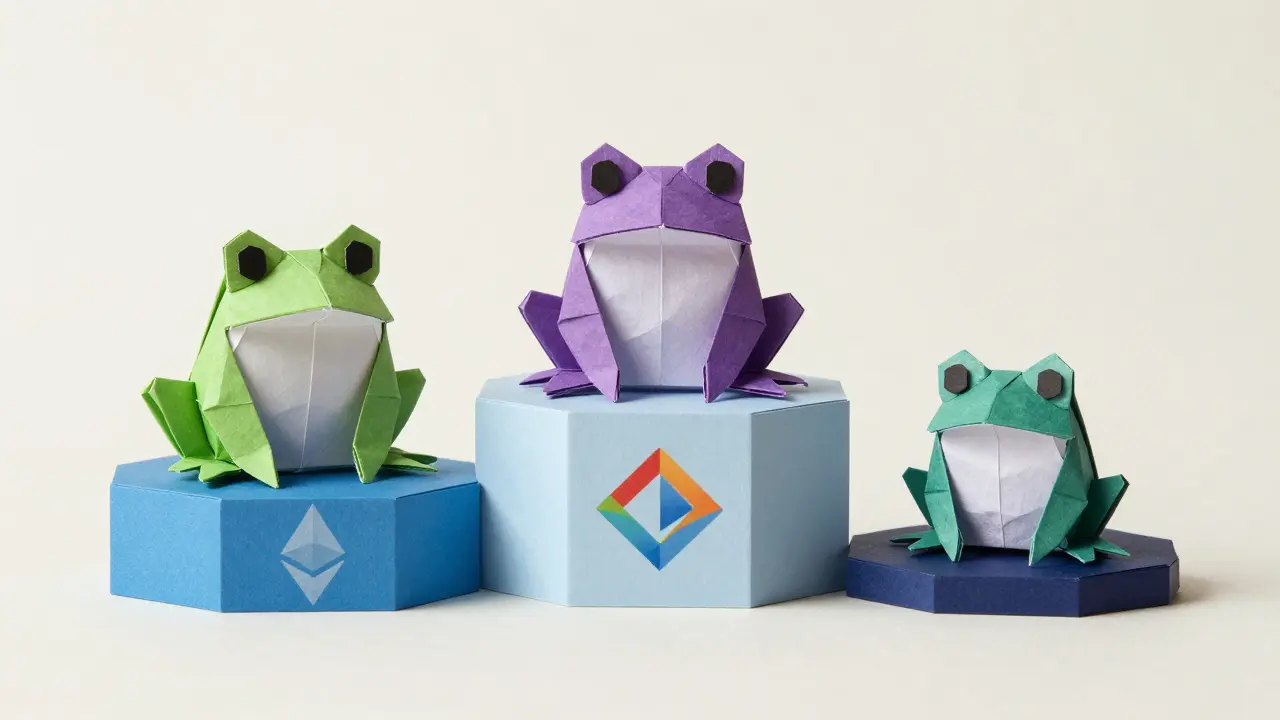
Before you buy anything, you need to know which Ribbit you are looking at. The ticker symbol RIBBIT or RBT appears on multiple chains. Mixing them up can lead to buying the wrong asset entirely.
| Token Name | Blockchain | Primary Narrative | Market Cap Range (Approx.) |
|---|---|---|---|
| Ribbit Meme (RIBBIT) | Ethereum (ERC-20) | Fair-launch meme coin; entertainment only | $100k - $250k USD |
| RIBBIT (RBT) | Solana | Education & Rubic swap integration | $200k - $800k USD |
| Ribbit on Base | Base (Layer 2) | Collectible meme token | ~$19k USD |
Ribbit Meme (Ethereum): The Fair-Launch Experiment
This is likely the first version most people encounter when searching for "RIBBIT." It operates on the Ethereum blockchain. Its main selling point isn't technology-it's transparency in how it was launched.
Unlike many meme coins that give huge amounts of tokens to insiders before the public can buy any, this version claims a "fair launch." According to data from Coinbase and other trackers, about 93.1% of the total supply was sent directly into a liquidity pool. The tokens used to create that pool were burned, meaning they can never be sold off to dump the price. Furthermore, the smart contract ownership was renounced. This means the creator cannot change the code, add taxes, or mint more tokens later.
However, fairness doesn't mean safety. The remaining 6.9% of the supply sits in a multi-signature wallet for things like listing fees. While small, this is still a centralized stash. More importantly, Coinbase explicitly states that this token has no intrinsic value and is "completely useless and for entertainment purposes only." As of mid-2026, its market cap hovers around $117,000 to $240,000 USD, with daily trading volumes often dipping below $1,000. That is extremely low liquidity. If you try to sell a large amount, you could crash the price yourself.
RIBBIT (RBT) on Solana: The Education Angle
If you see the ticker RBT, you are looking at the Solana-based version. This one tries to stand out from the crowd by claiming utility. It positions itself as the "first frog-related coin on Solana" and aims to educate users about the Solana ecosystem.
It also integrates with Rubic, a cross-chain bridge aggregator. The idea is that RBT helps facilitate swaps between different blockchains and rewards users for using the platform. This gives it a slightly more "serious" narrative than pure joke coins. It was promoted by figures in the Solana meme space, including someone known as "Solana Bateman," who helped push its visibility.
Despite the educational mission, the numbers tell a story of a niche asset. In late 2024, it saw some hype, with prices briefly reaching higher levels. But by July 2026, the price had settled much lower, around $0.0000005 per token, with a market cap near $220,000. It ranks outside the top 2,500 cryptocurrencies. While it has better volume than the Ethereum version-often trading hundreds of dollars daily-it remains a high-risk speculative play.
Ribbit on Base: The Collectible
There is also a third variant on Coinbase’s Base network. Launched in November 2022, this one is described as a "collectible token" and the "crowned prince of the meme coin pond." It has a fixed supply of 1 billion tokens. As of late 2025, its market cap was roughly $19,000. This makes it a micro-cap asset with very little trading activity. It serves primarily collectors within the Base ecosystem rather than traders looking for quick flips.
Don't Confuse It With Ribbit Wallet
Here is where things get tricky. You might find an app called "Ribbit Wallet" on the Google Play Store or Apple App Store. This is not the official wallet for any of the Ribbit coins mentioned above.
Ribbit Wallet is a separate product built on Supra’s layer-1 network. It is a non-custodial wallet that supports Bitcoin, Ethereum, Polygon, and others. It allows you to store assets, swap tokens, and stake. While it shares the same brand name, there is no evidence linking the wallet developers to the creators of the RIBBIT meme tokens. Always check the contract address of the token you are buying, not just the name of the app you are using.
Why Do These Coins Exist?
Meme coins thrive on attention. After the massive success of Dogecoin and Shiba Inu, the market became saturated with animal-themed tokens. Frogs became the next big wave, led by PEPE. Ribbit attempts to ride that cultural momentum.
For the Ethereum version, the appeal is the "anti-insider" narrative. For the Solana version, it’s the combination of memes with actual platform integration (Rubic). For the Base version, it’s early adoption in a growing Layer 2 network. None of these provide dividends, governance rights, or real-world utility in the traditional sense. Their value comes entirely from what other people are willing to pay for them at any given moment.

Risks You Need to Know
If you are thinking of buying Ribbit, you must understand the risks. These are not investments; they are speculation.
- Extreme Volatility: Prices can drop 90% in a week based on social media trends. The Ethereum RIBBIT has seen drops of over 99% from its all-time highs.
- Low Liquidity: With daily volumes often under $1,000, you may struggle to sell your tokens without significantly lowering the price.
- No Fundamental Value: There is no revenue stream, no user base paying for services, and no underlying technology that generates income. The value is purely psychological.
- Confusion Risk: Because there are three different tokens with similar names, you could easily buy the wrong one on a decentralized exchange.
How to Buy Ribbit (If You Still Want To)
Since none of these tokens are listed on major centralized exchanges like Coinbase Pro or Binance for direct trading, you will need to use decentralized exchanges (DEXs).
- Get a Compatible Wallet: For Ethereum/Base, use MetaMask or Phantom. For Solana, use Phantom or Solflare.
- Buy Base Currency: Purchase ETH for Ethereum/Base tokens, or SOL for Solana tokens on a major exchange.
- Transfer to Wallet: Send the ETH or SOL to your self-custody wallet.
- Connect to DEX: Use Uniswap (for Ethereum/Base) or Raydium/Jupiter (for Solana).
- Paste the Contract Address: This is crucial. Never search by name alone. Copy the exact contract address from a trusted tracker like CoinGecko or CoinMarketCap to ensure you are getting the right token.
- Swap: Execute the trade. Be aware of slippage settings; you may need to increase slippage tolerance due to low liquidity.
Final Thoughts
Ribbit is a collection of small, speculative meme coins riding the wave of internet culture. They offer no guarantees, no utility beyond swapping, and carry significant risk. If you treat them like lottery tickets-money you are fully prepared to lose-they can be entertaining. If you treat them like investments, you are likely setting yourself up for disappointment. Always do your own research, verify contract addresses, and never invest more than you can afford to lose.