

If you've spent any time in the crypto space, you've seen the term TVL tossed around constantly. But why does it actually matter? Imagine walking into a bank; you'd likely feel more secure if you saw billions of dollars in deposits rather than just a few thousand. In the decentralized world, Total Value Locked is the aggregate value of cryptocurrency assets deposited into smart contracts, serving as a real-time pulse check for a protocol's adoption and trust. Commonly referred to as TVL, it is the primary metric used to judge if a platform is a ghost town or a financial powerhouse.
As of mid-2025, the total TVL across the entire ecosystem hit roughly $142 billion. While that sounds like a massive number, the real story is where that money is sitting. Most of it is concentrated in a few giant protocols that have fundamentally changed how we earn interest, lend assets, and swap tokens. However, a high TVL isn't always a green flag. We've seen cases like the Anchor Protocol collapse where billions in TVL vanished almost overnight because the underlying yield was unsustainable. To really understand the landscape, we have to look past the big numbers and see what's actually driving the growth.
The Heavy Hitters: Who Leads the TVL Race?
When you look at the leaderboard, a few names always stay at the top. These aren't just apps; they are the infrastructure of the new internet of money. The dominance of these protocols usually comes down to their ability to solve a specific, painful problem for users.
Lido is currently the undisputed king, commanding around $13.9 billion in TVL. Its secret sauce? Solving the liquidity trap of staking. Normally, when you stake your ETH, your coins are locked up. Lido creates stETH, a liquid staking derivative that represents your staked ETH, allowing you to earn rewards while still being able to trade or use your assets in other DeFi apps. It's a brilliant move that captured over 30% of Ethereum's liquid staking market.
Then there's Aave, a lending powerhouse with about $4.5 billion locked across nine different chains. Unlike a traditional bank, Aave uses automated smart contracts to handle loans. One of its standout features is credit delegation, which helps reduce bad debt. During the market crashes of 2024, Aave's risk management proved far superior to older models like Compound, making it a go-to for people who want to lend their assets securely.
We can't ignore MakerDAO (now evolving through the Sky protocol), which holds around $4.9 billion. They basically invented the concept of decentralized stablecoins with DAI, a stablecoin backed by over-collateralized crypto assets. If you've ever wondered how people get a loan in USD without selling their Bitcoin, MakerDAO is the answer.
| Protocol | Approx. TVL (2025) | Primary Function | Key Innovation | Network Reach |
|---|---|---|---|---|
| Lido | $13.9 Billion | Liquid Staking | stETH Derivatives | Multi-chain (ETH, SOL, POLY) |
| Aave | $4.5 Billion | Lending/Borrowing | Isolated Pools | 9+ Chains |
| MakerDAO (Sky) | $4.9 Billion | Stablecoin Minting | CDP Model | Primarily Ethereum |
| Uniswap | $3.2 Billion | DEX (Trading) | Concentrated Liquidity | 8+ Chains |
| EigenLayer | $3.8 Billion | Restaking | Shared Security | Ethereum |
How TVL is Actually Calculated (And Why It Can Lie)
You might think TVL is just a simple sum of balances, but it's a bit more complex. Tools like DefiLlama is a leading analytics platform that tracks TVL by auditing smart contract balances and multiplying them by real-time prices provided by oracles. To get an accurate number, these platforms rely on Chainlink, which provides the precise price feeds needed to convert a random amount of tokens into a USD value.
But here is the catch: TVL can be misleading. There is such a thing as "mercenary capital." This is money that flows into a protocol just to chase a high, unsustainable yield. Once the rewards drop, that money vanishes. If a protocol has $1 billion in TVL but only generates $10,000 in actual fees, it's basically a house of cards. This is why experts are moving toward "TVL Efficiency"-measuring how much revenue a protocol makes per dollar locked.
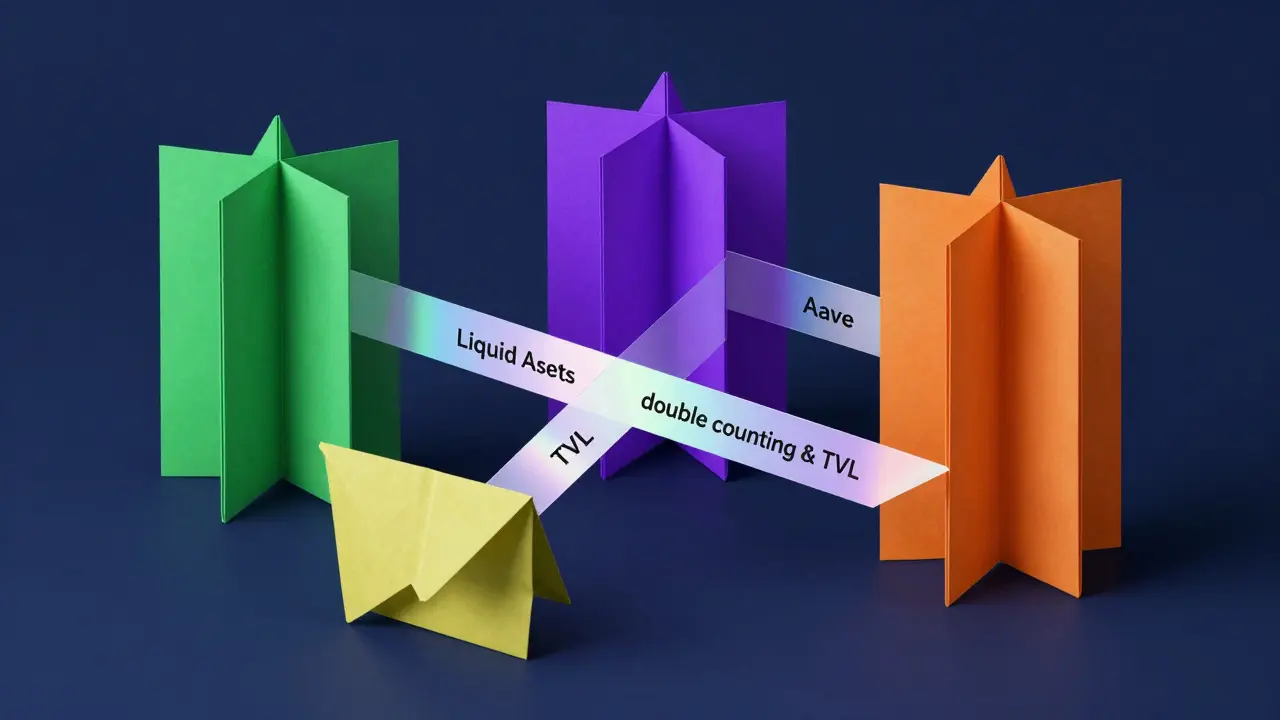
Another risk is the "double counting" problem. If you deposit ETH into Lido to get stETH, and then deposit that stETH into Aave to borrow against it, the value of that same ETH is being counted in the TVL of both protocols. This inflates the perceived size of the DeFi ecosystem.
The New Wave: Restaking and Concentrated Liquidity
The DeFi landscape isn't static. We're seeing a shift from simple lending to more complex utility. Take EigenLayer, for example. It introduced "restaking," which allows users to use their already-staked ETH to secure other services. It quickly captured nearly $4 billion in TVL because it creates a new way to earn yield. However, it also adds a new layer of risk-if the secondary service fails, you could face "slashing," where a portion of your ETH is taken away.
On the trading side, Uniswap has changed the game with v3's concentrated liquidity. In the old days, you'd provide liquidity across a whole price range (from zero to infinity), and most of your capital would just sit there unused. Now, professional liquidity providers can pick a narrow price range. This makes the trading experience faster and cheaper for the user and more profitable for the provider, though it requires a much steeper learning curve.
Common Pitfalls When Using High-TVL Protocols
Just because a protocol is huge doesn't mean it's foolproof. Many users jump into these platforms and get burned by simple mistakes. Here are the most common traps:
- Slippage Errors: On DEXs like Uniswap or Curve, setting your slippage too low can cause transactions to fail, while setting it too high can let bots "sandwich" your trade and steal a few percentage points of your profit.
- Liquidation Blindness: In protocols like Aave or MakerDAO, if the value of your collateral drops significantly, the protocol will automatically sell your assets to pay back the loan. If you aren't monitoring your health factor, a 30% dip in ETH can wipe out your position.
- Oracle Lag: Though rare, some protocols use slower price feeds. During extreme volatility, the price on the platform might be different from the actual market price, leading to incorrect liquidations.
To avoid these, experienced users often use tools like Zapper.fi to manage their positions across different protocols in one dashboard, rather than hopping between ten different websites.

The Future of TVL and the "Institutional Shift"
We are entering the era of "TVL 2.0." The focus is shifting from raw numbers to sustainability. We're seeing a massive influx of institutional capital through custodians like Fireblocks. Interestingly, these big players aren't gambling on risky yield farms; nearly 80% of institutional capital is parked in stablecoin pools. They want safety and predictability, not 1,000% APY.
Regulatory pressure is also reshaping the map. When the SEC began classifying certain protocols as unregistered exchanges in early 2025, billions of dollars shifted toward truly non-custodial architectures. The future likely belongs to protocols that can balance high TVL with a clear legal framework and a real-world revenue model.
Does a high TVL mean a protocol is safe?
Not necessarily. While high TVL shows trust and adoption, it can also attract more hackers. Research shows a strong correlation between TVL growth and the number of exploit attempts. Always check if the protocol has been audited by reputable firms like CertiK or OpenZeppelin.
What is the difference between TVL and Market Cap?
Market Cap is the total value of the protocol's native token (Price x Circulating Supply). TVL is the amount of actual assets deposited in the smart contracts. A protocol can have a huge market cap but very little TVL, which often suggests the token is overvalued and the platform isn't being used.
Why is Ethereum the dominant chain for DeFi TVL?
Ethereum was the first to enable complex smart contracts at scale. This created a "network effect" where the most liquidity and the most developers are already there. While Solana and Binance Smart Chain offer faster speeds, the sheer volume of capital in Ethereum makes it the primary hub for the largest protocols.
What is liquid staking and why does it inflate TVL?
Liquid staking allows you to stake assets (like ETH) and receive a tradable token (like stETH) in return. This inflates TVL because the original asset is locked in the staking protocol, and the derivative token can be deposited into another protocol, effectively counting the same value twice in the ecosystem's total statistics.
How can I find real-time TVL data?
The most reliable source is DefiLlama, which tracks thousands of protocols across nearly 90 chains. CoinGecko also provides TVL rankings and has recently added sustainability scores to help users distinguish between productive capital and speculative deposits.
Next Steps for DeFi Users
If you're just starting, don't put all your eggs in one basket. Start by exploring a liquid staking platform like Lido to get a feel for how derivatives work. Once you're comfortable, try a lending protocol like Aave with a small amount of collateral to understand how borrowing and liquidations function. Always remember to double-check your slippage settings and keep a close eye on your health factor. The goal isn't just to find the protocol with the highest TVL, but the one that fits your specific risk tolerance.




Ian Chait
Typical globaist propaganda. TVL is just a fancy way to hide the fact that most of these "protocols" are just Ponzi schemes run by the same shadow cabal in Davos. You think stETH is a "brilliant move"? It's just another layer of abstraction to make the exit scam easier when the fiat system finally collapses. Real money is gold and land, not some bunch of zeros on a ledger managed by a few whales in the US. Wake up people, the double counting is literally just cooking the books in plain sight!!
Prachi Bhadarge
Imagine actually believing TVL means safety. Cute.
Joshua Salwen
LMAO imagine not mentioning the massive exploit risk in the restaking meta!! Like, EigenLayer is literally just adding another layer of risk on top of an already risky asset. It's absolutely INSANE that people are just blindly throwing money into this because some number on DefiLlama went up. The hubris is truly unbeleivable. One bad slash event and it's a bloodbath. Absolute carnage!!
Andrew Southgate
I think it's really important to remember that while the risks are there, the innovation in concentrated liquidity on Uniswap v3 is actually a huge step forward for the whole industry. If you're a new user, I'd suggest spending some time on the Uniswap documentation because the learning curve is indeed steep, but once you get the hang of it, the efficiency is unmatched. Just take it slow, use a small amount of capital first, and maybe set up a few alerts for your price ranges so you don't have to stare at the screen all day. It's all about gradual learning and managing your own risk appetite over time.
Tracy Sperandio
Let's get this energy going! The shift toward sustainability is an absolute game-changer for anyone looking to build real wealth. We are moving away from those degenerate yield farms and into a sophisticated, high-octane financial era where real-world assets actually matter! It's time to stop playing small and start utilizing these powerhouse protocols to maximize your capital efficiency. Absolute goldmine if you play your cards right!
Ankit Sindhu
I really appreciate the breakdown of the different protocols. For those who are feeling a bit overwhelmed by the technical side, remember that it's okay to start small. We're all learning together in this space, and taking a cautious approach is often the most sustainable path to success.
Michelle Stanish
TVL is not a good metric.
Adedamola Oyebo
TVL Efficiency is the only metric that matters!! Revenue per dollar locked proves the actual utility!!
Sean Mitchell
The sheer audacity of calling a liquid staking derivative "brilliant" when it's essentially just creating a recursive loop of synthetic assets is truly breathtaking. It's a house of cards built on top of another house of cards, and yet we treat it as the pinnacle of financial engineering. I find it utterly exhausting that this is what passes for "innovation" in the current market. Truly a tragic comedy of errors.
Shannon Kelly Smith
Totally agree on the institutional shift! 🚀 It's great to see the big players bringing some stability to the chaos. If you're new, don't be afraid to dive in, just keep your eyes open! 💎🙌 Let's grow this ecosystem together!
Saurav Bhattarai
Of course the author thinks the SEC is the main problem. How quaint. While you lot worry about regulators, the real elite are already moving their capital into private pools that you'll never even hear about. This whole "public" DeFi scene is just a playground for the masses to feel like they're in control while the real money stays hidden. Pathetic.
John and Lauren Busch
Double counting is a vibe. 💀
Kaitlyn Wu
The warning about liquidation blindness is critical. People treat Aave like a savings account and then act shocked when a 20% flash crash wipes them out. You must set your own hard limits and not rely on the platform's default settings. It's your capital, not the protocol's job to save you from a bad loan-to-value ratio.
nikki krinkin
I just use Zapper for everything. It's way less stressful than opening fifteen tabs just to check if I'm about to get liquidated.
Evan Iacoboni
The mention of "mercenary capital" is the most important part of this whole thing. If the yield is 100% but the protocol doesn't actually do anything, it's just a fancy way to pay people to stay for a week. We need to see more protocols that actually generate organic revenue from real users, not just incentivized farmers. Until then, TVL is just a vanity metric for VCs to pump their portfolios. I'm tired of seeing these numbers go up while the actual utility stays flat.