

| Feature | Old Status (Pre-2025) | Current Status (2026) |
|---|---|---|
| Legal Status | Unofficial Ban / Grey Area | Regulated under Virtual Assets Act 2025 |
| Regulator | State Bank of Pakistan (SBP) | Pakistan Virtual Asset Regulatory Authority (PVARA) |
| Energy Access | Residential/Illegal taps | Dedicated 2,000 MW allocation |
| Taxation | Unclear / Unreported | Progressive Income Tax (5-35%) + 15% CGT |
The New Legal Backbone: The Virtual Assets Act 2025
The turning point arrived in July 2025 with the enactment of the Virtual Assets Act 2025 is the primary legislative framework that governs the creation, trading, and mining of digital assets within Pakistan . This law finally cleared the air, moving oversight away from traditional banking regulators and creating a dedicated body called the Pakistan Virtual Asset Regulatory Authority (PVARA). Think of PVARA as the new sheriff in town; they handle everything from licensing to security standards.
Why does this matter? Because before this, the State Bank of Pakistan (SBP) viewed cryptocurrencies as a violation of banking laws. While the Pakistan Crypto Council (PCC) was pushing for adoption, the banks were shutting doors. Now, the government recognizes crypto mining regulations in Pakistan as a way to attract foreign investment and utilize waste energy. However, the SBP still doesn't recognize crypto as legal tender, which means you might still run into some friction when trying to move your mined rewards into a traditional bank account.
Powering Up: The 2,000 MW Energy Strategy
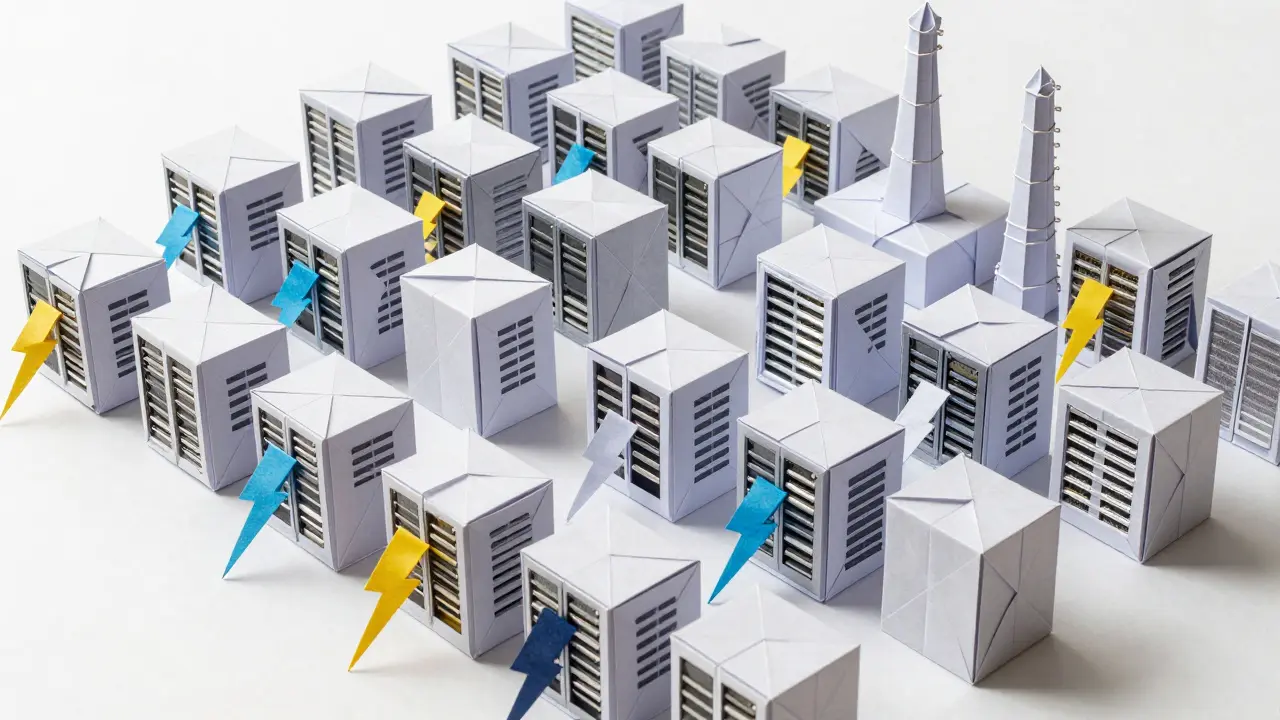
Mining is all about electricity, and Pakistan has a unique advantage. The government has allocated 2,000 megawatts (MW) specifically for Bitcoin mining and AI data centers. They aren't building new plants for this; instead, they're tapping into underutilized coal-based power stations and surplus energy from regions where SMEs have shifted to solar power.
If you're a large-scale operator, the math is exciting. Using modern ASIC miners-the kind that run at 30-40 joules per terahash-this energy pool could push Pakistan to contribute over 60 exahashes per second (EH/s) to the global network. That's enough to potentially put Pakistan in the top five mining hubs globally. But there's a catch: you cannot use residential electricity. PVARA requires commercial facilities to use industrial tariffs with a minimum connection of 500 kW. If you're caught mining on a home connection, you're risking heavy fines and the loss of your license.
Getting Your License: The PVARA Application Process
You can't just plug in a machine and start hashing. To operate legally, you need a license from PVARA. The process is rigorous and designed to keep out bad actors. You'll need to submit a detailed business model that covers your expected hash rate, energy consumption, and security protocols. More importantly, you must prove you follow standards set by the Financial Action Task Force (FATF) and the IMF.
The rollout is happening in two phases:
- Phase 1 (Late 2025): Open to international giants with hash rates over 1 EH/s. To qualify, you usually need an existing license from a recognized global regulator like the SEC in the US, the FCA in the UK, or VARA in the UAE .
- Phase 2 (Early 2026): Open to domestic, small-scale miners with a minimum capacity of 100 PH/s.
For those worried about religious or ethical concerns, PVARA has introduced regulatory sandboxes for Shariah-compliant mining operations, ensuring that the tech aligns with local cultural values.
Taxes and Reporting: What the FBR Wants
The government isn't giving away this infrastructure for free. The Federal Board of Revenue (FBR) has a very clear set of rules for mining income. First, the rewards you mine are treated as regular income. This means you're taxed on a progressive scale:
- Income up to ₨600,000: 5% tax.
- Income over ₨12 million: 35% tax.
If you hold those coins and sell them later for a profit, you're hit with a flat 15% capital gains tax. Every miner is required to report their earnings using Form IT-1 by the September 30 annual deadline. Since mid-2025, PVARA has been sharing transaction data directly with the FBR, so trying to hide your hash rate is a losing game.

Environmental Mandates and Future Hurdles
Pakistan is under pressure from the IMF to ensure that crypto mining doesn't crash the national grid or rely on expensive subsidies. To counter this, PVARA released guidelines requiring mining operations to use at least 70% renewable or repurposed energy by 2027. This is a huge push toward green mining, forcing companies to look at wind and solar integration rather than relying solely on the coal surplus.
Despite the progress, the road isn't perfectly smooth. There's currently a tug-of-war in the government. While the Ministry of Finance currently handles the Pakistan Crypto Council, a Senate committee has suggested moving it to the Ministry of Information Technology. This is mostly a bureaucratic shuffle, but it shows that the country is still figuring out where digital assets fit into the traditional government structure.
Is crypto mining legal in Pakistan in 2026?
Yes, it is legal provided you are licensed by the Pakistan Virtual Asset Regulatory Authority (PVARA) and comply with the Virtual Assets Act 2025. Mining on residential connections remains prohibited.
How much tax do I pay on mined Bitcoin?
Mining rewards are taxed as regular income on a progressive scale from 5% to 35%. Additionally, a flat 15% capital gains tax applies when you sell the mined assets.
Can I use my home electricity for mining?
No. The regulatory framework strictly prohibits the use of subsidized residential rates for mining. All legal operations must use industrial tariffs with a minimum connection of 500 kW.
What is the minimum capacity for a domestic mining license?
Under Phase 2 of the PVARA roadmap, domestic small-scale miners must demonstrate a minimum capacity of 100 PH/s to be eligible for licensing.
Who regulates crypto in Pakistan?
The Pakistan Virtual Asset Regulatory Authority (PVARA) is the autonomous federal regulator responsible for overseeing virtual asset activities and issuing licenses.
Next Steps for Miners
If you're a small operator, your first move should be to audit your current hash rate. If you're anywhere near the 100 PH/s mark, start preparing your technical documentation for the Phase 2 PVARA window. For larger firms, focus on your energy sourcing; if you can prove a transition to 70% renewables, you'll have a much smoother path to approval. Finally, get your tax records in order for the September 30 filing-the FBR is no longer ignoring the blockchain.



Nishant Goyal
Actually a pretty solid move for the region. 🌏
Andrew Southgate
It's really fascinating to see how they're tackling the energy problem by using underutilized coal plants. Most people just complain about the carbon footprint of Bitcoin, but repurposing energy that's already being generated-or would otherwise be wasted-is a brilliant middle ground that allows a developing economy to leapfrog into high-tech infrastructure without immediately bankrupting their residential grid. I've seen similar attempts in other regions, but the scale of 2,000 MW is seriously impressive if they can actually manage the distribution without the whole thing collapsing under its own weight. It's a high-risk, high-reward strategy that could definitely turn them into a global powerhouse if the PVARA keeps things transparent.
Prachi Bhadarge
Sure, it's "regulated" now.
Can't wait for the first massive corruption scandal when someone's cousin gets a PVARA license without actually having a single ASIC miner. Typical.
Anna Grealis
dont trust the PVARA... its probably just a front for the IMF to track evry single transaction and control the flow of money before they switch to a digital currency that they control completely. the 2000mw thing sounds fake too lol.
Shantal Sanjur
Oh please, the "Shariah-compliant" sandboxes are just a marketing gimmick to keep the locals from rioting while the international giants suck the grid dry. It's honestly hilarious that anyone thinks this is about "cultural values" and not just about the 35% tax bracket the FBR is itching to fill.
Robert Preston
For those wondering about the 500 kW minimum, that's basically to ensure you're running a professional operation. If you're trying to do this from your garage, you're just begging for a visit from the authorities. Stick to the industrial tariffs and keep your documentation tight.
Luke George
This is all just a play to bring more foreign influence into the region under the guise of "investment." They want the data centers there so they can monitor the traffic. Classic move by the globalists to institutionalize a decentralized technology.
Trudy Morse
The 100 PH/s minimum for domestic miners is a bit steep, but it makes sense. Quality over quantity.
siddharth narula
It is truly a lamentable state of affairs when the pursuit of material wealth through digital alchemy outweighs the spiritual tranquility of one's soul. 🙄 One must wonder if the 15% capital gains tax is a fair price for such greed.
Sean Douglas
Imagine the absolute CARNAGE when the first power outage hits and a dozen multi-million dollar data centers go dark simultaneously because the grid can't handle a summer heatwave. I can practically smell the burning silicon from here!
Michael Harms
This is such a cool opportunity for local tech talent to actually get into the game legally! It's going to be a great learning curve for a lot of people.
Adam Mann
I really think this could be the start of something beautiful for the local economy. By inviting the big players in Phase 1, they're essentially creating a mentorship environment where the smaller domestic players in Phase 2 can learn the ropes. It's not just about the Bitcoin; it's about building a sustainable infrastructure for the future of the whole country, and the focus on renewables by 2027 shows they're thinking about the planet too, which is just awesome.
Thomas Jewett
Why are we talking about Pakistan's energy when our own US grid is falling apart and we're letting these foreign entities dictate how we handle tech!! its totaly ridiculous that people are excited about a country that barely has stable power for its own peopel to start mining crypto of all things!!
Alex Long
Waste of time. Who cares.
Gillian Kent
Hope everythin goes smooth with the transision to renewabel energy. it would be grate to see a green crypto hub.
Ian Chait
Absolute rubbish. The hash-rate stats are cooked by the PVARA to lure in venture capital. Its a classic pump-and-dump on a national scale, mate. Total poppycock.
Karen Mogollon Gutierrez
The sheer audacity of the FBR to demand 35% of income is simply scandalous! One would think a burgeoning industry would be met with more incentive and less predatory taxation.
Sandeep Bhoir
I'm sure the 70% renewable mandate will be followed strictly... as long as nobody checks the actual meters. 🙄
Tracy Sperandio
This is an absolute game-changer! The sheer vibrancy of this new framework is electrifying! ⚡ Let's get those rigs humming and push the boundaries of what's possible in the region!
Kevin Lư
I mean, it's fine, but honestly, the government is just trying to act like they're modern. They'll probably change the rules again in six months because some politician had a bad dream.
Vicky Duffala
The duality of this is wild. On one hand, we have state-backed industrialization, and on the other, we have the inherent chaos of crypto. It's like trying to put a leash on a hurricane. 🌪️ Still, the potential for economic growth is huge if they don't mess it up!
Gaurav Undirwade
It is imperative that the domestic miners realize that the 100 PH/s requirement is a test of their resolve and financial discipline. Only the disciplined shall prosper.
Ankit Sindhu
If anyone needs help with the technical documentation for Phase 2, feel free to reach out. It's all about presenting a clean business model.
Chintu Parikh
I wholeheartedly agree with the approach to integrate renewables. It is the only sustainable path forward for the industry. 🚀
nathan jones
Interesting shift in policy.
Sandeep Bhoir
Exactly. The bureaucracy usually ignores the actual output as long as the paperwork looks pretty.