
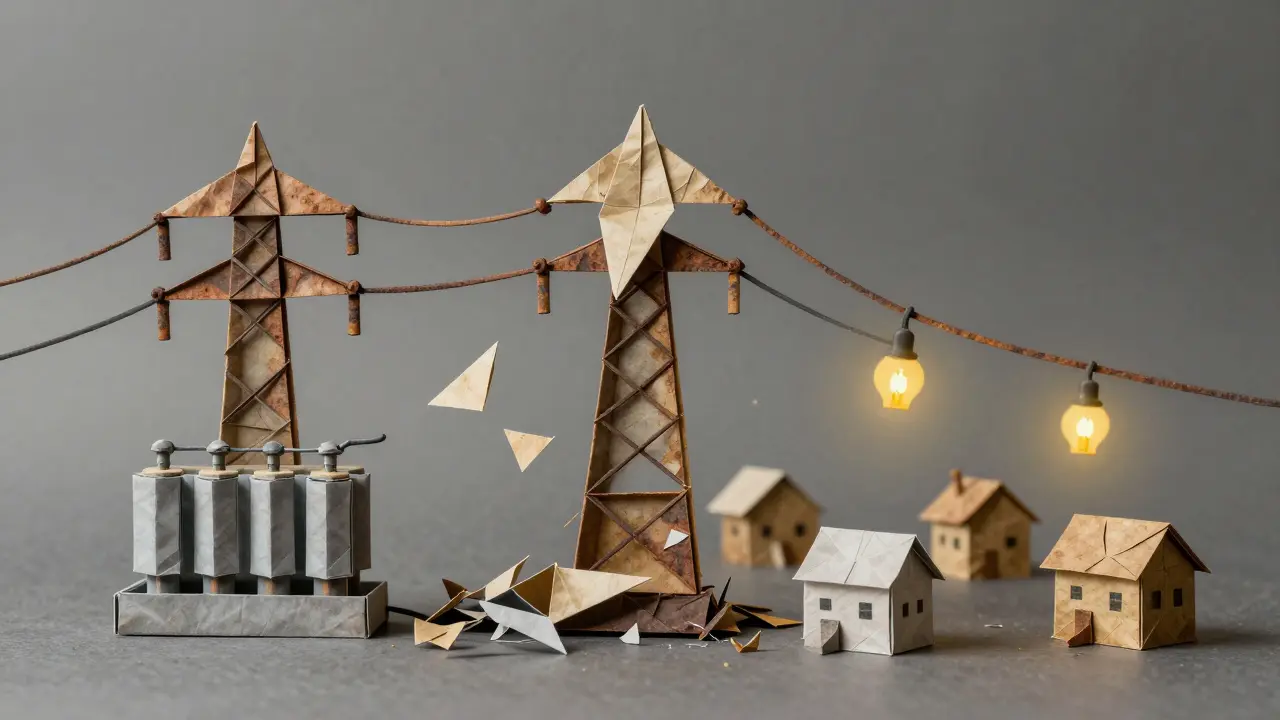
By early 2026, Kazakhstan’s power grid is on the brink. It’s not a future scare-it’s happening right now. Over one-third of the country’s power plants are worn out, some with 90% of their original parts degraded. In rural areas, electricity losses hit 18%, meaning for every five kilowatts sent out, nearly one vanishes before it reaches homes. This isn’t just a technical glitch. It’s a system collapse in slow motion.
Why the Grid Is Failing
Kazakhstan’s electricity system was built for a different era. The Unified Power System (UPS), managed by KEGOC, connects 220 power plants, but many were installed in the 1970s and 80s. Transformers are rusting. Transmission lines are overloaded. In Oral, a city in the north, losses peaked at 18%-far beyond the 10-12% limit that even developing nations consider acceptable. In some regions, losses reached 17.44%. That’s not inefficiency. That’s waste on a national scale.Technical violations jumped from 18,609 in 2022 to over 28,000 in 2023. Even though they dropped slightly in 2024, the trend is clear: the grid is breaking under strain. And it’s not just aging hardware. The system lacks flexibility. Coal plants, which still supply most of the country’s power, can’t ramp up or down quickly. When wind or solar suddenly kicks in, the grid can’t adjust. So instead of using clean energy, they shut it off.
The Renewable Energy Gap
Kazakhstan has the sun. It has the wind. It even has the land. Yet, renewables make up only 6% of total electricity generation. That’s less than half of what countries like Poland or Mexico are achieving today. The government says it’s serious about change. Three 1-gigawatt wind farms are planned. Solar and wind are expected to outpace hydropower this year, and coal by 2025.But here’s the catch: no one can afford to install solar panels on their roof. The laws are good. Net metering is allowed. The rules say households can sell back power. But the upfront cost? $3,000 to $5,000 for a small system. Most families earn less than $500 a month. Without subsidies, grants, or low-interest loans, the policy is just a brochure.
Investments in renewables have hit $2.6 billion-solid, but far behind Uzbekistan’s $6 billion. Without faster funding, Kazakhstan won’t meet its 2030 demand projections. And when demand outpaces supply, blackouts follow.

Crypto Mining and the Energy Crunch
In 2022, Kazakhstan was the world’s second-largest crypto mining hub after the U.S. Bitcoin miners flooded in after China cracked down. They brought rigs. They brought power-hungry ASICs. And they brought a spike in demand that the grid couldn’t handle.By late 2023, miners were using over 1.2 GW of electricity-roughly the same as the entire city of Almaty. During winter, when heating demand peaked, power shortages hit hard. Schools closed. Hospitals ran on backup generators. People in Pavlodar and Kostanay woke up to no electricity because miners had priority access through private agreements with regional utilities.
By early 2024, the government moved. It didn’t ban mining outright. It banned crypto mining from using state-owned grid power. Miners could still operate-but only if they paid for their own generation. No more tapping into public lines. No more siphoning electricity meant for hospitals, schools, or homes.
The result? Thousands of rigs shut down overnight. Mining companies moved to Turkmenistan or Georgia. Others built their own solar farms or co-located with industrial plants that had excess capacity. The grid’s load dropped by nearly 15% in six months. That’s the equivalent of turning off 1.2 million homes.
It wasn’t about targeting crypto. It was about survival. The government didn’t say, “We hate Bitcoin.” It said, “We can’t afford to lose power to a machine that doesn’t feed anyone.”
What’s Being Done Now
The KEGOC 2023-2032 plan is the clearest roadmap yet. Key projects include:- Completing the North-South HVDC Line by 2029-adding 2,000 MW of transmission capacity.
- Unifying the Western Zone into the national grid by 2040.
- Installing smart meters and automated load balancing in 12 major regions.
- Creating a real-time electricity market to match supply and demand within seconds.
These aren’t theoretical ideas. They’re under construction. The North-South line alone will connect coal-heavy southern regions to wind-rich northern ones. It’s the first real step toward a flexible, modern grid.
But progress is slow. Funding is tight. And corruption still lingers. In 2024, a regional utility in Kyzylorda was caught diverting funds meant for transformer upgrades into private accounts. The project stalled. People still lose power every other week.

The Bigger Picture
Kazakhstan’s crisis isn’t unique. It’s a warning. Countries that rely on old, centralized grids while trying to plug in renewables will face the same pressure. Crypto mining didn’t cause the problem-it exposed it. The real issue is infrastructure neglect.When a country lets its power lines rot, and then lets miners plug in without limits, it’s not a free market. It’s a gamble with people’s lives. The ban wasn’t about stopping technology. It was about protecting people.
Now, Kazakhstan has a choice: keep patching the old system, or rebuild from the ground up. The smart meters are being installed. The wind turbines are being ordered. The HVDC line is being laid. But time is running out. By 2030, demand could outstrip supply by 30%. If nothing changes, the lights won’t just go out-they’ll stay off.
What Comes Next
The path forward is clear, but hard:- Fast-track funding for grid upgrades-no more delays.
- Create a national subsidy program for rooftop solar-make it affordable.
- Enforce strict rules: no mining on public grids. Period.
- Link renewable projects directly to industrial zones, not cities.
- Build regional microgrids so one town’s blackout doesn’t take down the whole system.
Kazakhstan doesn’t need to become a crypto powerhouse. It needs to become a country that can keep the lights on. That’s the real challenge.
Did Kazakhstan completely ban cryptocurrency mining?
No, Kazakhstan did not ban crypto mining outright. Instead, in early 2024, the government banned miners from drawing power from the public electricity grid. Miners can still operate-but only if they generate their own power through private solar farms, gas generators, or industrial excess capacity. This move cut grid demand by 15% without eliminating the industry.
How much electricity does crypto mining use in Kazakhstan?
At its peak in late 2023, crypto mining consumed about 1.2 gigawatts of electricity-equivalent to the entire power demand of Almaty, Kazakhstan’s largest city. After the grid restrictions took effect in early 2024, mining-related demand dropped by nearly 40%, freeing up enough power for millions of households.
Why are electricity losses so high in Kazakhstan?
High losses stem from decades of underinvestment. Over one-third of power plants are 70-90% worn out. Transmission lines are outdated, transformers leak power, and metering systems are manual or broken. In some regions, losses hit 18%, meaning nearly one in five kilowatts vanishes before reaching consumers. The national average in 2024 was 17.42%, far above the 10-12% acceptable range.
Is renewable energy helping solve the crisis?
Yes, but slowly. Renewables made up only 6% of generation in 2024. Three 1-gigawatt wind farms are planned, and solar is growing fast. However, most households can’t afford solar panels, and the grid can’t yet store or balance intermittent power. Without modernizing transmission and adding storage, renewables alone won’t fix the crisis.
What’s the North-South HVDC Line, and why does it matter?
The North-South HVDC Line is a high-voltage direct current transmission project connecting wind-rich northern regions with coal-dependent southern ones. It’s set to be completed between 2024 and 2029 and will add 2,000 MW of capacity. This line is critical because it will let Kazakhstan move clean energy where it’s needed most, reducing reliance on coal and preventing blackouts during peak demand.