
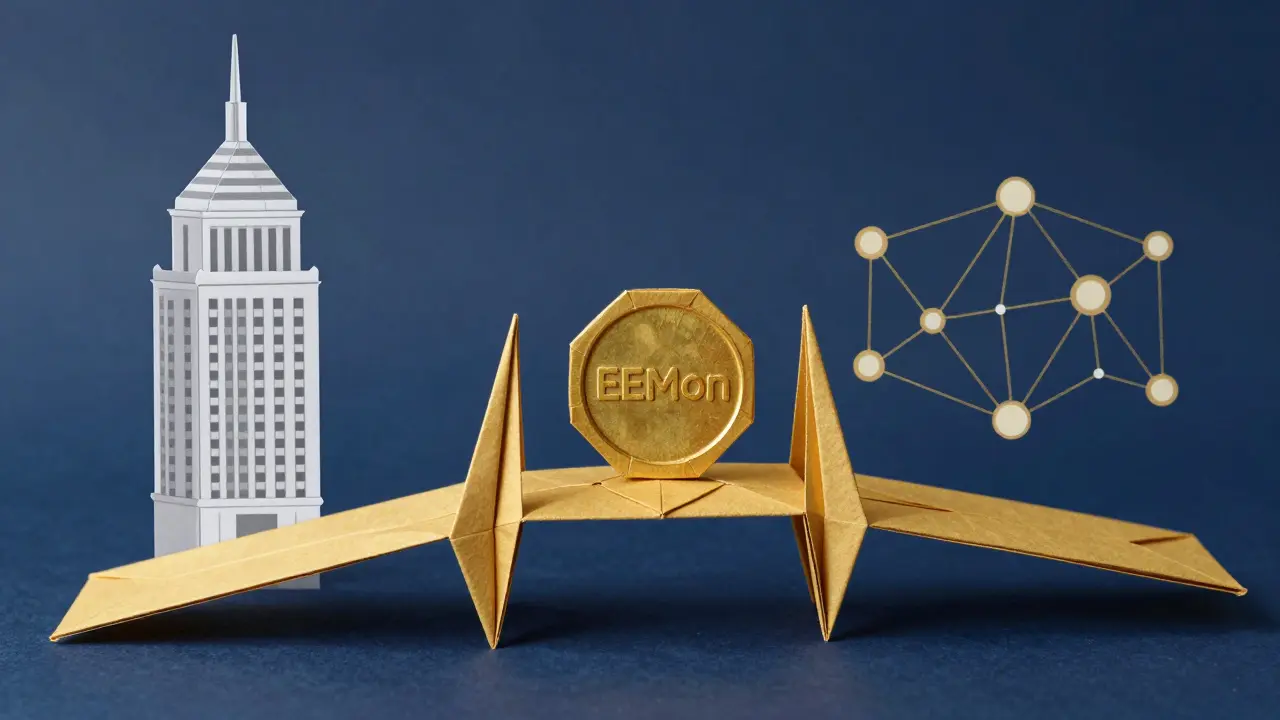
Imagine wanting to invest in a diversified basket of emerging market stocks but finding yourself blocked by regional restrictions, complex brokerage accounts, or slow settlement times. For many non-US investors, accessing high-quality US securities is a headache. This is where EEMon is a blockchain-based tokenized version of the traditional iShares MSCI Emerging Markets ETF (EEM) enters the picture. By wrapping a traditional financial product into a digital token, it bridges the gap between Wall Street and the world of DeFi.
How EEMon Actually Works
At its core, EEMon is created by Ondo Finance , a firm specializing in Real World Assets (RWA). Instead of buying shares of the iShares MSCI Emerging Markets ETF (ticker: EEM) through a traditional stockbroker, you hold a token that tracks its value. This isn't a "bet" on the price; it's designed to maintain a 1:1 economic relationship with the underlying ETF.
When you hold EEMon, you get the same economic exposure as if you owned the EEM ETF directly. A key advantage here is the automatic dividend reinvestment. In the traditional world, you'd see a dividend hit your account and then have to manually buy more shares. With this tokenized version, that process is streamlined within the blockchain infrastructure.
Current Market Stats and Pricing
Since its recent launch on major exchanges around April 8, 2026, EEMon has shown the typical behavior of a niche financial asset. As of April 13, 2026, prices hover around $60.83 to $61.11 depending on where you trade. You'll notice slight differences between platforms like LBank and CoinGecko-this is normal in crypto, reflecting how liquidity varies across different order books.
| Metric | Value |
|---|---|
| Current Price | ~$60.98 USD |
| Market Capitalization | $6.72 Million |
| Circulating Supply | 111.34K EEMon |
| 24h Trading Volume | ~$720.59K |
| Token Holders | 178 |
Who is this coin for?
You probably don't need EEMon if you already have a US brokerage account and can buy EEM with one click. However, it's a game-changer for a few specific groups:
- International Investors: People in countries where accessing US-listed ETFs is legally difficult or administratively exhausting.
- Crypto-Native Portfolios: Investors who want to diversify away from volatile altcoins and into global equities without exiting the blockchain ecosystem.
- Institutional Users: Funds that need the instant minting and redemption capabilities that traditional T+2 settlement cycles can't provide.
Trading and Technical Details
If you're looking to trade, the primary pair is EEMON/USDT. The token recently hit the WEEX exchange, and it's also tracked on LBank and CryptoRank. From a technical standpoint, the project has undergone a security audit by CertiK , which is a standard industry move to ensure the smart contracts aren't riddled with bugs.
One detail to keep in mind is the operational window. While the blockchain never sleeps, the underlying US markets do. EEMon allows for minting and redemption 24 hours a day, five days a week. This is a massive improvement over traditional banking, but you still have to deal with the reality that the NASDAQ and NYSE are closed on weekends.
The Pros and Cons of Tokenized ETFs
Moving a traditional fund onto a blockchain isn't without its trade-offs. You get speed and access, but you lose some of the regulatory familiarity of a standard brokerage account.
On the plus side, the liquidity is impressive. Because it's backed by one of the most liquid ETFs in the world, the token doesn't suffer from the extreme "pump and dump" volatility you see in meme coins. Its price movements are tied to the actual performance of emerging markets-think Brazil, China, and India.
On the downside, there are "additional restrictions" mentioned by Ondo Finance. While they don't list every single one in the public docs, these usually involve KYC (Know Your Customer) requirements to ensure the token isn't being used to bypass sanctions or money laundering laws.
How it compares to traditional investing
If we compare EEMon to buying a standard ETF, the difference is mostly in the "plumbing." The asset (the emerging market stocks) is the same, but the delivery method is different.
- Settlement: Traditional ETFs take days to settle. EEMon settles almost instantly on the blockchain.
- Accessibility: Traditional ETFs require a broker and a bank account. EEMon requires a crypto wallet and an exchange account.
- Dividends: Traditional dividends are paid as cash. EEMon handles this via automated reinvestment, increasing the value or quantity of your holding.
Is EEMon a cryptocurrency or a stock?
It is a tokenized asset. This means it is a cryptocurrency token that represents a claim on the underlying shares of the iShares MSCI Emerging Markets ETF. You are holding a digital proxy for a traditional financial product.
How do I earn dividends with EEMon?
Unlike traditional stocks where you receive a cash payment, EEMon incorporates dividend reinvestment. This means the economic value of the dividends is reflected in the token's structure, effectively growing your investment automatically.
Can I redeem EEMon for the actual ETF?
Yes, Ondo Finance provides minting and redemption functionality. This allows users to move between the tokenized version and the traditional exchange exposure, though this usually requires following specific institutional or retail guidelines provided by Ondo.
Is EEMon volatile?
Compared to typical crypto coins, EEMon is relatively stable. Its volatility is tied to the emerging markets index, not to speculative hype. For example, its weekly range recently stayed within a tight window of about $60.07 to $61.22.
Where can I buy EEMon today?
EEMon is available on several platforms, including WEEX (where it trades as EEMON/USDT) and LBank. It is also tracked and analyzed on platforms like CoinMarketCap and CryptoRank.



EDOZIEM MICHAEL
this is just another way of saying we are digitizing the essence of growth. moving assets to the chain is like moving our souls to a new plane of existence where speed is the only law
Heather Warren
The automated dividend reinvestment feature is a huge plus for anyone looking to compound their gains without the manual hassle. It's a great way to stay diversified!
Samson Selleck
The delta between the tokenized wrapper and the underlying NAV is negligible, yet the counterparty risk introduced by Ondo is a variable that most retail participants are simply too intellectually lazy to quantify. We are seeing a systemic shift toward synthetic exposure where the provenance of the asset becomes secondary to the efficiency of the settlement layer. The marginal utility of a T+0 settlement is profound for high-frequency institutional portfolios, but for the average user, it is merely a shiny wrapper on a legacy index. One must also consider the slippage on platforms like LBank which essentially erodes the theoretical 1:1 peg during periods of high volatility. It is an exercise in financial engineering that prioritizes accessibility over absolute security. The regulatory arbitrage being played here is a fascinating study in the erosion of traditional jurisdictional boundaries. Ultimately, the efficacy of the EEMon token depends entirely on the transparency of the redemption mechanism. Without a rigorous, third-party audited proof-of-reserve, you are essentially trusting a black box with your emerging market exposure. The juxtaposition of DeFi's permissionless nature with the KYC requirements mentioned is a paradoxical contradiction that will either resolve into a new standard or collapse under its own weight. It's a bold move, but the structural vulnerabilities are glaringly obvious to anyone with a basic grasp of quantitative analysis.
Kieran Smith
wow this sounds cool i bet its grate for people who cant get a us bank account!
Alan Seiden
Absolutely typical. We outsource our financial infrastructure to a bunch of blockchain dreamers while the actual markets are run by bureaucrats in New York. Utterly pathetic.
Lela Singh
Such a vibrant way to access global markets! Truly a sparkling opportunity for all!
Amanda Faust
everyone knows RWA is the next big thing and ondo is just doing what everyone else in the valley has been talking about for years
Jessie Tayaban
Omg I can't even believe how slow tradFi is!! Like actually who uses T+2 in 2026?? its literally prehistoric 🙄
Jason Davis
The certik audit is a gud sign but always read the full report beofre buying
Chidinma Sandra okafor
Oh great, another tool to let US investors play with our emerging markets while we do the actual work. So helpful of them.
Omotola Balogun
Actually the liquidity on LBank is quite low compared to the actual EEM fund so the price gap is just basic arbitrage at work.
Prasanna Shembekar
my portfolio is bleeding red and now this comes out i just cant win
Surender Kumar
looks like a solid way to diversify buddy
Artavius Edmond
I'm just vibing with the idea of 24/5 minting. Definitely beats waiting for the bank to open on Monday morning.
Emily H
It is quite prudent to acknowledge that the underlying assets remain subject to the volatility of emerging economies.
Tracie and Matthew Hartley
probly just a scam way to lock up your funds lol
jennelle williams
it feels good to have more doors open for everyone
Mikayla Murphy
It's interesting how this bridges the gap for people who are usually left out of the US system.
Stanly Hayes
Get on board or get left behind! This is how the future of money looks!
Lane Montgomery
Where can I buy this?
logan bates
US securities are the only ones that matter anyway.
Akshay Gorad
A balanced approach to investing is always recommended.
Lauren Abrams
I wonder how the KYC process actually works for the non-US residents.
Rob Mitchell
Just use a hardware wallet for this.
7stargee Emmanuel Obani
Waste of time 🤡
Terrance Hausmann
I really think we should all try to support these new bridges between old and new finance because if we don't collaborate we will just keep fighting the same battles over and over again and never actually progress as a global community.
daniella davis
um actually the market cap is tiny so its basically a ghost town compared to the real EEM lol
Swati Sharma
The liquidity provisioning for these RWA wrappers usually involves complex slippage parameters that require a deep dive into the smart contract's vault logic to truly understand the risk-adjusted return.
Agnessa Dale
This is such a wonderful step forward for global financial inclusion!