
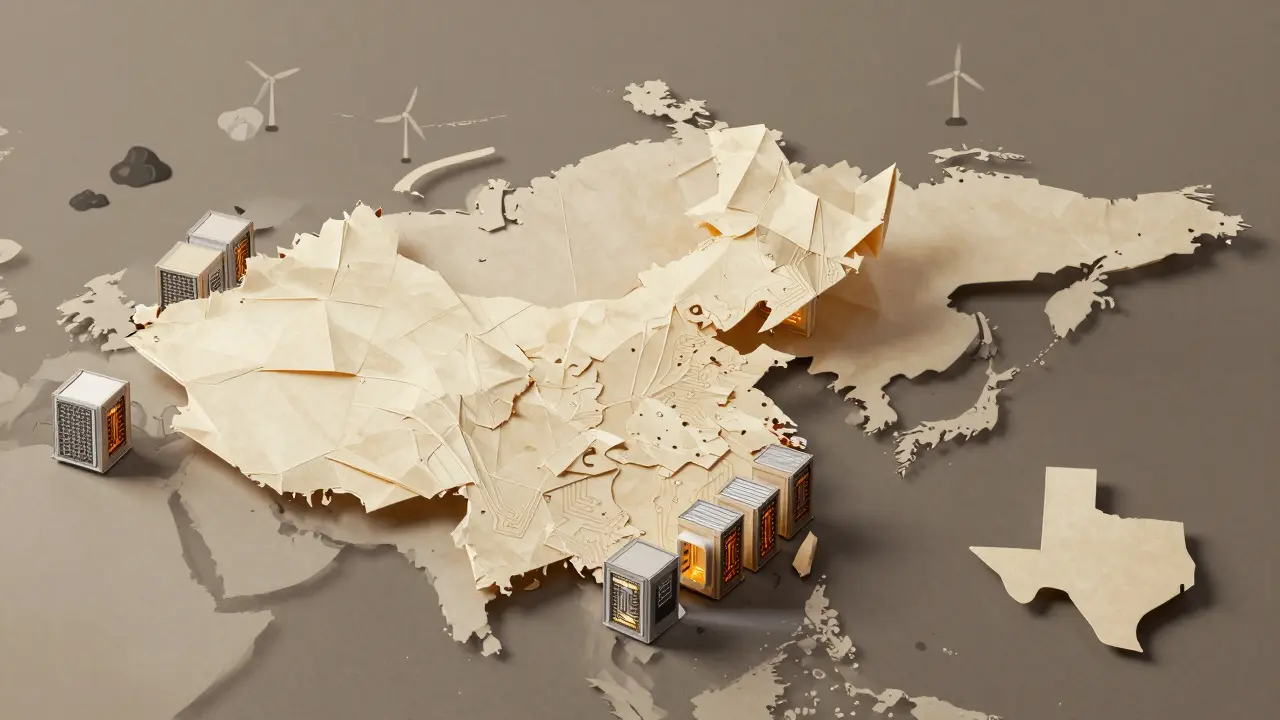
When China shut down Bitcoin mining in 2021, the world’s largest mining operation didn’t just slow down-it vanished. Overnight, more than 75% of global Bitcoin mining power disappeared from one country. But Bitcoin didn’t crash. Instead, it moved. And where it went changed the entire industry.
Why China Banned Mining
China didn’t just discourage crypto mining-it erased it. In 2021, the central government ordered provinces to shut down mining operations, starting with Inner Mongolia, where coal-powered farms were seen as energy waste. Then came the national ban. This wasn’t a slow policy shift. It was a top-down purge. Miners had weeks, sometimes days, to pack up ASIC rigs and leave. No warnings. No grace period. Just a directive from the State Council: stop mining or face penalties.Why? Because China’s energy grid was under strain. Mining operations, often running 24/7, consumed power equivalent to entire countries. In provinces like Xinjiang and Sichuan, miners were using hydropower during rainy seasons and coal power the rest of the year. When the government cracked down, it wasn’t just about controlling crypto-it was about reclaiming energy for industry and households.
The Great Migration Begins
Bitcoin mining equipment doesn’t need roads, factories, or workers. Just electricity and internet. That made it the most portable industrial asset on Earth. ASIC miners-those boxy, fan-heavy machines-could be unplugged, loaded onto trucks, shipped overseas, and reconnected in weeks. Entire farms moved. Some miners flew with their rigs in cargo planes. Others shipped containers across borders.The scale was unprecedented. According to the Cambridge Centre for Alternative Finance, China’s share of global Bitcoin mining dropped from 75.5% in September 2020 to 46% by April 2021. In six months, more than half the world’s mining power left one country.
Kazakhstan: The Unexpected Winner
Kazakhstan didn’t advertise for miners. It just had what they needed: cheap electricity, lots of coal, and no rules.Before the crackdown, Kazakhstan accounted for just 1.4% of global Bitcoin mining. By April 2021, that jumped to 8.2%. By October, it surpassed China in total mining capacity. Why? Its power grid was underused. Mines in the north, near coal plants, could absorb massive new loads. Local governments didn’t ask questions-they welcomed the investment.
Miners from Inner Mongolia and Shanxi moved north. Entire data centers were rebuilt from scratch. Some operations were set up in former Soviet-era factories. Others used repurposed warehouses. Within months, Kazakhstan became the third-largest mining hub, behind only the U.S. and Russia. It wasn’t glamorous. But it worked.
Texas: The U.S. Hotspot
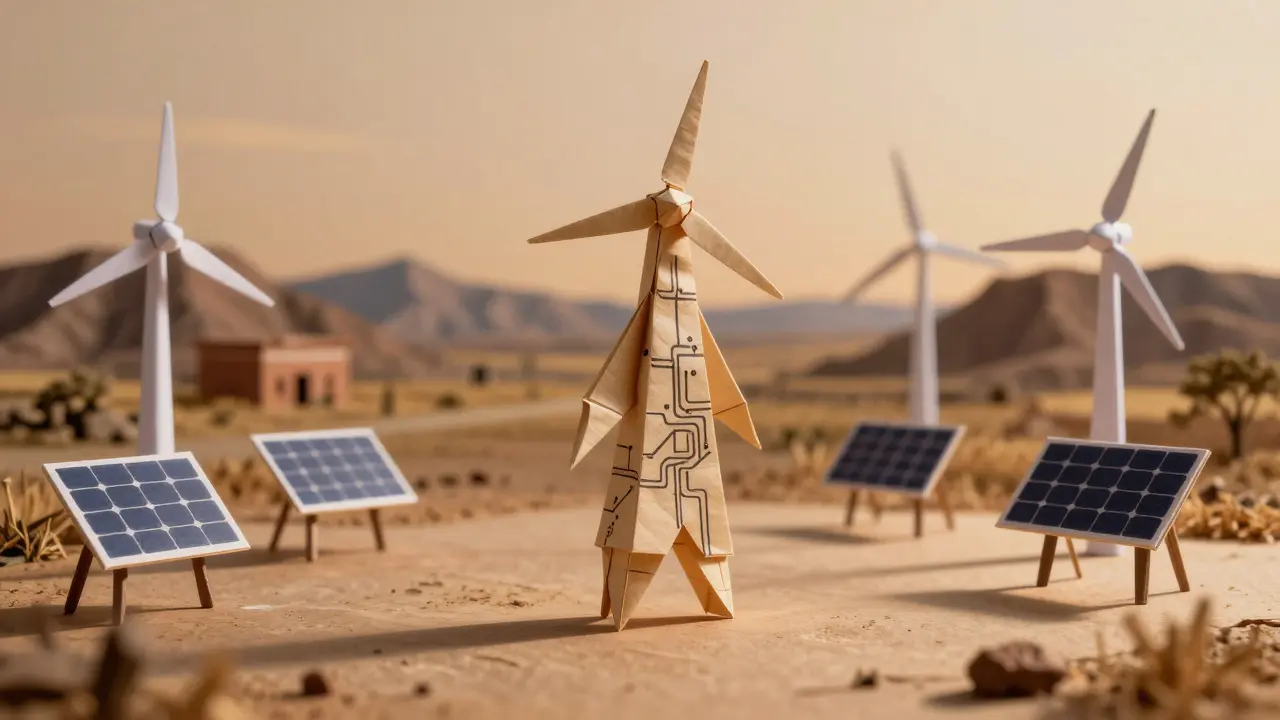
While Kazakhstan relied on coal, Texas leaned on wind and solar.The state’s deregulated energy market let miners negotiate directly with power providers. No middlemen. No fixed rates. Some miners locked in deals as low as $0.02 per kWh-cheaper than in most parts of the world. Wind farms in West Texas, which often produced more power than the grid could use, began selling surplus energy directly to mining farms. Solar farms in South Texas did the same.
By 2023, Texas hosted about half of all Bitcoin mining in the U.S.-roughly 2.6 gigawatts of power. That’s more than the entire country of Germany used for mining. Mining companies built new facilities in places like Abilene, Fort Worth, and Houston. Some even partnered with local utilities to stabilize the grid. When Texas had blackouts in 2021, miners reduced power use during peak hours. That helped prevent total grid collapse.
It wasn’t just about cost. Texas passed laws protecting crypto mining. Governor Greg Abbott signed bills that banned local governments from banning Bitcoin mining. That sent a clear message: if you want to mine, come here.
Other Destinations: Russia, Iran, and Beyond
Russia quietly became the fourth-largest mining nation. It had surplus power from Siberian hydro plants and low labor costs. Miners from China moved across the border into Kazakhstan and then deeper into Russia. Some operations were hidden in remote industrial zones. Others were openly licensed.Iran, despite U.S. sanctions, saw a surge in mining. Its government even started subsidizing electricity for miners. By 2022, Iran was mining more Bitcoin than Canada. But it came with risks-blackouts, internet shutdowns, and sudden policy changes.
Other countries tried. Georgia, Sweden, and Canada all saw spikes in mining activity. But none matched the scale of Kazakhstan or Texas. Why? Infrastructure. Power. Stability. Miners didn’t just want cheap electricity-they wanted it reliable, legal, and scalable.
What Happened to the Equipment?
The physical move was staggering. Thousands of tons of ASIC miners were shipped out of China. Some were transported by rail through Central Asia. Others flew on cargo planes. A few were even smuggled across borders in trucks.Not all equipment survived. Some rigs broke during transit. Others were too old to be worth moving. Many miners simply sold their gear at fire-sale prices. Used ASICs from China flooded markets in Eastern Europe and Southeast Asia. A single Antminer S19 could drop from $4,000 to $800 in a week.
But the ones that made it? They’re still running. In Kazakhstan, Texas, and beyond. The same machines that once lit up the night in Inner Mongolia now hum in warehouses in Abilene and Almaty.
Did the Network Get Stronger?
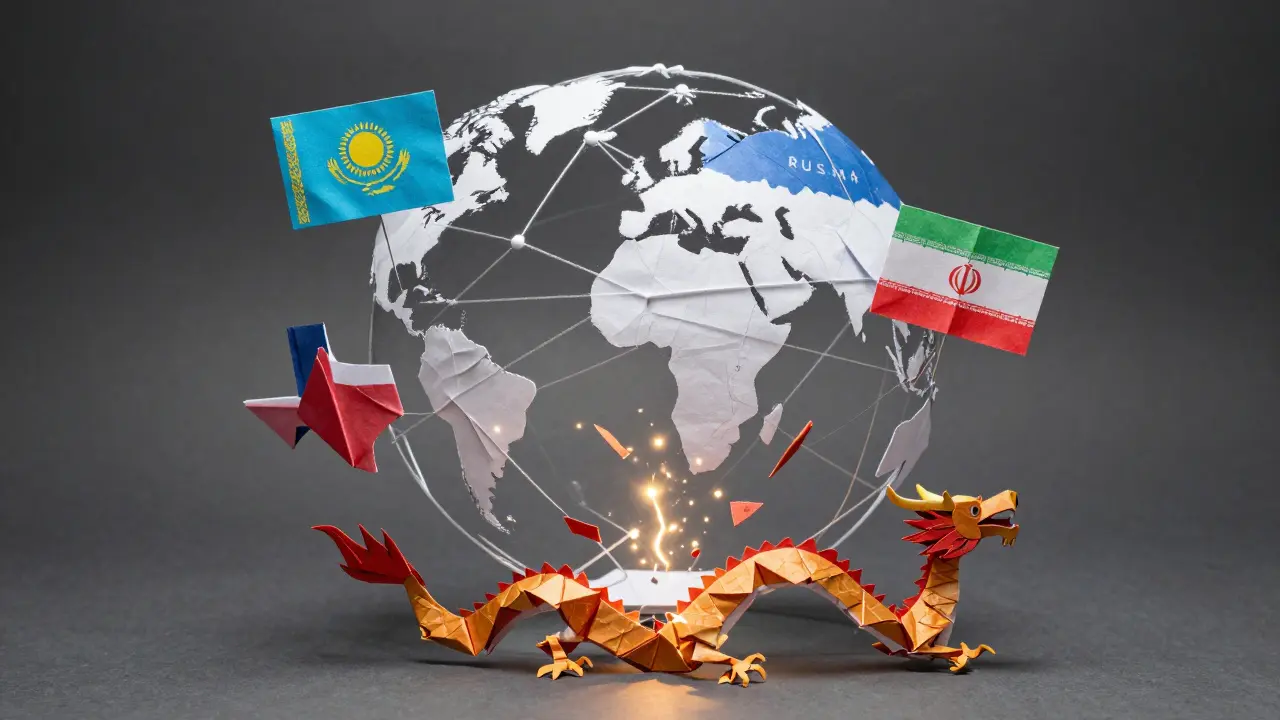
Yes. And that’s the real story.Before 2021, Bitcoin’s network was dangerously centralized. Over 75% of mining happened in one country. That meant if China shut off power-or decided to censor the network-it could have crippled Bitcoin.
After the exodus, mining became distributed. No single country held more than 20% of the hashrate. The U.S. and Kazakhstan together held about 35%. Russia, Iran, and Canada split the rest. That made Bitcoin more resilient. If one region had a blackout, a policy change, or a war, the network kept going.
It also made Bitcoin more decentralized in practice-not just in theory.
What’s the Long-Term Impact?
The Chinese exodus didn’t just move mining-it redefined it.Miners now plan for regulation. They don’t just look for cheap power. They look for stable laws. They choose states and countries with clear rules, not hidden crackdowns. Texas is a model. Kazakhstan is a gamble. Canada is safe but expensive.
Energy providers now design grids with mining in mind. Wind farms in Texas and hydro plants in Kazakhstan are built with mining loads in mind. Some even offer “mining-only” power contracts.
And the trend continues. New mining hubs are popping up in Paraguay, Finland, and even parts of Africa. The lesson? Bitcoin mining doesn’t care about borders. It only cares about power, policy, and price.
Is China Still Mining?
A little. But not like before.China’s mining share is now below 10%. Some operations are still running underground-small, scattered, and hidden. But the big farms? Gone. The government hasn’t reversed the ban. And miners who stayed? Most were arrested or fined.
The Chinese mining era is over. What replaced it? A global network. One that’s more spread out, more resilient, and more unpredictable.
Why did Bitcoin miners leave China?
Bitcoin miners left China because the government banned mining nationwide in 2021. Provincial bans started earlier, especially in coal-heavy regions like Inner Mongolia, but the central government’s crackdown was sudden and total. Miners had no legal protection, and power to their facilities was cut off. With no way to operate legally, they had to move.
Where did most Chinese miners go?
The majority went to Kazakhstan and the United States, especially Texas. Kazakhstan saw its mining share jump from under 2% to over 8% in less than a year. Texas became the largest mining hub in North America, hosting nearly half of all U.S. mining capacity. Smaller numbers went to Russia, Iran, and Canada.
Why was Texas so attractive to miners?
Texas offered low electricity prices, a deregulated energy market, and laws that protected mining. Miners could buy power directly from grid operators and even use surplus renewable energy from wind and solar farms. Some utilities even offered special rates for mining operations. Plus, the state government actively supported crypto mining, making it one of the few places in the world with legal clarity.
Did the Bitcoin network get weaker after China’s ban?
No. The network actually got stronger. Before the ban, over 75% of Bitcoin mining happened in China, making it a single point of failure. After miners relocated, the network became more distributed. No single country controls more than 20% of mining power now. This made Bitcoin more resilient to regional power outages, policy changes, or geopolitical risks.
Can Bitcoin mining move again like this?
Yes. Bitcoin mining equipment is designed to be portable. ASIC miners can be unplugged, shipped, and reconnected in weeks. If another country bans mining-or raises electricity prices-miners will move again. The industry now plans for this. Locations with stable laws, cheap power, and grid capacity are the new targets.




Ryan Burk
Texas ain't no savior. They're just letting miners burn through power like it's free. Meanwhile, real people get blacked out during heatwaves. This isn't innovation-it's exploitation dressed up as freedom.
Reggie Fifty
You think Kazakhstan is better? Their grid runs on coal from the 1970s. At least Texas uses wind. You're just mad because you don't own ASICs and you're jealous.
Kaitlyn Clark
I love how this whole thing just... moved like water. 💫 Miners didn't ask for permission, they just found where the juice was. Texas wind farms? Pure genius. 🌬️⚡
Tabitha Davis
I'm telling you, this is the most dramatic thing to happen to crypto since Satoshi vanished. Like, imagine your whole life's work-poof-gone. Then boom, you're in a warehouse in Abilene with 3000 rigs and a cowboy hat. Pure cinema.
Amanda Markwick
The real win here isn't where they went-it's that Bitcoin survived. Before 2021, it was one country holding the whole network. Now? It's spread out like a decentralized web. That's not luck. That's resilience.
Sriharsha Majety
India should do this too. We got so much solar and so many people who just want to earn. Why are we letting others take this? We could be the next big hub
Vishakha Singh
The shift demonstrates remarkable adaptability of decentralized systems. It also highlights the importance of regulatory clarity and infrastructure investment. Nations that prioritize energy stability will lead the next phase of digital asset mining.
Don B.
I mean, who even cares? Miners are just rich dudes with fans. We could’ve used all that electricity for hospitals. Now it’s just powering a bunch of boxes that make numbers go up.
Neeti Sharma
China was right. Mining is a waste. All this energy for a digital ghost? We should’ve shut it down everywhere. Now we got Texas and Kazakhstan running on fossil fuels like it’s 1999. Pathetic.
Nadia Shalaby
I just think it’s wild that a bunch of machines can move across continents like that. Like, imagine packing up your whole house and relocating it to another country. That’s what these miners did.
Fiona Monroe
The structural transformation of Bitcoin's mining landscape constitutes a paradigm shift in decentralisation theory. The geographical dispersion of hashpower, coupled with regulatory divergence, has significantly enhanced network security. This is not merely logistical-it is systemic.
Maggie House
I never thought about how wind farms could sell excess power to miners. That’s actually kinda beautiful. Like, nature’s leftover energy gets put to work. I love that.
Dianna Bethea
The real story is how fast this happened. One day you're in Inner Mongolia, next week you're in a shipping container in Kazakhstan. No paperwork. No permits. Just plug in and go. That’s the spirit of crypto right there. No bureaucracy. Just raw, unfiltered hustle.
KingDesigners &Co
China banned mining because they’re scared. They know Bitcoin can’t be controlled. That’s why they panicked. And now? The world’s got proof that crypto doesn’t need governments to survive.
Felicia Eriksson
I just feel happy for the miners. Imagine losing everything overnight. Then finding a new home where people actually welcome you. That’s a real win.
aaron marp
The move to Texas wasn’t just about cheap power. It was about legal clarity. You can’t build a business on a promise. You need laws. Texas gave miners a foundation. That’s why it worked.
Patrick Streeb
The decentralisation of mining power represents a profound evolution in the resilience of peer-to-peer networks. It is a textbook case of emergent adaptability in the face of centralized suppression.
Phillip Marson
They call it mining but it’s just burning electricity to make digital gold for billionaires. Meanwhile, my electric bill doubled. I don’t get why we’re celebrating this like it’s a victory. It’s not. It’s a power grab.
Tracy Whetsel
I think the most beautiful part is how it all just... rearranged itself. No one planned it. No one led it. It just happened because people needed to keep going. That’s what makes crypto real. Not the tech. The people.
Elana Vorspan
It’s wild to think that the same machines that used to light up a coal town in China are now humming under solar panels in Texas. Kinda poetic, honestly. 🌞⛏️
Ryan Burk
You’re all just ignoring the fact that Texas is building more coal plants to keep up. This isn’t clean energy. It’s just a different kind of exploitation.