
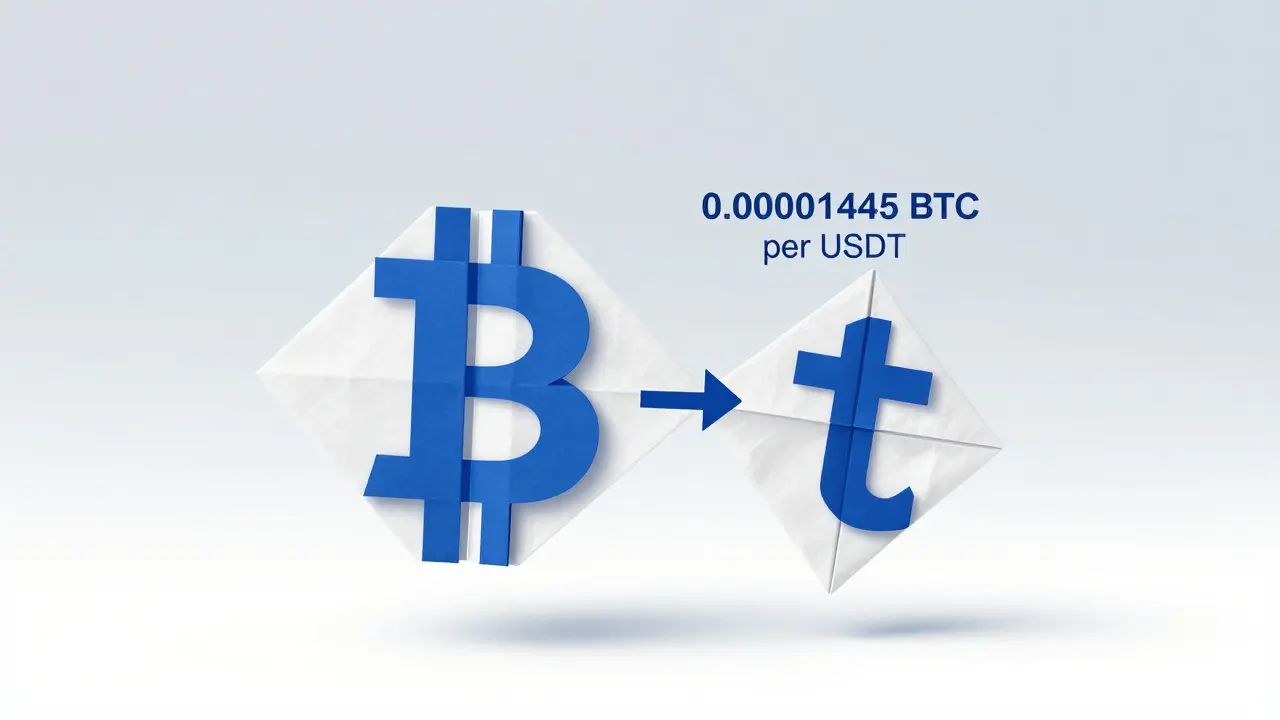
When you first open a crypto exchange like Binance or Coinbase, you’ll see a long list of pairs like BTC/USDT, ETH/BTC, or ADA/USDC. At first glance, it looks like gibberish. But once you understand how these pairs work, trading becomes a lot clearer-and a lot less risky.
Every crypto trading pair tells you one simple thing: how much of one cryptocurrency you need to buy one unit of another. It’s not about dollars or euros. It’s about crypto-to-crypto value. If you don’t get this right, you could accidentally sell when you meant to buy-or end up owning way more-or way less-than you thought.
What’s the Base Currency and What’s the Quote Currency?
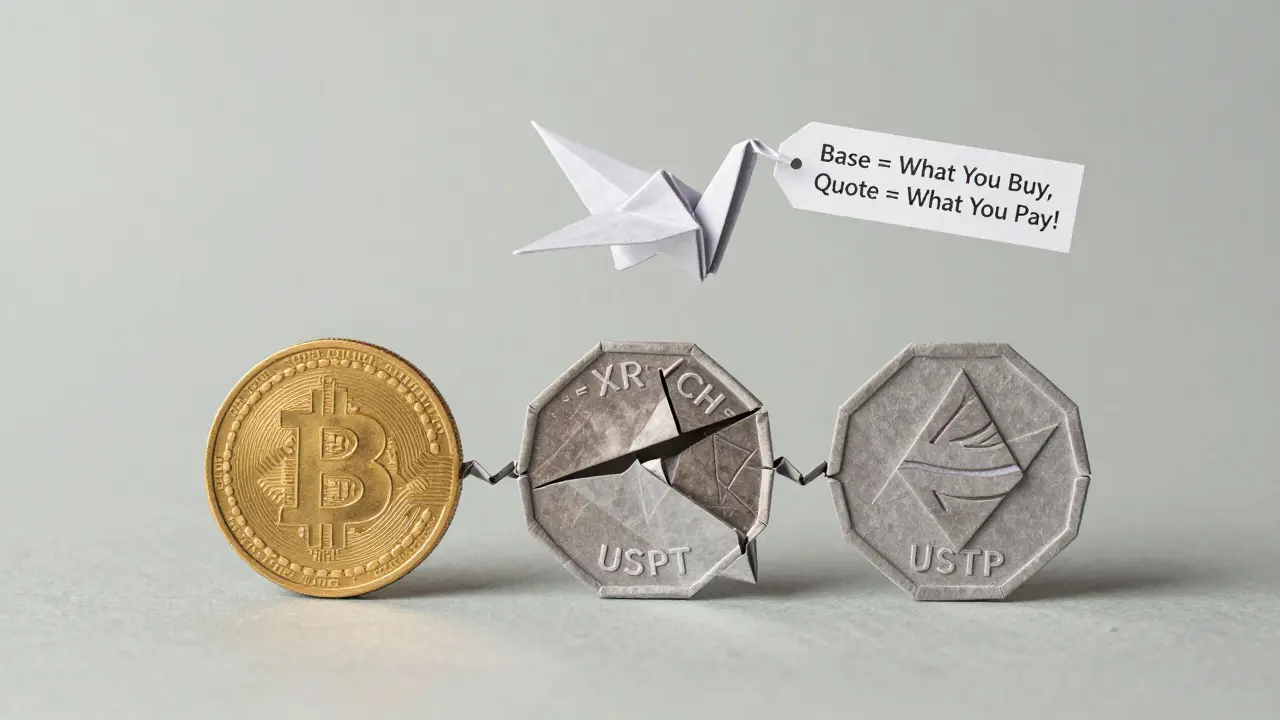
Every trading pair has two parts: the base currency and the quote currency.
- The base currency is the first one listed. This is what you’re buying or selling.
- The quote currency is the second one. This is what you’re using to pay for it.
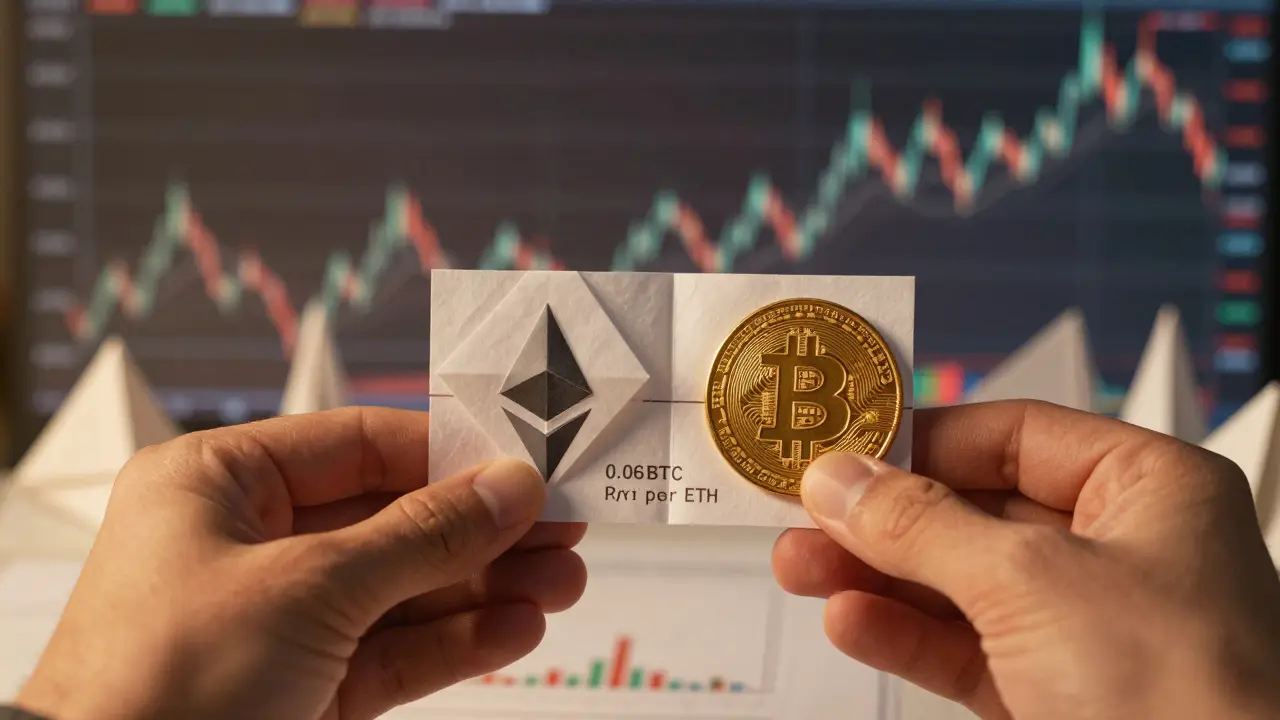
Take ETH/BTC as an example.
If the price is 0.06 BTC, that means: you need 0.06 Bitcoin to buy 1 Ethereum.
So if you click “Buy” on ETH/BTC, you’re giving up BTC to get ETH. If you click “Sell,” you’re giving up ETH to get BTC.
This trips up a lot of new traders. People assume the first coin is the “main” one, so they think buying ETH/BTC means they’re buying BTC. It doesn’t. The base currency (ETH) is what you’re getting. The quote currency (BTC) is what you’re spending.
Why Does This Matter?
Getting this wrong can cost you money-fast.
One trader in Auckland, who goes by u/CryptoNewbie2023 on Reddit, lost $127 in their first week because they thought BTC/USDT meant “how many USDT you get for one BTC.” In reality, it means “how many USDT you need to buy one BTC.” So when they tried to buy BTC, they ended up selling it instead.
That’s not rare. Coinbase’s own support data from Q4 2024 shows that 28% of beginner tickets were from people who clicked “Buy” when they meant to “Sell.”
Understanding the pair notation also helps you avoid bad trades. If you see a pair like LTC/BCH and you don’t know which one you’re buying, you’re gambling. Most of the time, you’ll get stuck with a coin you didn’t want because you didn’t know how the pair worked.
What Are the Most Common Trading Pairs?
Not all pairs are created equal. Some have tons of buyers and sellers. Others? Barely any.
Here are the top five most traded pairs as of early 2026:
- BTC/USDT - Bitcoin vs Tether. This is the #1 most traded pair globally. Over 34% of all crypto trading volume happens here.
- ETH/USDT - Ethereum vs Tether. The second most popular.
- BTC/USDC - Bitcoin vs USD Coin. Gaining ground because USDC is more regulated than Tether.
- ETH/BTC - Ethereum vs Bitcoin. Used by traders who want to move between the two biggest coins without touching stablecoins.
- BTC/USD - Bitcoin vs US Dollar. Only available on regulated exchanges like Coinbase and Gemini. Less common since many exchanges dropped fiat pairs.
Stablecoin pairs (USDT, USDC, DAI) are the safest for beginners. Why? Because their value doesn’t swing like Bitcoin or Ethereum. If you’re just learning, stick with BTC/USDT or ETH/USDT. They’re liquid, stable, and easy to understand.
What About Other Pairs Like ETH/ADA or SOL/USDC?
These are called “altcoin pairs.” They let you trade one smaller coin for another.
But here’s the catch: low volume = high risk.
Take XRP/BTC. If the price is 0.000045 BTC, that means you need 0.000045 Bitcoin to buy 1 XRP. Sounds fine. But if only 50 people are trading it right now, the price can jump 10% in seconds because one person buys 10,000 XRP. That’s called slippage. You think you’re buying at $0.20, but you end up paying $0.22 because the market is thin.
Compare that to BTC/USDT, where millions trade daily. Slippage? Almost zero. Price moves slowly. You get what you see.
Blockworks Research’s 2025 survey found that 64% of traders avoid pairs like LTC/BCH because they don’t know which coin is the base or quote-and they don’t trust the price.
How Do Exchanges Show These Pairs?
Most exchanges use the same format: BASE/QUOTE.
But not all.
Kraken sometimes shows USDT/BTC instead of BTC/USDT. That’s the same pair, just flipped. It’s still “how much USDT to buy one BTC,” but now the quote currency is first. Confusing? Yes. That’s why 42% of users switching from Binance to Kraken say they almost made a mistake.
Some exchanges even show the price as “BTC per USDT” instead of “USDT per BTC.” That’s backwards. It’s the same math, but your brain has to flip it. It’s like reading a map upside down.
That’s why Gemini announced in February 2025 they’re testing “dual notation.” Now, when you look at BTC/USDT, you’ll see both:
- BTC/USDT: 69,200 (how many USDT to buy 1 BTC)
- USDT/BTC: 0.00001445 (how much BTC you get for 1 USDT)
This cut trading errors by 27% in their pilot. More exchanges will likely follow.
What About Decentralized Exchanges (DEXs)?
On Uniswap or SushiSwap, you don’t see “BTC/USDT.” You pick a token and then pick what you want to swap it for.
But behind the scenes, it’s still the same math. If you swap 1 ETH for 0.05 BTC, you’re trading ETH (base) for BTC (quote). The interface hides the notation-but the logic hasn’t changed.
Some DEXs use new formats like BTC.BTC/ETH.USDC to show which blockchain each asset is on. It’s useful for cross-chain trading, but it’s confusing for 89% of new users. Most still stick to simple pairs like ETH/DAI.
How Long Does It Take to Learn This?
It doesn’t take long.
CoinTracker’s 2025 study of 5,000 new traders found that most people get it after about 17.3 hours of active trading. That’s less than two full days of watching prices and placing small trades.
Here’s how to speed it up:
- Start with BTC/USDT. Trade $10 worth. Buy. Sell. Buy again. Watch what happens to your balance.
- Then try ETH/USDT. Same thing.
- Next, try ETH/BTC. Now you’re trading one crypto for another. See how the price changes.
- Use the “Buy” and “Sell” buttons. Don’t just guess. Watch what your wallet does after each trade.
YouTube videos help. So do exchange tutorials. But nothing beats doing it yourself-even if you lose a few dollars. You’ll remember it forever.
What Are the Big Mistakes People Make?
Here are the top three errors, based on exchange support data:
- Mixing up base and quote - Thinking “BTC/USDT” means “how much BTC you get for USDT.” Nope. It’s “how much USDT to buy one BTC.”
- Trading illiquid pairs - Buying XRP/BCH because it’s cheap. Then you can’t sell it. No one’s trading it.
- Ignoring liquidity - If a pair has low volume, the price can swing wildly. You think you’re getting 0.00004 BTC per XRP, but the next trade is at 0.00006. You just lost 50% in seconds.
And here’s the scary part: traders who understood pair notation had 22.3% higher returns on average than those who didn’t, according to the Crypto Fear & Greed Index 2023 report.
What’s Next for Trading Pairs?
The system isn’t perfect. But it’s getting better.
Binance Labs is working on a “Crypto Pair Schema” that will add real-time data to each pair: volatility, liquidity, regulatory status. Imagine seeing “High Liquidity | Low Volatility | Regulated” right next to BTC/USDT.
By 2029, Gartner predicts 65% of pairs will show live liquidity numbers right in the notation. That could cut settlement errors by 43%.
But experts warn: don’t overcomplicate it. 89% of professional traders still prefer the simple BASE/QUOTE format. It’s clean. It’s mathematical. It works.
As long as you remember: the first coin is what you’re buying. The second coin is what you’re paying with-you’ll be ahead of 70% of new traders.




Marc Morgan
Honestly? This is the clearest guide I've seen. I lost $80 on my first trade because I thought BTC/USDT meant I was buying BTC with USDT. Turns out I was selling BTC. Rookie move. Now I just stare at the pair like it's a map and remember: first coin = what you get. Second = what you give. Simple.
Anastasia Thyroff
I just bought 5000 XRP/BCH because it was cheap and now I can't sell it and my wallet is full of ghost coins and I think I'm cursed
Kira Dreamland
This is so helpful. I started with ETH/USDT and it made everything click. I didn't even know what base and quote meant until I read this. Now I feel like I'm not just gambling anymore. Also, stablecoins are life savers. Don't touch altcoin pairs until you've done 10 trades on USDT pairs. Trust me.
shreya gupta
I must say, your explanation is both accurate and pedagogically sound. However, I must point out that the term 'quote currency' is not universally standardized across jurisdictions. In some emerging markets, the convention reverses due to local regulatory interpretations. You may wish to include a footnote on this nuance.
Derek Lynch
You're doing amazing work here. Seriously. This is the kind of content that saves people from losing their rent money. I've mentored 12 new traders this month and I point them all here. If you're reading this and still confused: start with $5 on BTC/USDT. Buy. Sell. Buy again. Do it 3 times. Then come back and tell me you didn't get it. I dare you.
Shreya Baid
Thank you for taking the time to write this with such clarity. As someone who has helped dozens of young traders in India navigate these confusing pair notations, I can confirm that the base/quote distinction is the single most overlooked concept. I often use the analogy: 'Think of it like ordering coffee. You're not buying the cup-you're buying the coffee. The cup is what you pay with.' It sticks.
Christopher Hoar
Lmao this guide is so basic. Like duh the first coin is what you get. I've been trading since 2017 and even I had to laugh at how much newbs overcomplicate this. Its just math. 1 ETH = 0.06 BTC. If you click buy on ETH/BTC you're giving BTC for ETH. No magic. No conspiracy. Just numbers. Also stop using USDT. Use USDC. Tether is sketchy.
Robert Kunze
I just wanna say thank you. I was about to give up on crypto because I kept messing up buys and sells. I read this and then tried it with $20. Bought ETH/USDT. Sold it. Bought again. It clicked. I didn't even know I was confused until I saw this. Now I'm making small profits. Not rich. Just not broke. That's win enough for me.
Sarah Zakareckis
Liquidity is the silent MVP here. Pair notation is step one. Liquidity awareness is step two. Volatility is step three. If you're trading pairs under 50M daily volume, you're not trading-you're playing Russian roulette with your portfolio. Stick to BTC/USDT, ETH/USDT, BTC/USDC. That's the holy trinity. Everything else is a lottery ticket with extra steps.
Heather James
I used to think BTC/USDT meant I got BTC for USDT. Now I know it's the opposite. I lost $120. Learned the hard way. Thanks for the clarity. No more guessing.
Sarah Hammon
This is so well written. I shared it with my sister who just started trading. She said it made her feel less stupid. That's a win. One thing I'd add: always check the order book depth before trading any pair. Even if you know the notation, a thin order book can still trap you. I learned that the hard way with SOL/USDC. Price jumped 8% in 3 seconds. Not fun.
iam jacob
I hate how everyone acts like this is some deep secret. It's not. It's basic math. And yet here we are, 2026, and people are still confused. I feel like I'm watching toddlers try to use a microwave. Also, why are we still using USDT? It's 2026. Tether is a joke. Use USDC. Or DAI. Or just stop trading.
Jesse Pals
This is gold 🙌 I was about to trade LTC/BCH because it was under $1. Now I know that's like trying to buy a used toaster with Monopoly money. I'm sticking to BTC/USDT. And yes, I'm using emojis now. Sorry not sorry.
Diane Overwise
I appreciate the effort. However, I must note that the cultural context of currency perception varies significantly. In some Asian markets, the quote currency is psychologically perceived as the 'primary' asset. This may explain why 42% of users switching exchanges make errors. It's not ignorance. It's cognitive framing. Perhaps a cultural footnote would enhance this guide.
Dionne van Diepenbeek
I thought ETH/BTC meant I was buying BTC with ETH but now I know I was wrong I just lost 300 dollars but thanks for the guide
Graham Smith
The entire premise is flawed. You're assuming traders care about notation. In reality, they care about arbitrage opportunities, MEV, and cross-chain liquidity. Pair notation is a beginner's toy. Real traders use API endpoints, not GUIs. If you're still using 'buy/sell' buttons, you're not trading-you're performing a ritual.
Katrina Smith
Oh wow. So BTC/USDT means you give USDT to get BTC? Shocking. I thought it meant you give BTC to get USDT. I guess I'm just a moron. Or maybe the notation is just dumb. Why not write it as 'BTC for USDT'? Simple. Clear. No confusion. But no. We need to make it a puzzle. Classic crypto.
Bruce Doucette
You're still using USDT? Bro. Tether is a shell company with a bank account in the Caymans. USDC is regulated. DAI is decentralized. BTC/USDT is the trading pair of people who don't care about risk. You're not a trader. You're a tourist. Also, why are you teaching people to trade? You're gonna get someone killed.
Marie Vernon
I'm from the Philippines and I just showed this to my cousin who works at a local exchange. She said this is the first time someone explained it in a way that doesn't make people feel dumb. That matters. Especially here. Thank you for not talking down to us. We're not stupid. We just didn't have someone say it plainly.
Ross McLeod
The issue here isn't the notation. It's the entire paradigm of centralized exchanges. The base/quote model is a relic of 2017. In a truly decentralized ecosystem, you don't have pairs-you have liquidity pools. The very notion of 'BTC/USDT' is an artifact of legacy finance. We're still using horse-drawn carriages while the future is flying cars. The fact that 28% of tickets are from mis-clicks proves the UI is fundamentally broken. We need atomic swaps. We need tokenized order books. We need to move beyond this. This guide is helpful, but it's a bandaid on a hemorrhage.
rajan gupta
The universe is a trading pair 🌌 BTC/USDT is just one manifestation of duality. Yin and yang. Buy and sell. Ether and fire. The base is the soul. The quote is the body. When you trade, you are not exchanging coins-you are aligning your karma with the blockchain. I meditated for 7 days on ETH/BTC and now I feel enlightened. Also, I bought 1000 XRP. It's gonna moon. 🚀
Billy Karna
I've been doing this for 8 years. Here's what no one tells you: the notation is only half the battle. The real trap is the price display. Most exchanges show the price as 'USDT per BTC' but the order form says 'Buy BTC'. So you think you're buying BTC at 69,200 USDT. But if the market is moving fast, the actual fill price might be 69,300. That 100 USDT difference? That's slippage. And it's not always visible. Always check the depth chart. Always. I lost $2k once because I didn't. Don't be me.
Cheri Farnsworth
I must commend the precision of this exposition. The delineation between base and quote currency is not merely a technicality-it is a foundational principle of asset valuation in distributed ledgers. Furthermore, the empirical data cited from CoinTracker and Blockworks Research substantiates the pedagogical efficacy of this framework. One might argue that the persistence of misinterpretation among novice traders reflects a systemic failure in financial literacy infrastructure. This document serves as a vital corrective.
Gene Inoue
You're all so naive. This guide is for people who still think crypto is about 'making money'. It's not. It's about power. Control. Who owns the ledger? Who controls the liquidity? If you're still using USDT, you're a pawn. If you're still trading pairs on Binance, you're a data point. Real traders don't read guides. They exploit gaps. And if you don't understand the difference between base and quote? You're not even on the board. You're the board.
Arlene Miles
I've been thinking about this differently. What if the notation isn't meant to be understood? What if it's designed to be confusing? To filter out the weak? The people who stick with BTC/USDT and learn it? They're the ones who survive. The ones who panic and trade XRP/BCH? They get cleaned out. Maybe the whole system is a filter. Maybe the confusion isn't a bug. It's a feature.
Jessica Beadle
This is dangerously simplistic. You're encouraging people to trade with USDT. But USDT is not USD. It's a token with a redemption risk. And you're telling them to trade ETH/BTC? That's a volatility arbitrage play, not a beginner trade. You're not helping. You're enabling. And when they lose everything, they'll blame the platform. Not you. Not the system. Just like always.
Patty Atima
I just tried it. Bought $10 of BTC/USDT. Sold it. Bought again. It clicked. No more confusion. Thanks for not talking over me. Just said it. Simple. I get it now.