

Most traders think they understand the market until a 20% drop hits their portfolio in a single week. Then, panic sets in. The screen turns red, and every instinct screams to sell. But what if that chaos isn't random? What if the violent swings you see during a crash follow a predictable rhythm, just like the slow grind of a rally?
In blockchain and crypto assets, volatility patterns are not just noise; they are the heartbeat of the market. Understanding how these rhythms shift between bullish expansions and bearish contractions can mean the difference between wiping out your account and compounding gains. We often treat bull and bear markets as opposites, but their volatility profiles are actually mirror images with distinct durations, intensities, and psychological traps.
Defining the Cycles: More Than Just Up and Down
To navigate volatility, we first need to define what we are looking at. In traditional finance, and increasingly in mature crypto sectors, definitions are strict. A bull market is defined by a rise of 20% or more from recent lows, sustained over time. Conversely, a bear market occurs when prices fall 20% or more from their peaks. These aren't arbitrary numbers; they represent structural shifts in investor sentiment and capital flow.
However, the duration of these phases tells a different story. Historical data from the S&P 500, which serves as a baseline for global risk asset behavior, shows that bull markets last an average of 988 days (about 2.7 years). Bear markets, on the other hand, average only 289 days (roughly 9.6 months). This means that while bear markets feel endless when you are holding the bag, they are statistically short-lived events compared to the long, grinding climb of a bull run.
In crypto, these cycles compress due to 24/7 trading and higher leverage, but the ratio remains similar. Bulls take longer because they require broad adoption and institutional inflow. Bears happen fast because fear is contagious and liquidations cascade instantly across exchanges.
The Intensity Paradox: Why Bears Bite Harder
If bears are shorter, why do they cause so much damage? The answer lies in intensity. Bear markets concentrate volatility into compressed timeframes. During a bull market, price action tends to be smoother, with gradual uptrends and shallow pullbacks. In a bear market, volatility spikes dramatically. Prices don't just drift down; they crash, spike, and bleed.
Consider the concept of "volatility clustering." In calm years, you might see zero days where the market swings more than 2%. In crisis years, dozens of days feature massive swings. For example, during the peak of the 2008 financial crisis, 72 out of 253 trading days in the S&P 500 saw moves of plus or minus 2% or more. In stable years like 2017, that number was zero. In crypto, this translates to 10%, 20%, or even 50% daily swings during bearish phases.
This concentration of pain makes bear markets psychologically harder to endure. You aren't losing value slowly; you are watching it evaporate in minutes. This triggers the "flight to safety" response, causing investors to dump assets, which fuels further selling. It is a feedback loop of fear that defines the bearish volatility profile.
The Counter-Intuitive Truth: Big Gains Hide in Bears
Here is where most traders get it wrong. They assume bear markets are only about losses. While the net result is negative, the path is rarely a straight line down. In fact, some of the strongest single-day rallies occur during bear markets.
Data shows that 42% of the S&P 500's strongest single days in the past two decades happened during bear market periods. Why? Because after a sharp sell-off, short sellers cover their positions, and bargain hunters step in. This creates "relief rallies" that can be explosive. In the 2022 crypto bear market, despite an overall annual decline, half of the most volatile days were actually green candles.
This pattern is crucial for active traders. If you try to short every dip in a bear market, you will likely get squeezed out by these violent reversals. The volatility is bidirectional, but the gravity is downward. Recognizing that extreme positive volatility often emerges within declining cycles allows you to capture quick profits without falling for the trap of thinking the trend has reversed permanently.
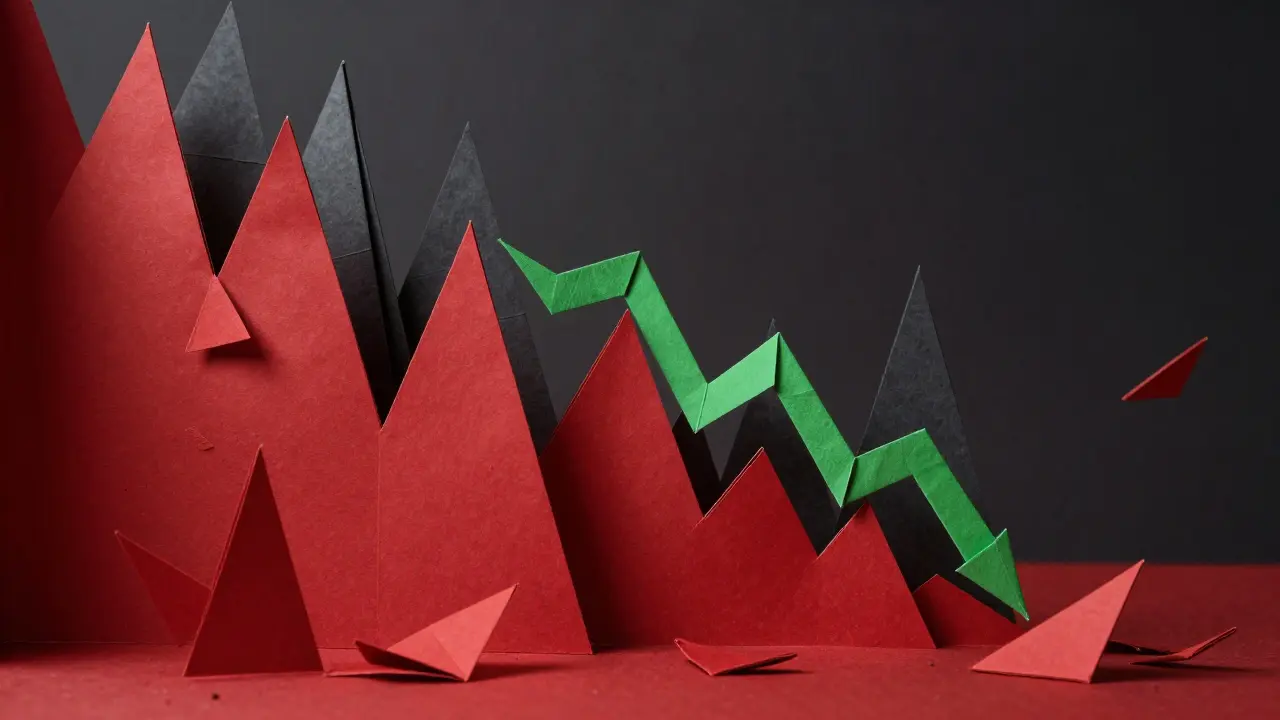
What Triggers the Shift? From Earnings to Geopolitics
Bear markets don't start out of nowhere. They are usually preceded by specific catalysts that disrupt the status quo. According to fundamental analysis from firms like Scotiabank, several key factors drive these transitions:
- Economic Recessions: When corporate earnings drop and consumer spending slows, asset prices adjust to reflect lower future cash flows.
- High Inflation: Rising costs squeeze profit margins and force central banks to raise interest rates, making risky assets like crypto less attractive.
- Rising Interest Rates: Higher borrowing costs reduce business investment and increase the discount rate for future valuations, crushing speculative bubbles.
- Geopolitical Events: Wars, pandemics, and trade wars create uncertainty, triggering a flight to liquidity.
- Overvaluation: When prices detach from fundamentals, a correction becomes inevitable to restore equilibrium.
In the blockchain space, additional triggers include regulatory crackdowns, exchange collapses (like FTX or Mt. Gox), and protocol exploits. These events act as black swans that accelerate the onset of bearish volatility. For instance, recent tariff announcements caused the S&P 500 to briefly enter bear territory before recovering, showing how policy shocks can transmit instantly across equity and fixed-income markets, including crypto.
Managing Volatility: Strategies for Both Phases
Knowing the patterns is useless if you don't have a plan. Here is how professional investors approach volatility in each phase:
In Bull Markets
The goal is preservation of gains. Since bull markets last longer but have lower daily volatility, you can afford to hold core positions. However, avoid over-leveraging. The smooth ride can lull you into complacency. Use trailing stops to lock in profits as new highs are formed. Remember, the end of a bull market is often marked by euphoria and excessive speculation, so watch for signs of mania.
In Bear Markets
The goal is survival and opportunistic buying. Since volatility is high and concentrated, cash becomes a strategic asset. Do not try to catch every falling knife. Instead, wait for volatility to subside slightly before entering. Focus on quality projects with strong fundamentals that can withstand the downturn. Dollar-cost averaging (DCA) into blue-chip assets like Bitcoin or Ethereum can help mitigate timing risk. Also, be wary of "dead cat bounces"-sharp, temporary recoveries that lure traders back in before the next leg down.
| Feature | Bull Market | Bear Market |
|---|---|---|
| Average Duration | ~988 days (2.7 years) | ~289 days (9.6 months) |
| Volatility Profile | Lower, distributed over time | Higher, concentrated spikes |
| Price Movement | Gradual uptrend with shallow dips | Sharp drops with violent rallies |
| Investor Psychology | Greed, optimism, complacency | Fear, panic, despair |
| Best Strategy | Hold, trail stops, rebalance | Cash reserves, DCA, selective shorts |

The Role of Modern Tools: AI and Real-Time Data
Today's markets are faster than ever. Artificial intelligence trading systems and real-time information dissemination have altered traditional volatility patterns. Algorithms can detect micro-trends and execute trades in milliseconds, amplifying both upward and downward moves. This means that the window for manual reaction is shrinking.
For retail traders, this emphasizes the importance of automation and pre-defined rules. You cannot react faster than a bot. Instead, set up alerts based on volatility indices (like VIX for stocks or CVIX for crypto) and technical indicators. When volatility exceeds historical norms, it is a signal to tighten risk management, not to increase exposure.
Furthermore, the interconnectedness of markets means that volatility in one sector spills over into others. A spike in Treasury yields can trigger a sell-off in tech stocks and crypto simultaneously. Monitoring cross-asset correlations helps you anticipate shocks before they hit your primary portfolio.
Conclusion: Embracing the Rhythm
Volatility is not your enemy; it is the mechanism of price discovery. Bull and bear markets are natural cycles, driven by human psychology and economic fundamentals. By understanding their distinct patterns-duration, intensity, and triggers-you can stop reacting emotionally and start acting strategically. Whether you are riding the long wave of a bull run or navigating the choppy waters of a bear market, respect the rhythm, manage your risk, and let the data guide your decisions.
How long do bear markets typically last in crypto?
While crypto cycles are more compressed than traditional markets, bear markets generally last between 9 to 18 months. Historical data from equities suggests an average of 9.6 months, but crypto's higher volatility can shorten or extend this depending on regulatory news and macroeconomic factors.
Why are there big rallies during bear markets?
These are called "relief rallies" or "short squeezes." After a sharp drop, traders who bet against the market (short sellers) close their positions to lock in profits, driving prices up. Additionally, bargain hunters buy the dip, creating temporary upward momentum within the broader downtrend.
What is the best strategy to survive a bear market?
The best strategy is to preserve capital. Keep a significant portion of your portfolio in stablecoins or cash. Use dollar-cost averaging (DCA) to buy high-quality assets gradually rather than trying to time the bottom. Avoid high leverage, as volatility can trigger liquidations quickly.
How does inflation affect market volatility?
High inflation often leads to rising interest rates, which make risky assets like crypto less attractive. This causes capital to flow out of speculative investments, increasing downward pressure and volatility. Investors seek safer havens, leading to sharper sell-offs in growth-oriented sectors.
Can AI predict market crashes?
AI can identify patterns and anomalies that precede volatility spikes, but it cannot predict black swan events with certainty. Algorithms excel at processing vast amounts of data quickly, helping traders react faster to emerging trends, but they are not crystal balls. Human judgment and risk management remain essential.




Jay Sharma
They want you to believe in 'patterns' and 'cycles' so you stay trapped in the matrix of their financial slavery. The volatility isn't random, it's engineered by the same central banks that printed trillions out of thin air while we were told to save for retirement. It's a controlled demolition of your purchasing power disguised as market correction.
Scott Miller
Stop listening to conspiracy theorists and start looking at the data! The article is spot on about intensity paradoxes. You think you're special? You're not. Learn to manage risk or get rekt. There is no secret cabal, just basic supply and demand dynamics playing out in real time. Wake up and trade smart.
Abby Martin
I mean, honestly, it is quite pathetic how everyone rushes to defend the system when they are losing money. We all know the game is rigged against the little guy. It is morally bankrupt that institutions can short sell with impunity while retail traders get liquidated for minor fluctuations. You should be ashamed of yourselves for participating in this casino.
Mélanie Boulay
I appreciate the detailed breakdown of the historical data provided in the post, as it offers a nuanced perspective on the duration differences between bull and bear markets which are often overlooked in casual discourse, and I would like to add that understanding these temporal distinctions is crucial for maintaining psychological equilibrium during periods of extreme market stress, because without such context, one might erroneously attribute temporary setbacks to permanent failure rather than recognizing them as part of a larger cyclical pattern that has repeated itself throughout economic history.
Maurice Flynn
It is what it is. The market breathes. In and out. Life goes on regardless of your portfolio balance. Just chill and watch the waves. Don't let it consume your soul.
nancy jarecki
This analysis is painfully superficial and lacks any rigorous quantitative backing. A true professional understands that stochastic volatility models require far more sophisticated calibration than simple historical averages. The reliance on S&P 500 proxies for crypto assets is intellectually lazy and demonstrates a fundamental misunderstanding of asset class decoupling. Please do not disseminate such amateurish content to the masses.
Robert Hundley
Hey guys! Great read! :D Volatility is just opportunity waiting to happen! Keep your head up and remember that every dip is a chance to buy the dip! Let's gooo! :)
Melissa L
i dont really get all teh big words but i lost half my money last week so yeah its pretty scary. hope it comes back soon cause i need that cash for rent lol
Rob Morton
The concept of relief rallies during bear markets is fascinating. It suggests that human psychology drives price action more than fundamentals alone. When fear peaks, the contrarian impulse becomes powerful. This aligns with behavioral economics theories regarding loss aversion and regret minimization. How do you think algorithmic trading affects this natural emotional cycle?
Routh Middaugh
I think we can all agree that volatility is inevitable; however, it is important to note that panic selling is rarely beneficial. One must remain calm. One must breathe. One must analyze. The market will always find a way. It is a dance. A chaotic, beautiful dance.
Ryan Peters
Typical weak mindset. If you can't handle a 20% drop, you don't deserve to trade. Real men hold through the bloodbath. This soft guidance for DCA and cash reserves is for losers who want to play it safe. Take leverage, make moves, or get out of the way.
ross harris
The market is a meat grinder fueled by greed and fear, churning bones into dust. These 'patterns' are merely the scars left by previous victims. To navigate this abyss, one must embrace the chaos, becoming one with the void where logic dies and instinct reigns supreme. Only then can you feast on the carcasses of the cautious.
Carl Belgrave
Foreign capital flows are destabilizing our domestic markets. We need strict regulations on offshore exchanges to protect American investors from these volatile schemes. The globalist agenda of unregulated crypto is destroying our economic sovereignty. Buy local, stay strong, and reject foreign influence.
Carl Hanzel
Everyone here is missing the point. Volatility is not a feature, it is a bug designed to keep you poor. The elites profit from your confusion. Do not trust the data. Do not trust the cycles. Trust only your own paranoia. They are watching. They are waiting. Stay hidden.
Rebecca Shoniker
I feel completely drained just reading about these endless cycles. It is exhausting to constantly monitor these shifts. Why must we endure such emotional turbulence? The jargon-heavy explanations only add to the cognitive load. I just want peace, not another lecture on beta coefficients and standard deviations.