
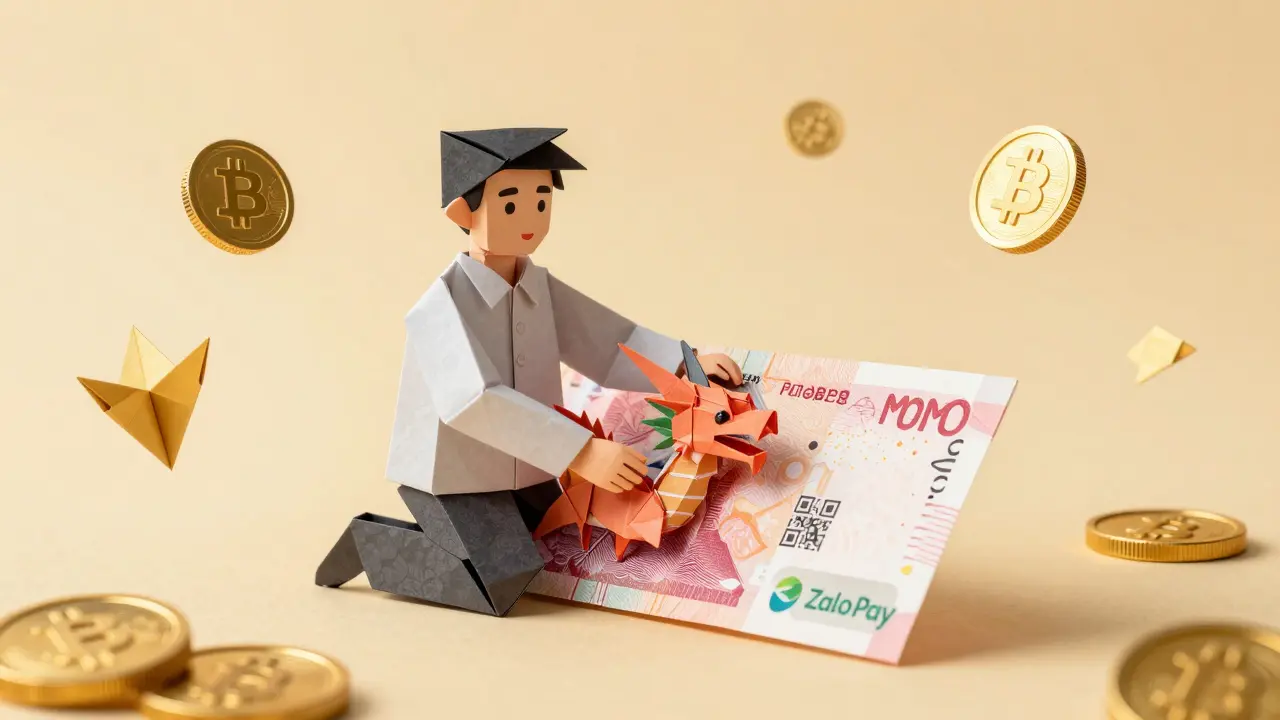
Over 21 million people in Vietnam-more than one in five-are holding cryptocurrency. That’s more than the entire population of New Zealand. Yet, Vietnam has no official national crypto exchange. No government-backed app. No state-run platform. Instead, millions of Vietnamese traders access global crypto markets every day using a mix of clever workarounds, local payment tools, and platforms built for them-even if they weren’t made in Vietnam.
Why Vietnam’s Crypto Market Is Unique
Vietnam doesn’t ban crypto. It never did. But it also never said it’s legal. For years, the State Bank of Vietnam called Bitcoin and Ethereum "not legal tender," which meant banks couldn’t touch them. That created a gray zone: you could buy crypto, but not with your bank account. So people found ways. In January 2025, everything changed. The government passed Resolution 05/2025, launching a five-year pilot program. Only five companies can run licensed crypto exchanges in Vietnam. Each must have at least VND 10 trillion (around $380 million) in capital. Most of that must come from institutional investors. And no foreign company can own more than 49% of the business. This wasn’t meant to stop crypto. It was meant to control it. The goal? To keep trading in Vietnamese dong (VND), limit speculation, and stop money laundering. But the result? A bottleneck. Only a handful of local players even qualify. And even those are still waiting for approval. So where do regular traders go? Not to these new local exchanges. They go to the big global names-Binance, Bybit, OKX, Bitget-and they use them in ways the platforms never expected.How Traders Actually Deposit VND
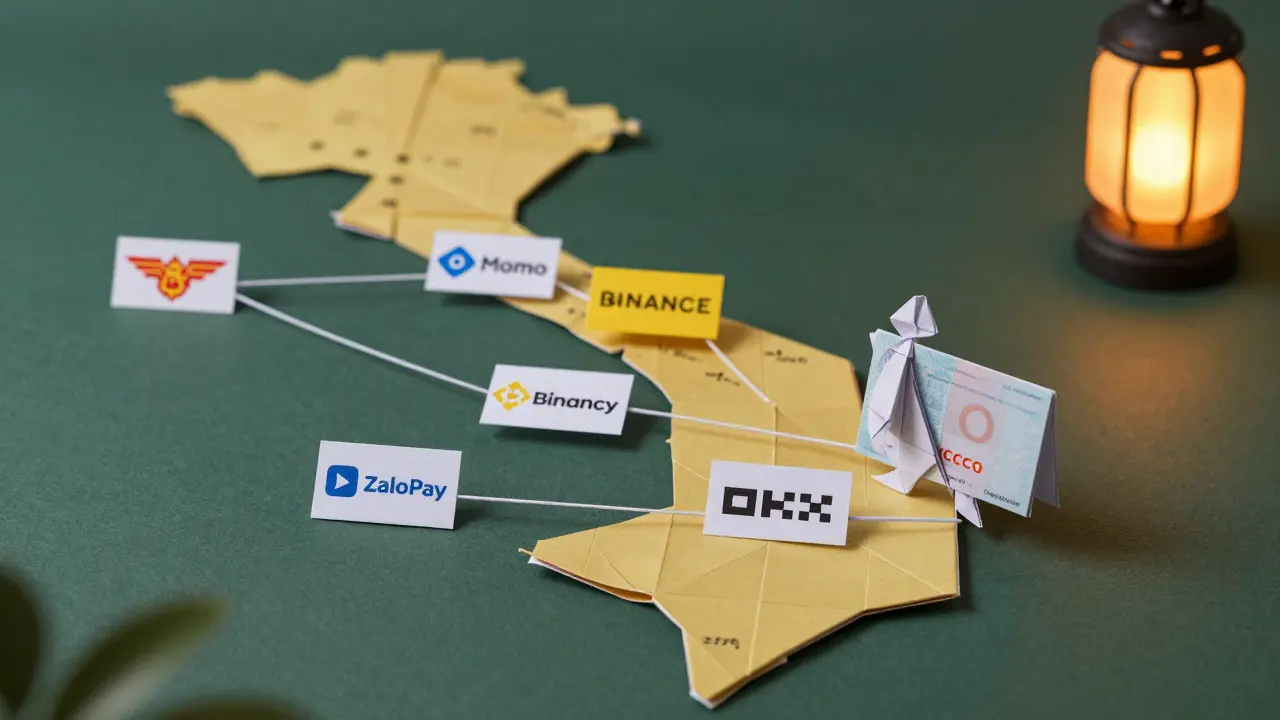
You can’t wire money from a Vietnamese bank directly to Binance like you would to PayPal. But you can do something better: use peer-to-peer (P2P) trading. P2P lets you buy crypto directly from another person. In Vietnam, this works like a local classified ad. You find a seller on Binance’s P2P marketplace, agree on a price in VND, and pay them via MoMo, ZaloPay, or VNPay. These are Vietnam’s most popular e-wallets-used by 70% of adults. The seller releases the crypto once they see the payment hit their wallet. It’s fast. It’s simple. And it’s how over 80% of Vietnamese crypto trades begin. Banks don’t like this. Some freeze accounts if you deposit more than VND 100 million ($4,000) in a single transfer. So smart traders break it up. Five transfers of VND 20 million? No problem. One transfer of VND 100 million? Red flag. There’s also direct bank integration. As of September 2025, 28 Vietnamese banks connect directly with major exchanges via NAPAS, Vietnam’s national payment network. Deposits take 2-5 minutes. Withdrawals? 15-30 minutes. But this only works if you’re using an exchange that’s been approved for this feature-and only Binance, Bybit, and Bitget have fully rolled it out.Which Exchanges Vietnamese Traders Use (and Why)
Not all exchanges are equal in Vietnam. Here’s what’s actually happening on the ground:- Binance dominates with 45% market share. Why? It’s the only one with deep VND liquidity. You can trade BTC, ETH, or SOL directly against VND with tight spreads-sometimes as low as 0.08%. It also has 24/7 Vietnamese customer support, local promotions (like its $5 million Bitcoin giveaway in Q3 2025), and the fastest KYC process: under 18 hours.
- Bybit is the king of futures. Over 68% of Vietnamese trading volume on Bybit is in perpetual contracts. Leverage is capped at 25x, but that’s still enough for traders chasing quick gains. It’s also the most popular among younger users thanks to its clean interface and partnerships with Vietnamese esports teams like Team Secret.
- OKX is trusted for transparency. It publishes monthly proof-of-reserves audits. Fees are lower than Binance’s (0.08% spot), but its customer service is mostly in English. Many users report problems with KYC verification because their National ID (CCCD) doesn’t match the system’s facial recognition-especially if their ID photo is old or blurry.
- MEXC and KuCoin attract traders looking for new coins. They list tokens early, often before Binance does. But their VND support is weaker. You’ll need to use P2P more often.
- Remitano is the beginner’s choice. Simple interface. No complex trading tools. But it’s also the most vulnerable to scams. In Q3 2025, over 4,200 fraud cases were reported on P2P platforms in Vietnam, mostly on smaller, less monitored services.
Security and Identity: What You Need to Verify
To trade on any of these platforms, you must verify your identity. Vietnam doesn’t accept passports or driver’s licenses. You need your CCCD-the national ID card with a chip and facial photo. And you need to use the exchange’s app, not the website. The verification process is strict. You take a live selfie. The system compares it to the photo in Vietnam’s national database. If your face doesn’t match within 0.8% accuracy? Your application gets rejected. Many users fail because they’re wearing glasses, have changed hairstyles, or took the photo in bad lighting. Two-factor authentication (2FA) is mandatory. Most use Google Authenticator. A few use Vietnam’s national digital identity app, which is being rolled out in early 2026. That will replace the current system entirely.The Hidden Costs: Taxes, Fees, and Latency
Crypto trading in Vietnam is taxed. Capital gains are 22%. But here’s the catch: exchanges don’t report it. You have to track every trade yourself. Buy 0.1 BTC for VND 50 million. Sell it for VND 70 million. You owe tax on the VND 20 million profit. No exchange gives you a tax report. You need spreadsheets. Or a local accountant. Fees vary. Binance charges 0.1% for spot trades. Bybit is 0.06% for takers. MEXC? 0.02%. But lower fees mean less liquidity. If you’re trading large amounts, you’ll pay more in slippage than in fees. Latency is another issue. Because Vietnam’s internet backbone isn’t as fast as Singapore’s or Hong Kong’s, API response times are 38% slower. That matters if you’re scalping or using bots. A 420ms delay means you miss orders. Some traders use VPNs to connect through servers in Thailand or Singapore to reduce lag.
What’s Coming Next
By early 2026, Vietnam’s National Digital Identity system will go live. That means you won’t need to upload your CCCD anymore. You’ll log in with your government-issued digital ID-just like logging into a bank app. It’ll be faster. More secure. And harder to fake. The five licensed exchanges are still being reviewed. SSI Digital, TCEX (Techcom Securities), and VPCrypto (VPBank) have applied. But none are live yet. Until then, global platforms will keep dominating. Experts warn that if the government tightens rules further-like banning P2P or forcing all trades through licensed exchanges-many traders might leave. Some already have. Since January 2025, 27% of Vietnamese crypto startups have moved to Singapore. But for now, the system works. Millions of people are trading. Banks are adapting. Payments are flowing. And even with the rules, Vietnam remains one of the most active crypto markets in the world.What Traders Wish They Knew Earlier
- Never deposit more than VND 100 million ($4,000) in one bank transfer. Split it into smaller amounts.
- Use Binance or Bybit for P2P. They have the most sellers and the least fraud.
- Don’t trust apps that aren’t on Google Play or Apple App Store. Many fake crypto apps are circulating in Vietnam.
- Keep screenshots of every trade. You’ll need them for taxes.
- Join Vietnamese crypto Telegram groups. The biggest one, "Crypto Vietnam Official," has over 48,000 members and shares daily tips.
Can I use a foreign bank account to trade crypto in Vietnam?
No. Vietnamese law requires all crypto transactions to be conducted in Vietnamese dong (VND) through approved channels. Using a foreign bank account to deposit funds into crypto exchanges violates the spirit-and possibly the letter-of Resolution 05/2025. Even if you manage to transfer money, exchanges will flag it, and your account may be frozen. All legitimate trading must use local payment methods like MoMo, ZaloPay, or bank transfers within Vietnam.
Are Vietnamese crypto exchanges safe?
The five licensed exchanges expected to launch by 2026 will be the safest-but none are live yet. Until then, traders rely on global platforms like Binance and Bybit, which follow international security standards: 2FA, cold storage, and biometric KYC. These platforms have proven resilient, with no major hacks targeting Vietnamese users. However, P2P trading carries risk. Always use escrow services, check seller ratings, and never send money before receiving crypto.
Why can’t I use PayPal or Stripe to buy crypto in Vietnam?
PayPal and Stripe don’t support cryptocurrency transactions in Vietnam due to regulatory uncertainty and banking restrictions. Even if you have a PayPal account, it won’t connect to Vietnamese exchanges. The government’s focus is on keeping all crypto activity within the VND system. That means only local e-wallets (MoMo, ZaloPay) and bank transfers are accepted. Global payment tools are blocked to prevent capital flight and maintain control over the financial system.
Do I need to pay taxes on crypto profits in Vietnam?
Yes. Vietnam imposes a 22% capital gains tax on crypto profits. However, exchanges do not report your trades to the tax authority. You are responsible for tracking every buy and sell, calculating your profit in VND, and declaring it during tax season. Many traders use Excel sheets or local tax apps like "CryptoTax Vietnam" to manage this. Failure to report can lead to penalties, but audits are rare unless your transactions exceed VND 200 million ($8,000) in a single year.
What happens if my bank freezes my account for crypto trading?
Bank freezes are common if you make large or frequent transfers. To avoid this, spread deposits under VND 100 million per transaction and avoid using the same account for daily trading. If your account is frozen, contact your bank and explain the transfers were for personal crypto purchases-not business activity. Most banks will unfreeze the account after a few days if you provide proof of identity and show no signs of illegal activity. Some traders open a second bank account just for crypto to avoid disrupting their main finances.

Arya Dev
So let me get this straight: 21 million people are trading crypto... using P2P... because the government won't let them use banks... but also won't ban it? That's not a gray zone. That's a bureaucratic nightmare with a side of chaos. And don't even get me started on the 22% tax... you're expected to track every single trade?? I mean, come on. Who has time for this??
Maggie House
this is actually kinda amazing?? i had no idea vietnam had this whole system going on!! i love how people just figured it out with momo and zalo pay!! it's like grassroots finance!! also, the 48k telegram group?? i need to join that lol
Cameron Pearce Macfarlane
Oh wow. So Vietnam's "solution" is to create a bottleneck so small only five companies can fit through it? And you think that's innovation? That's not control. That's a monopoly in training wheels. The real story here isn't how people trade crypto. It's how the state is trying to turn innovation into a bureaucratic cage.
Elizabeth Smith
I mean... if you're going to let people trade crypto but then tax it like it's illegal... and then force them to use local payment apps that are basically glorified Venmo... isn't that just capitalism with a side of moral superiority? We're all just trying to survive. Why does the state need to be the gatekeeper of your money?
Robert Kromberg
I'm not saying this system is perfect. But I also don't think the answer is to shut it down. People are adapting. They're finding workarounds. That's not a bug. That's human ingenuity. The government's trying to control something that can't be controlled. And honestly? That's kind of admirable.
Daisy Boliaan
I just read this whole thing and I'm emotionally drained. 22% tax? No reports? 420ms latency? You're telling me people are using VPNs just to make trades faster?? And they're still doing it?? I have so many feelings right now. Like... why is this so dramatic?? Also, who is the guy who said "don't trust apps not on Google Play"?? That's the most basic advice ever. Like, if you're downloading crypto apps from a random Telegram link... you're already doomed.
Carl Gaard
I love how people are using emojis and memes to navigate a financial system that doesn't want them to exist. Also, the fact that you need a live selfie that matches your national ID within 0.8% accuracy?? That's not security. That's a sci-fi movie. And yet... it works. I'm weirdly impressed. 🤖💸
bella gonzales
So... let me get this straight... you have to split your deposits under 100 million VND because banks will freeze you... and then you have to use a VPN to reduce latency... and then you have to track every trade manually... and then you pay 22% tax... and then you still use Binance? This isn't a market. This is a survival simulator. And I'm not even mad. I'm just... impressed??
Paul Reinhart
The real story here isn't the crypto. It's the infrastructure. Vietnam didn't wait for permission. They built their own financial ecosystem around the cracks in the system. P2P trading isn't a loophole. It's a cultural adaptation. The e-wallets, the bank integrations, the KYC processes-all of it evolved organically because people needed to trade. This isn't about regulation. It's about necessity. And that's what makes it beautiful. The state didn't create this. The people did. And that's why it's resilient. Even if the government tries to shut it down, it won't die. It'll just go underground. Again.
Samantha Stultz
The P2P model here is a textbook example of decentralized financial onboarding. The fact that 70% of adults use MoMo/ZaloPay means the payment rails were already in place. The regulatory gray zone forced innovation in settlement layers. This isn't crypto adoption-it's financial sovereignty through emergent infrastructure. The 22% tax is a fiscal control mechanism, but the lack of reporting creates asymmetric information asymmetry, which paradoxically enables arbitrage opportunities. Also, 420ms latency is catastrophic for HFT. The fact that traders are using Thai servers suggests an implicit regional consensus on latency arbitrage. The real question: is this sustainable when the digital ID system goes live?
Jeff French
Honestly? This is one of the most interesting financial stories I've seen in years. People aren't fighting the system. They're just... working around it. And it's working. No drama. No protests. Just quiet, efficient adaptation. I'm not saying it's perfect. But it's real. And that matters.
Shannon Black
The structural ingenuity displayed in Vietnam's crypto ecosystem is a masterclass in regulatory arbitrage. The confluence of informal payment networks, institutional capital constraints, and biometric identity verification represents a novel convergence of state control and grassroots innovation. One cannot help but admire the resilience of a population that has effectively engineered a parallel financial architecture without formal sanction.
Richard Cooper
Binance wins. P2P works. Taxes suck. Don't use PayPal. Done.
Dee Resin
So the government says crypto isn't legal... but also says you can't use foreign banks... and then they tax your profits... and then they say "don't use apps not on Google Play"... and you're telling me this isn't satire? I'm laughing. And crying. And also... maybe a little impressed?
Tanvi Atal
This is what happens when you let people be smart. No wonder they're moving startups to Singapore. Vietnam's system isn't innovative. It's a mess with a fancy name.
Sony Sebastian
The fact that you're using VND for crypto trades is a red flag. You're not trading crypto. You're trading VND with crypto as a middleman. That's not innovation. That's financial illusion. And the 22% tax? That's just the state sucking blood. You're not a trader. You're a tax cow.
Megan Lavery
I love that people are just figuring this out for themselves. No one asked for permission. They just made it work. That's the spirit! Also, the $5 million Bitcoin giveaway? That's wild. I need to check that out 😊
Mae Young
So let me get this straight: the government created a system where the only way to participate is to break the rules in a way that's technically legal? And then they tax you for doing it? And then they say "don't use PayPal"? This isn't policy. This is performance art. And I'm not sure if it's genius or just deeply, deeply broken.
Trenton White
Vietnam's approach is a quiet revolution. No fanfare. No headlines. Just millions of people quietly building a parallel economy. That's not chaos. That's culture. And it's worth understanding, not judging.
Cheryl Fenner Brown
ok so i just learned that you need a selfie that matches your national id within 0.8%?? like... how do they even measure that?? and why is it so strict?? also, i just used a vpn to connect to thailand to trade crypto?? i feel like i'm in a spy movie 😅
Colin Lethem
I didn't know this was happening. This is wild. I thought crypto was all about Bitcoin and blockchain. But here? It's about e-wallets, bank transfers, and selfies. It's real. It's messy. And honestly? It's more human than any whitepaper I've read.
Kristi Emens
The quiet resilience of these traders is remarkable. No grand movements. No protests. Just steady, consistent adaptation. It's not flashy. But it's powerful.