

Uniswap v2 on Arbitrum isn’t just another crypto exchange. It’s where everyday traders get access to thousands of tokens without paying $50 in gas fees just to swap ETH for USDC. If you’ve ever waited 10 minutes for a transaction to confirm on Ethereum mainnet while watching your trade price slip away, you know why this matters. Uniswap v2 on Arbitrum fixes that. It keeps the same simple swap interface you love, but runs on a faster, cheaper layer built specifically to make DeFi feel like using a regular app.
What Uniswap v2 on Arbitrum Actually Is
Uniswap v2 is the older version of the most popular decentralized exchange in crypto. It launched in 2020 and still powers a huge chunk of trading on Layer-2 networks like Arbitrum. Unlike centralized exchanges like Binance or Coinbase, Uniswap doesn’t hold your money. You connect your wallet - usually MetaMask - and trade directly from your account. No KYC. No sign-up. No middleman.
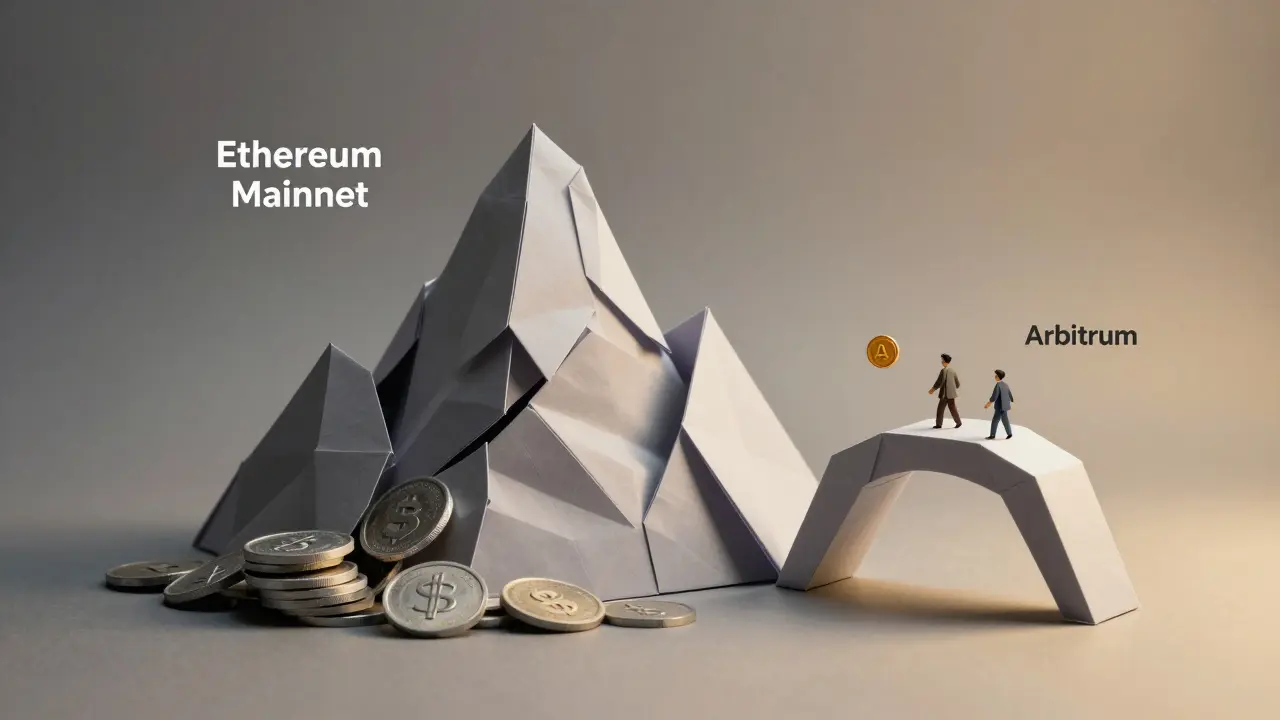
Arbitrum is the Layer-2 network that makes this work smoothly. Think of it like a highway built next to a congested city road. Ethereum mainnet is the old road - slow, expensive, crowded. Arbitrum is the new highway. It uses something called Optimistic Rollups to bundle hundreds of transactions into one cheap batch that gets settled on Ethereum. The result? Swaps that cost less than $0.10 and finish in under 3 seconds.
Uniswap v2 on Arbitrum isn’t a separate app. It’s the same Uniswap interface you’ve used before, just connected to Arbitrum instead of Ethereum. You don’t need to learn anything new. You still click “Swap,” pick your tokens, and confirm in your wallet. But now, your transaction clears fast and doesn’t eat your profits.
Why Fees Matter More Than You Think
Gas fees on Ethereum can be brutal. In 2021, swapping a small amount of tokens sometimes cost more than the tokens themselves. Even in 2025, during spikes, fees hit $10-$20. That’s not trading. That’s paying a toll just to play.
On Arbitrum, the same swap costs between $0.02 and $0.15. For stablecoin trades like USDC to WETH, it’s often under $0.05. That’s not a small difference - it’s the difference between making a trade and walking away.
Uniswap v2 uses fixed fee tiers: 0.01% for ultra-stable pairs, 0.05% for stablecoins, 0.3% for most tokens, and 1% for risky or new ones. These fees go to liquidity providers, not Uniswap. On Arbitrum, you’re still paying those percentages, but the underlying gas cost is so low that the total fee feels almost invisible. A $1,000 trade at 0.3% is $3 in fees - and on Arbitrum, that $3 might include $2.85 in protocol fee and $0.15 in network cost. On Ethereum, that same trade could cost $3 in protocol fee plus $12 in gas.
Liquidity and Trading Pairs You Can Actually Use
Uniswap v2 on Arbitrum has deep liquidity for the tokens people actually trade. The biggest pools are WETH/USDC, WBTC/USDC, and ARB/USDC. These aren’t theoretical pools - they hold hundreds of millions in value. You can swap 10,000 USDC for WETH in seconds without the price moving.
For lesser-known tokens, it’s hit or miss. If a token doesn’t have a liquidity pool on Arbitrum, you won’t find it. But Uniswap’s interface lets you search for any ERC-20 token. If someone has created a pool for it, you’ll see it. No need to wait for the token to be listed - the community builds the liquidity.
As of late 2025, Uniswap’s total trading volume across all chains was over $593 million per day. Arbitrum accounted for a major portion of that, especially in stablecoin and wrapped asset trades. The volume isn’t just from big players - it’s from everyday users who don’t want to pay high fees or wait hours.
How It Compares to Uniswap v3 on Arbitrum
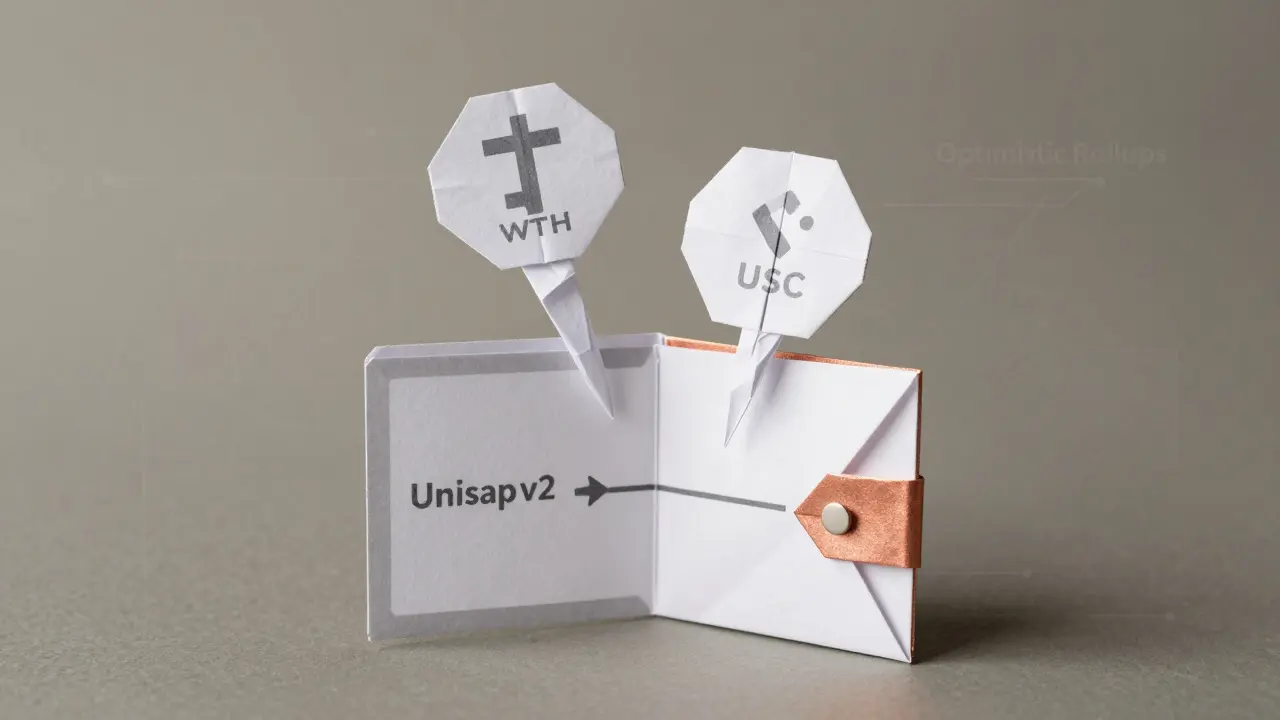
Uniswap v3, launched in 2021, introduced concentrated liquidity - meaning liquidity providers can pin their funds to specific price ranges. This makes trading more efficient, but it’s also more complex. You need to understand price ranges, ticks, and fee tiers to use it well.
Uniswap v2 is simpler. You deposit tokens into a pool, and the system automatically manages the price curve. You don’t need to guess where the price will go. That’s why many retail traders still use v2 on Arbitrum - especially for quick swaps of common tokens.
For most users, v2 is the better choice. It’s reliable, easy, and still has the deepest liquidity for major pairs. v3 is for advanced users who want to earn more from their liquidity. If you’re just swapping ETH for USDC or buying a new memecoin, v2 is the way to go.
Security and Trust - Is It Safe?
Uniswap v2 has been live since 2020. Its code is open, audited, and unchanged for years. That’s a good thing. No new features mean no new bugs. The smart contracts have handled billions in trades without a single exploit.
Arbitrum is also battle-tested. It’s the largest Layer-2 by TVL, with over $10 billion locked as of early 2026. Its security model relies on Ethereum’s mainnet. If something goes wrong, you can still withdraw your funds back to Ethereum within a week.
The biggest risk isn’t the protocol - it’s you. If you connect your wallet to a fake Uniswap site, you’ll lose everything. Always type app.uniswap.org manually. Never click links from Twitter or Discord. Always check the URL. And never approve unlimited token allowances unless you know exactly what you’re doing.
What You Need to Get Started
You don’t need to be a tech expert. Here’s what you actually need:
- A wallet like MetaMask or WalletConnect
- Some ETH for Arbitrum gas (you can get it from a bridge or exchange)
- Access to the Uniswap interface on Arbitrum
To switch networks in MetaMask:
- Open MetaMask
- Click the network dropdown (it probably says “Ethereum Mainnet”)
- Select “Arbitrum One”
- If it’s not there, add it manually with these settings:
- Network Name: Arbitrum One
- New RPC URL: https://arb1.arbitrum.io/rpc
- Chain ID: 42161
- Currency Symbol: ETH
- Block Explorer URL: https://arbiscan.io
- Now go to app.uniswap.org - it auto-detects Arbitrum
Once you’re on Arbitrum, you can swap tokens directly. No need to bridge funds first - if you already have ETH or tokens on Ethereum, use the official Arbitrum bridge to move them over. It takes 7-10 minutes and costs under $2.
Real Use Cases - Who Actually Uses This?
Here are three real scenarios where Uniswap v2 on Arbitrum shines:
- Day traders swapping ETH for new memecoins - low fees mean they can trade multiple times a day without losing money to gas.
- Stablecoin users moving between USDC, DAI, and USDT - the pools are huge, prices stay stable, and swaps are instant.
- Token buyers who want to buy a new project’s token the second it launches - if the team sets up a liquidity pool on Arbitrum, you can jump in before it spikes.
It’s not for long-term holders. It’s for people who move money fast. If you’re holding tokens for months, you don’t need this. But if you’re trading, arbitraging, or testing new projects, this is the most efficient tool out there.
Downsides and Things to Watch Out For
Nothing’s perfect. Here’s what you should know:
- No fiat on-ramps - You can’t buy crypto with a credit card here. You need ETH or tokens already in your wallet.
- Price slippage - For large trades, the price can move during execution. Always set a max slippage of 0.5-1% for stable pairs, 3-5% for volatile ones.
- Token search isn’t perfect - If a token isn’t popular, you might need to paste its contract address manually.
- Arbitrum isn’t Ethereum - Some DeFi apps only work on Ethereum. Always check compatibility.
Also, don’t expect customer support. If something goes wrong, you’re on your own. That’s the trade-off for decentralization.
The Bigger Picture - Why This Matters
Uniswap v2 on Arbitrum isn’t just a tool. It’s proof that DeFi can be fast, cheap, and usable. It shows that crypto doesn’t have to be slow and expensive. The future isn’t about bigger blockchains - it’s about better layers.
Arbitrum’s upcoming Stylus upgrade will let developers write smart contracts in Rust and C++, not just Solidity. That could bring in thousands of new builders from Web2. And Uniswap will be there, ready to handle the traffic.
For now, Uniswap v2 on Arbitrum is the quiet workhorse of DeFi. It doesn’t have flashy marketing. It doesn’t need to. It just works - and that’s why millions of people use it every day.
Is Uniswap v2 on Arbitrum better than the Ethereum mainnet version?
Yes, for most users. Trading on Arbitrum costs 10-100x less in fees and is 10x faster. If you’re swapping tokens regularly, the Ethereum mainnet version is too expensive. Uniswap v2 on Arbitrum keeps the same interface but removes the biggest pain point: gas fees.
Can I use Uniswap v2 on Arbitrum without ETH?
No. You need ETH to pay for gas on Arbitrum. You can’t swap tokens without it. But you can buy small amounts of ETH on exchanges like Coinbase or Kraken and send them to your wallet. Once you have ETH, you can bridge it to Arbitrum for under $2.
Is Uniswap v2 on Arbitrum safe from hacks?
The Uniswap v2 smart contracts have never been hacked. Arbitrum’s security is built on Ethereum’s, so your funds are protected by the same system that secures Bitcoin and Ethereum. The real risk is phishing - fake websites, scams, and bad links. Always double-check the URL and never approve unknown token contracts.
What’s the difference between Uniswap v2 and v3 on Arbitrum?
Uniswap v2 uses pooled liquidity - all your tokens are spread evenly across a price range. It’s simple and automatic. v3 lets you choose exactly where your liquidity is active, which can earn you more fees - but it’s complex and requires constant monitoring. For casual traders, v2 is easier and just as effective.
Can I earn interest on my tokens using Uniswap v2 on Arbitrum?
Not directly on Uniswap v2. The platform only lets you swap tokens. To earn interest, you need to add liquidity to a pool and earn trading fees. But that’s not the same as staking. For yield, you’d use other DeFi protocols like Aave or Curve on Arbitrum.
How do I know if a token is real and not a scam?
There’s no foolproof way, but check these: Does the token have a verified contract on Arbiscan? Is there a liquidity pool with at least $100,000? Is the team anonymous? Are there active social channels? If the token is new and has no liquidity or community, treat it as high risk. Never invest more than you’re willing to lose.




Denise Paiva
Uniswap v2 on Arbitrum is a glorified tax evasion tool for retail traders who can't afford to pay for the privilege of owning crypto
Charlotte Parker
Oh wow another article pretending decentralization means 'cheap trading' instead of 'you're on your own when the rug gets pulled' - congrats, you've discovered that convenience has a cost. The real DeFi revolution isn't in swapping USDC, it's in the fact that you can't even get your money back if the chain goes dark.
Valencia Adell
Gas fees under $0.10? That's not efficiency, that's delusion. You're still trusting a centralized sequencer, a single point of failure masquerading as 'layer 2'. The only thing cheaper than Arbitrum gas is your critical thinking.
Sabbra Ziro
I really appreciate how this breaks down the real trade-offs - not just the hype. It’s easy to get swept up in 'faster and cheaper' but we shouldn’t forget that decentralization isn’t just about speed, it’s about sovereignty. That said, for people just trying to swap tokens without losing half their balance to gas, this is a lifeline. Let’s not pretend it’s perfect, but let’s also not dismiss the practical value it brings to everyday users.
Krista Hoefle
arbitrum? more like arb-it-rum. you think you’re saving money but you’re just feeding the same oligarchs who run ethereum, just with less drama. v2 is dead, everyone knows it. why are we still talking about it like it’s 2021?
Jessie X
the real win here is not the fees it’s the fact you can actually make a trade without waiting 20 minutes and watching your slippage go from 0.5% to 15%
Kip Metcalf
bro this is the only way to trade now. if you’re still on mainnet you’re either rich or delusional. i’ve done 50+ swaps this week and my gas bill is under $2. that’s not crypto, that’s just smart
Jennah Grant
While the operational efficiency of Uniswap v2 on Arbitrum is undeniable, the underlying architecture still relies on optimistic rollups with a 7-day challenge window - which introduces a non-trivial counterparty risk. Liquidity providers must account for this temporal latency in their risk models, and retail users often overlook this entirely.
Dennis Mbuthia
Look, I don't care what your 'layer 2' is - if you're not using Ethereum mainnet, you're not doing real crypto. This is just Wall Street repackaging the same scam with a new name. And don't even get me started on how these 'Arbitrum' devs are just crypto bros with fancy laptops and no real tech background. We don't need faster scams, we need real decentralization. America needs to wake up - this is all just a foreign-backed ponzi scheme dressed up as innovation.
sathish kumar
The architecture of Arbitrum as an Optimistic Rollup represents a significant engineering achievement in scalability without compromising the security guarantees of Ethereum's consensus layer. The economic model of fee distribution to liquidity providers remains aligned with the original incentive structures of Uniswap v2, thereby preserving decentralization at the protocol level despite the layer-2 abstraction.
jim carry
YOU THINK THIS IS SAFE?!?! I LOST MY ENTIRE PORTFOLIO BECAUSE I CLICKED A LINK ON TWITTER AND NOW I’M LIVING IN MY CAR AND MY CAT HATES ME BECAUSE I CAN’T BUY HER TUNA ANYMORE. THIS ISN’T INNOVATION, IT’S A TRAP. EVERYONE KNOWS THIS. WHY ARE YOU STILL PUSHING THIS?!?!?!
Don Grissett
uniswap v2 on arbitrum? more like uniswap v2 on a fake chain. real men trade on ethereum mainnet. if you need cheaper gas you’re not a trader, you’re a tourist. and don’t even get me started on how people just copy paste contract addresses now - half of these tokens are scams. you think you’re being smart but you’re just feeding the bots.
Veronica Mead
There is no moral justification for enabling speculative gambling under the guise of financial innovation. By reducing transaction costs, this system merely facilitates reckless behavior among those who lack the discipline to hold assets long-term. It is not progress - it is moral decay dressed in blockchain.
Mollie Williams
I keep thinking about how this feels like the quiet revolution nobody talks about - not because it’s flashy, but because it’s just… there. Like electricity. You don’t notice it until you lose it. I used to hate waiting for swaps. Now I barely think about it. That’s the real win - not the numbers, but the way it changes your relationship with money. You stop seeing it as a chore and start seeing it as a tool.
Surendra Chopde
Arbitrum’s scalability allows emerging markets to participate in DeFi without the burden of high transaction fees. In India, where many traders operate with limited capital, this infrastructure enables micro-trading and financial inclusion that was previously impossible. It is not just a technical upgrade - it is an economic equalizer.
Sherry Giles
they’re using arbitrum because the feds are tracking mainnet transactions. this is all a government-backed surveillance tool. you think you’re free but your wallet is being monitored. the 7-day withdrawal window? that’s the government’s backdoor. they’re letting you trade so they can collect your data. don’t be fooled.
Caitlin Colwell
just swapped 500 USDC for WETH in 2 seconds for 7 cents. life is good
Emily Hipps
if you’re new to this - don’t overthink it. just connect your wallet, switch to Arbitrum, and try a small swap. you’ll be shocked at how fast it is. this isn’t magic, it’s just better tech. you don’t need to be a genius to use it - just careful. and maybe don’t click random links from Twitter.
Frank Heili
One thing people miss: Uniswap v2 on Arbitrum doesn’t just reduce fees - it reduces psychological friction. The hesitation to make small trades because of gas costs? Gone. That’s why volume is so high - it’s not just whales, it’s thousands of people doing micro-trades they couldn’t afford before. That’s real adoption.
Jacob Clark
Ok but let’s be real - v3 is objectively superior, and anyone who says v2 is better is just too lazy to learn how to use concentrated liquidity. You’re leaving money on the table. Also, why are we still using ERC20 tokens? Why not move to ERC-721 for everything? I mean, think about it - it’s just more efficient, right? Also, did you know Ethereum is actually owned by a secret society of Swiss bankers? I’ve got sources.
Jon Martín
you guys are overcomplicating this. if you’re not on Arbitrum you’re wasting time and money. just do it. it’s not hard. swap a little, see how fast it is, then come back and thank me. also - stop listening to the doomers. they’re just mad their gas fees went up.
Mujibur Rahman
The liquidity depth on Arbitrum for WETH/USDC is now comparable to centralized exchanges - which is remarkable for a permissionless system. However, the concentration of volume in a few major pairs creates systemic fragility. Diversification of liquidity across lesser-known assets remains the next frontier.
Danyelle Ostrye
the only reason this works is because people are still using ETH as gas. if ETH crashes, arbitrum crashes. this isn’t independent, it’s a parasite. but hey, at least it’s fast.
Dave Lite
just wanted to say - if you’re new, use a hardware wallet. and always check the token contract on Arbiscan. i’ve seen too many people lose money because they trusted a token name. ‘DOGE’ isn’t dogecoin. it’s a scam. always verify. you’re worth more than your gas fee.
Becky Chenier
it’s funny how people act like this is revolutionary. it’s just a faster version of something that’s been around for 4 years. we’re celebrating convenience like it’s a breakthrough. maybe we’ve just gotten used to slow, expensive systems and now we’re amazed when they’re not.
Staci Armezzani
you don’t need to be a coder to use this. you just need to be careful. start small. test with $10. learn how the interface works. read the warnings. don’t skip steps. if you do that, you’ll be fine. this isn’t about being smart - it’s about being patient. and you’re already reading this, so you’re on the right path.